


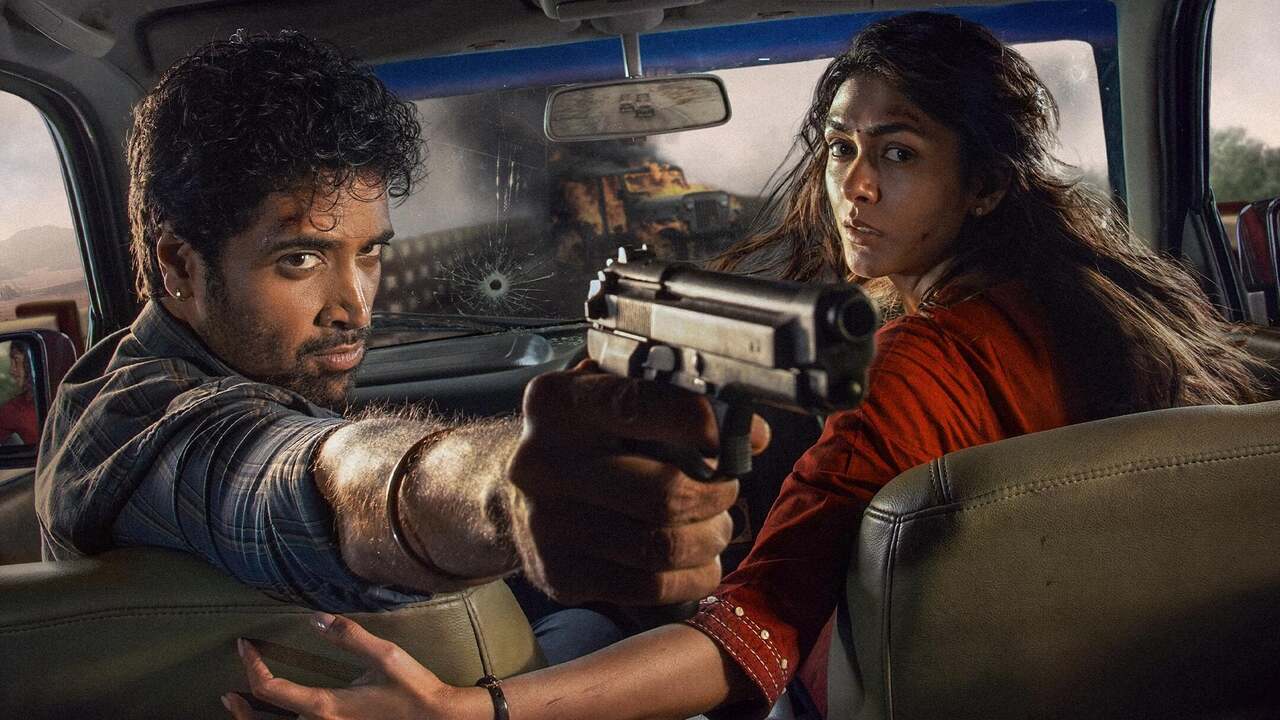
The opening scenes in Shaneil Deo's Dacoit reminded me of those reels where the couple engaged in PDA makes others around them cringe. When Hari (Adivi Sesh) tried to fool people into donating blood for a good cause led by Saraswati (Mrunal Thakur), I squirmed in horror as he said things like, "Blood donate karoge toh Madam ka number milega?" ("Madam" here refers to Saraswati; yes, I watched the Hindi dub of this film). If this weren't enough, Hari proceeds to ask Saraswati if she was impressed by his acting. Look, if I were in Saraswati's place, I would have laughed at Hari's third-rate "acting," but she is clearly, confoundingly impressed by him. As the film moves forward and delivers more Hari–Saraswati romantic scenes, I felt an overwhelming urge to vomit. I am glad I don't remember some of the lines. I do, however, recall how my legs implored me to sprint toward the exit. But I am a professional. I remained seated until the end credits. Perhaps I am not very bright.
You know who else thinks the audience isn't very bright? Shaneil Deo. No wonder, in Dacoit, he keeps repeating certain details both verbally and visually. I am talking about Hari's revenge plan to trap Saraswati. I am talking about the replay of the scene where Saraswati gives a statement blaming Hari for a crime in front of the police. Yes, we get it. Hari is wounded from within. Then again, he invited trouble by casting himself as Romeo and seeing Juliet in Saraswati. Hari's biggest flaw might be that he doesn't know the Romeo and Juliet story. If he had read it, he would have known it's a doomed romance—the couple doesn't find a happy ending. It's no surprise, then, that Dacoit, too, ends with death and tragedy. But Shakespeare, at least, gave us poetry. Deo, alas, offers us shaky, inelegant action sequences and chess pieces who do the script's bidding.
For someone who probably sees himself as a passionate lover, Hari makes the dumb decision of never allowing Saraswati to explain herself—to explain why she framed him. Does he enjoy wearing the expressions of a scarred boyfriend? Better yet, didn't he ever consider the possibility that Saraswati might have been pressured to provide a statement against him? This is the first conclusion many viewers will draw, especially considering the caste difference between Saraswati and Hari. Don't be surprised if this first guess proves to be right. Deo ineffectively attempts to create suspense around events that are clear from the beginning. This is why there is no room for suspense in this movie. Apart from the caste angle, Deo tosses in heart surgery, a locket, a little kid, corrupt doctors, and COVID. The climax, a shootout on a hill, is reminiscent of Hell or High Water, which doesn't suddenly make a dull film interesting.
Deo's bland social criticisms are channelled through one-dimensional villains like Prakash Raj's Solomon, which is the equivalent of kicking a dead bull and claiming to have the spine to confront a beast. And I am repulsed by filmmakers who use cute kids to pull at your heartstrings. In Dacoit, a little girl says things like, "Don't hurt my mother," and "Where is Hari uncle?" The audience, meanwhile, is aggressively pushed to respond with words like, "Aww, cho chweet!" Then again, what else can you expect from a director who uses greedy characters, criminals, and a caste angle to sell a rotten love story? At its core, Dacoit is your typical rich-boy-poor-girl (or vice versa) affair. The only interesting thing Deo does is show that your blood and organs don't judge others based on status or money. This one-line message, though, is packaged in a film that doesn't offer a subjective view of the struggles someone like Hari might experience daily. The bad guys, too, are pretty basic. Some might end up congratulating Deo for being a competent writer, given how he creates callbacks to moments like Saraswati giving driving lessons to Hari. But that only makes him a well-behaved, rule-following, rigid student. Deo doesn't play with the possibilities of the medium; he doesn't even consider his world with the necessary complexity and depth that would have raised Dacoit to a significant position. The director, in the end, is as basic as his characters—both are made for each other. I guess this means this match was made in heaven.
Final Score- [2/10]
Reviewed by - Vikas Yadav
Follow @vikasonorous on Twitter
Publisher at Midgard Times



Hi Everyone, after a due consideration, we have decided that we will be open for donations to help us in managing our website. We will be greatful for any kind of amount we receive. Thanks!
— Midgard Times 🎬 (@Moviesr_net) January 4, 2026
PayPal- [email protected] pic.twitter.com/DlNNz5Npm5
Get all latest content delivered to your email a few times a month.
Bringing Pop Culture News from Every Realm, Get All the Latest Movie, TV News, Reviews & Trailers
Got Any questions? Drop an email to [email protected]



 © Copyrights MOVIESR.NET All rights reserved