


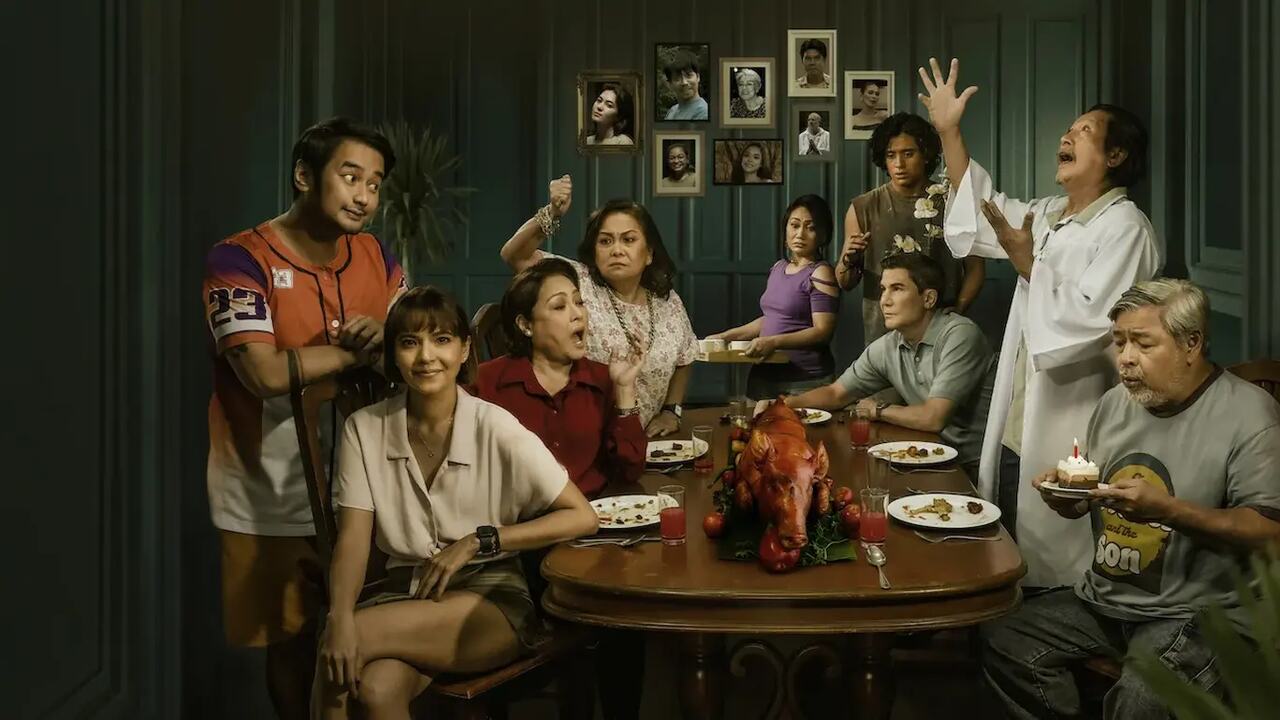
I went into Everyone Knows Every Juan curious about how far a Filipino family film could push form without losing emotional clarity. By the time it ended, I felt both impressed and slightly exhausted, which, strangely, feels appropriate for a story that mirrors the experience of being trapped in a family gathering that starts politely and slowly escalates into something louder, messier, and more revealing than anyone expected.
The film takes place almost entirely over a single day, inside and around the family home, and it commits hard to the idea of real-time storytelling. The camera glides from room to room, conversation to conversation, rarely giving the audience a chance to breathe or step away. At its best, this approach is immersive and intimate. You feel like a quiet observer moving through the house, overhearing arguments, jokes, passive-aggressive remarks, and sudden confessions. The lack of obvious cuts makes emotions feel immediate, as if things are unfolding whether the characters are ready or not.
The Sevilla siblings are the engine of the story. Each one arrives carrying unresolved grief and long-standing personal baggage. Some are more outwardly functional than others, but none of them are truly at peace. What I appreciated is that the film doesn’t rush to label anyone as the “good” or “bad” sibling. Instead, it lets them all be flawed in different ways. One is defensive and sharp-tongued, another avoids conflict through humor, another clings to moral superiority, and another barely hides their sense of being overlooked. These traits surface naturally through dialogue rather than exposition, which gives the film a grounded, lived-in feel.
The performances are one of the film’s strongest assets. This is an ensemble piece, and almost everyone pulls their weight. The actors play off one another with convincing familiarity, the kind that suggests shared history rather than forced chemistry. Several scenes work purely because of how a character reacts while someone else is speaking. A glance, a sigh, or a delayed response often says more than the dialogue itself. These moments are small, but they add up, making the family dynamic feel real rather than scripted.
The humor deserves special mention. The comedy here isn’t built on punchlines or exaggerated situations but on recognition. It comes from the way people talk past each other, repeat old arguments, or make jokes that are only funny because of shared history. I found myself laughing quietly more than once, especially during scenes where tension and humor exist side by side. The film understands that family arguments are rarely just angry or just funny; they’re usually both at the same time.
Visually, the film is confident and controlled. The moving camera is clearly choreographed, yet it usually avoids feeling showy. When it works, it enhances the sense of chaos and connection within the household. You notice how characters drift in and out of conversations, how private discussions are interrupted, and how personal moments are rarely fully private in a family setting. This visual strategy reinforces the central idea that in this family, everyone knows everyone’s business, whether they want to or not.
That said, the same stylistic choice is also where some of my issues begin. The commitment to long, uninterrupted takes occasionally works against the story. There are stretches where scenes linger longer than necessary, and without the relief of editing, the pacing can feel uneven. Some conversations repeat emotional beats that have already been established, and instead of deepening the impact, they slightly dull it. I found myself wishing for tighter trimming in a few places, not because the content was bad, but because the delivery was stretched.
The script is ambitious, perhaps a bit too ambitious for its own good. With a large cast and multiple emotional arcs running simultaneously, the film tries to give everyone their moment. While this generosity is admirable, it also means that some character developments feel incomplete. Certain conflicts are raised with intensity but resolved too quickly or quietly. Others are left hanging in a way that feels less intentional and more like a consequence of limited narrative space.
There is also a moment later in the film where the illusion of a continuous flow feels slightly disrupted. It doesn’t completely break immersion, but it does draw attention to the technique rather than the story. For a film that asks viewers to fully commit to its formal experiment, these small cracks become noticeable, especially for anyone paying close attention to the filmmaking itself.
Emotionally, the movie lands more often than it misses. The theme of grief runs through every interaction, even when it’s not openly discussed. The absence of the mother is felt in how the siblings argue, in what they blame each other for, and in what they’re afraid to admit. I appreciated that the film doesn’t turn grief into a neat lesson or dramatic monologue. Instead, it shows how loss lingers in tone, behavior, and unresolved tension. However, there are moments when the emotional beats verge on being too on-the-nose. A few confessions feel slightly overexplained, as if the film doesn’t fully trust the audience to read between the lines. These moments don’t ruin the experience, but they stand out in a film that otherwise excels at subtlety.
By the end, Everyone Knows Every Juan left me feeling that I had spent real time with this family. I didn’t love every minute, and I didn’t connect equally with every character, but I respected the effort and the honesty behind it. The film aims high, takes risks, and mostly succeeds in creating something that feels both personal and culturally specific without being inaccessible.
It’s not a perfect movie, and its flaws are closely tied to its ambitions. But it’s thoughtful, well-acted, often funny, and emotionally sincere. For viewers who enjoy character-driven stories and don’t mind a bit of narrative messiness in exchange for authenticity, Everyone Knows Every Juan offers a rewarding, if occasionally uneven, experience that stays with you longer than expected.
Final Score- [6/10]
Reviewed by - Anjali Sharma
Follow @AnjaliS54769166 on Twitter
Publisher at Midgard Times



Hi Everyone, after a due consideration, we have decided that we will be open for donations to help us in managing our website. We will be greatful for any kind of amount we receive. Thanks!
— Midgard Times 🎬 (@Moviesr_net) January 4, 2026
PayPal- [email protected] pic.twitter.com/DlNNz5Npm5
Get all latest content delivered to your email a few times a month.
Bringing Pop Culture News from Every Realm, Get All the Latest Movie, TV News, Reviews & Trailers
Got Any questions? Drop an email to [email protected]


 © Copyrights MOVIESR.NET All rights reserved