


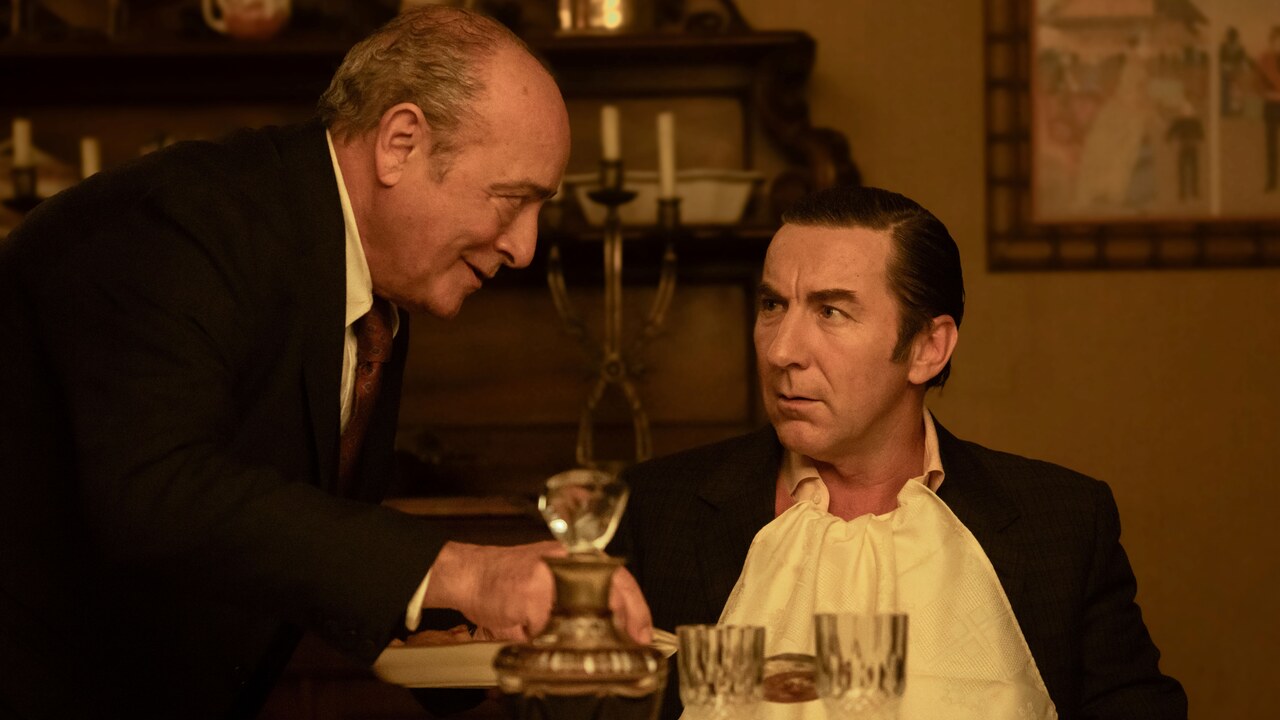
Leandro (Antonio de la Torre) is a marquis who thinks far too highly of himself. The world around him has moved towards democratic government, but he continues to live in his own delusional bubble. As far as he is concerned, being a marquis means he holds considerable sway and power over everyone. Moreover, he is surrounded by other noblemen and a chauffeur who never challenge his assumptions or confront him with the fact that his title means little to the wider world. When Leandro invokes his noble status to command a hotel receptionist to reveal details about a guest, she laughs at him rather than standing in awe of his aristocratic position. His mansion, too, has become a hollow shrine to past glory, now frequented only by porn filmmakers. Leandro's room is a mess and lies on the ground floor, which is also inhabited by rats. The rooms on the upper floors are clean and tidy, but they have no electricity. They are maintained so that visitors to the mansion can admire its rich decorations and Leandro can preserve the facade of being a wealthy and influential individual.
This man, who lives for titles, wants to acquire yet another one. He desperately wants to be recognized as a Grandee of Spain, as if the distinction meant anything in the modern world. There was a time when this rank granted its holders special privileges, but today, it carries little practical power beyond its ceremonial and social significance. Leandro, though, either doesn't understand how much the world has changed or refuses to acknowledge it. He is a deluded clown living in his own fantasy land, practically helpless without his chauffeur. Perhaps he is too much of a caricature for the task creators Juan Cavestany and Alvaro Fernandez Armero have set themselves in Fading Grandeur (original title: Grande de Espana). Through Leandro, they want to expose the hollowness of modern-day aristocracy, but the show never develops this one-line idea into anything more substantial. Cavestany and Armero create a fool worthy of a farce, yet they rarely exploit the absurd comic possibilities of the form. Puzzlingly, they keep the volume down, which is why scenes such as the one in which Sofia (Alexandra Jimenez) improvises lies while talking to a curator in front of Leandro, or the one in which a woman recognizes Sofia's dress and exposes her in front of everyone, never quite land with the comic force they promise to us.
Cavestany and Armero never push a joke or payoff to wildly chaotic heights. They deflate tension and shoot down any sign of giddiness almost immediately, leaving scenes to fizzle out before they can reach their full comic potential. What they seem to want, instead, is a balance between emotional sincerity and comedy. When Leandro accepts Sofia's lies, we catch glimpses of a man who may be lonely enough to prefer the comfort of illusion to the discomfort of confronting his life. Perhaps he senses, however dimly, that the world he inhabits is meaningless nonsense and that Sofia offers him something it cannot. Here is a woman who probably loves him more than anyone in his family does, and Leandro doesn't have many genuine friends either. The one good friend he does have is betrayed when Leandro sleeps with his wife, who also happens to be Leandro's cousin. Nothing particularly hilarious emerges from this sexual game either; it merely repeats the point that the husband is as much of a fool as Leandro, apparently his only friend. The problem is not that the show attempts to find an emotional dimension beneath Leandro's absurdity, but that it never develops this dimension enough to make it convincing. His willingness to accept Sofia's lies could have revealed something moving about his loneliness, his passivity, or his desire to believe in something. Instead, these possibilities remain little more than suggestions. Leandro is too much of a one-dimensional stick figure for us to care about his feelings or matters of the heart, and the emotional aftertaste the show seems to be chasing never quite materializes.
The show also fails to let us in on Leandro's backstory, leaving us to wonder how he became such a buffoon as an adult. How did he grow so thickheaded? His ignorance goes beyond politics or social change. Ask him which item doesn't belong in a list containing a pear, a banana, an apple, and a table, and he will pick the pear because he doesn't like pears. That might work perfectly well in an outright farce. I wouldn't have demanded a backstory if Fading Grandeur weren't so interested in veering towards drama. But the show wants us to feel for Leandro even as it makes him the butt of jokes about the death of aristocratic privilege. By shifting between two tonal registers while populating the story with characters firmly rooted in silliness and farce, the series proves incapable of doing justice to either mode of storytelling. By the end, you feel as though you've spent time with someone casually discussing a good idea rather than bringing it to life with fervor. The contradiction inherent in Fading Grandeur is also evident in its muddled handling of practical details: How does Leandro manage to get to a function from an "unglamorous" corner of Madrid without money or help? And, in the absence of the former, how does he pay a barber after getting his hair styled at the shop? Leandro's daughter is initially unwilling to marry a young nobleman with whom she has a one-night stand, but on the day of the wedding, she goes through with it because she doesn't want to give up the chance to live like a duchess. "No way in hell," she tells her father. Where did this change of heart come from? Her decision might have exposed how deeply the same class vanity has shaped her despite her initial resistance, but the series offers too little to make the reversal feel like a revelation rather than an arbitrary change of heart.
Of course, we wouldn't be asking these questions if Cavestany and Armero had chosen the "don't think too much; this is a dumb comedy" lane instead of repeatedly veering towards earnestness in an attempt to make us think about Leandro's sad existence. They want us to root for the jester, but this jester is thinly conceived and insufficiently developed to move us. Put simply, Cavestany and Armero miscalculate their approach and end up providing us with yet another Netflix series that can be left playing in the background as ambient noise while we do household chores. I know this line isn't original in reviews these days, but in my defense, these shows don't push any new buttons either. Which is why, if I were ever given the chance to make a series, I'd call it Fading Criticism. This one's for all those reviewers who are mentally exhausted by the constant downpour of slop. I hear you; I feel for you. Let me pick up my camera.
Final Score - [3.5/10]
Reviewed by - Vikas Yadav
Follow @vikasonorous on Twitter
Publisher at Midgard Times


Hi Everyone, after a due consideration, we have decided that we will be open for donations to help us in managing our website. We will be greatful for any kind of amount we receive. Thanks!
— Midgard Times 🎬 (@Moviesr_net) January 4, 2026
PayPal- [email protected] pic.twitter.com/DlNNz5Npm5
Get all latest content delivered to your email a few times a month.
Bringing Pop Culture News from Every Realm, Get All the Latest Movie, TV News, Reviews & Trailers
Got Any questions? Drop an email to [email protected]


 © Copyrights MOVIESR.NET All rights reserved