


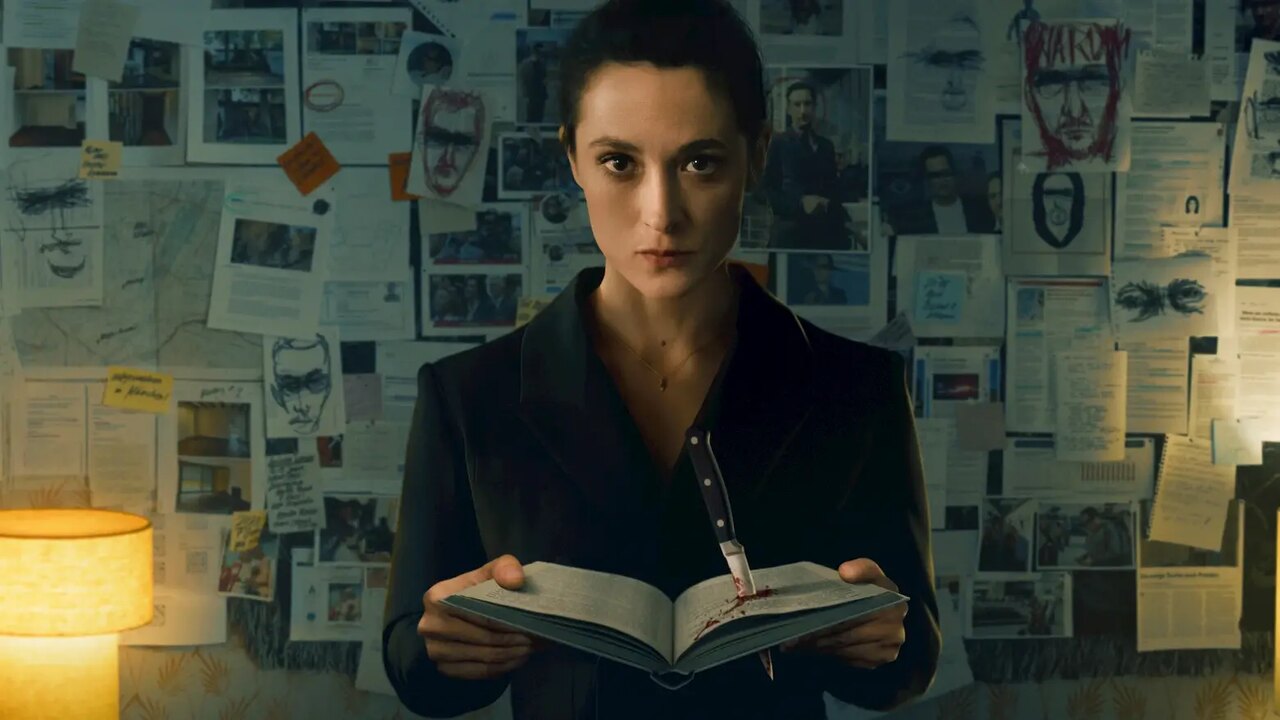
One night, successful author Lisa Konrad (Friederike Becht) arrives at her sister Anna's (Josephine Thiesen) house and finds her fatally wounded. With her dying breaths, Anna signals Lisa to look towards the balcony, where Lisa finds the murderer looking back at her. She picks up the murder weapon, a knife, and points it angrily at the killer, but he quickly disappears. Many years later, Lisa, now living alone in a mansion, suddenly spots that mysterious man on television. Further investigation reveals his name to be Robert Lenzen (Hans Löw). Who is he? An investigative reporter who, among other things, has covered the war in Afghanistan. Did he really kill Anna? Lisa thinks so. In fact, she is a hundred per cent sure. In that case, all she needs to do is collect evidence against him to put him behind bars. And how does she go about doing that? Why, by writing a novel about the murder and asking her publisher, Norbert Rudow (Matthias Brandt), to arrange an interview with Robert! Lisa Konrad? Call her Lisa Kickass instead.
What would you do if you were planning to confront a murderer by inviting him to your mansion? I suppose you'd have someone else in the house for safety. That someone could be the maid or the gardener; just tell them to stay nearby or remain in the adjacent room throughout the encounter. Ah, but when have characters in thrillers ever behaved according to logic and common sense? Lisa orders her housekeeper, Yuma (Malaya Stern Takeda), to take the week off, and when Norbert arrives and asks to stay at the house to ensure the interview goes without a hitch, she rudely sends him away as well. Does she have a death wish or what? To Lisa's credit, she undergoes strenuous physical and mental training before confronting Robert. A trainer puts her through gruelling workouts, while an FBI agent (or ex-agent) teaches her verbal techniques to mentally break down her opponent. That's all well and good, though I don't think these training sessions help her much.
Ultimately, The Trap (or Die Falle) delivers justice to Lisa the old-fashioned way: through secret recordings and a bullet to the head—in the form of suicide. At best, I suppose, the training helps her stay conscious and in control for longer when she is covertly drugged. Then again, it's the sort of thing a story can get away with under the guise of plot convenience. And anyway, had director Isabel Kleefeld simply shown Lisa acquiring a gun, one way or another, I think she could still have arrived at the same outcome. That's because the training sessions, which get an entire episode to themselves, come across as little more than filler. The trainer teaches Lisa boxing, but there is no hand-to-hand combat. He makes her run on a treadmill so she can run and escape danger, yet when she finally does run, she doesn't get very far before being shot in the leg. And as far as the mind games are concerned, it's Robert who succeeds in getting inside Lisa's head and gaining the upper hand. If I were Lisa, I'd demand a full refund from the trainers; if I were one of those trainers, I'd be very disappointed in Lisa.
In the first paragraph, I asked, "Did he really kill Anna?" Now, it appears that Robert is indeed the killer. Have I spoiled the show for you? I don't think so. The Trap moves in a straight line for most of its runtime, making Robert look guilty and Lisa seem justified in her suspicions. Kleefeld, too, might have recognized the show's predictability and straightforwardness, which is why she rather clumsily attempts to distract the viewer. That distraction almost qualifies as so-bad-it's-good material, given that it turns Lisa's literal isolation into a metaphor of sorts, suggesting that she might have been living in a psychological bubble. Kleefeld achieves this by making Lisa re-examine her past, extending certain flashbacks, including one in which Lisa and Anna, as young girls, lie on the ground embracing each other and talking about dying together. Kleefeld reveals more of the footage, and we see... let's just say, a mean girl.
I found the whole conceit quite laughable. It also reinforced my belief that The Trap has all the substance of a short film forcibly stretched into six "bingeable" episodes. After the interview at her house, Lisa might begin to doubt herself, but the show gives us more than enough clues to dismiss her self-doubt altogether. Why switch off the Wi-Fi? Why plant the drugs? Why snoop on a phone conversation? Kleefeld clearly fails to build an atmosphere of intrigue, mystery, and tension. Instead, she lures viewers in with a sensational premise only to bury them in drabness. The title, then, is perhaps less a description of the story than a promise—or a statement of intent—from the director. The Trap is her trap. Proceed with caution. Isabel Kleefeld? Call her Isabel Knavish instead.
Final Score - [3/10]
Reviewed by - Vikas Yadav
Follow @vikasonorous on Twitter
Publisher at Midgard Times





Hi Everyone, after a due consideration, we have decided that we will be open for donations to help us in managing our website. We will be greatful for any kind of amount we receive. Thanks!
— Midgard Times 🎬 (@Moviesr_net) January 4, 2026
PayPal- [email protected] pic.twitter.com/DlNNz5Npm5
Get all latest content delivered to your email a few times a month.
Bringing Pop Culture News from Every Realm, Get All the Latest Movie, TV News, Reviews & Trailers
Got Any questions? Drop an email to [email protected]



 © Copyrights MOVIESR.NET All rights reserved