


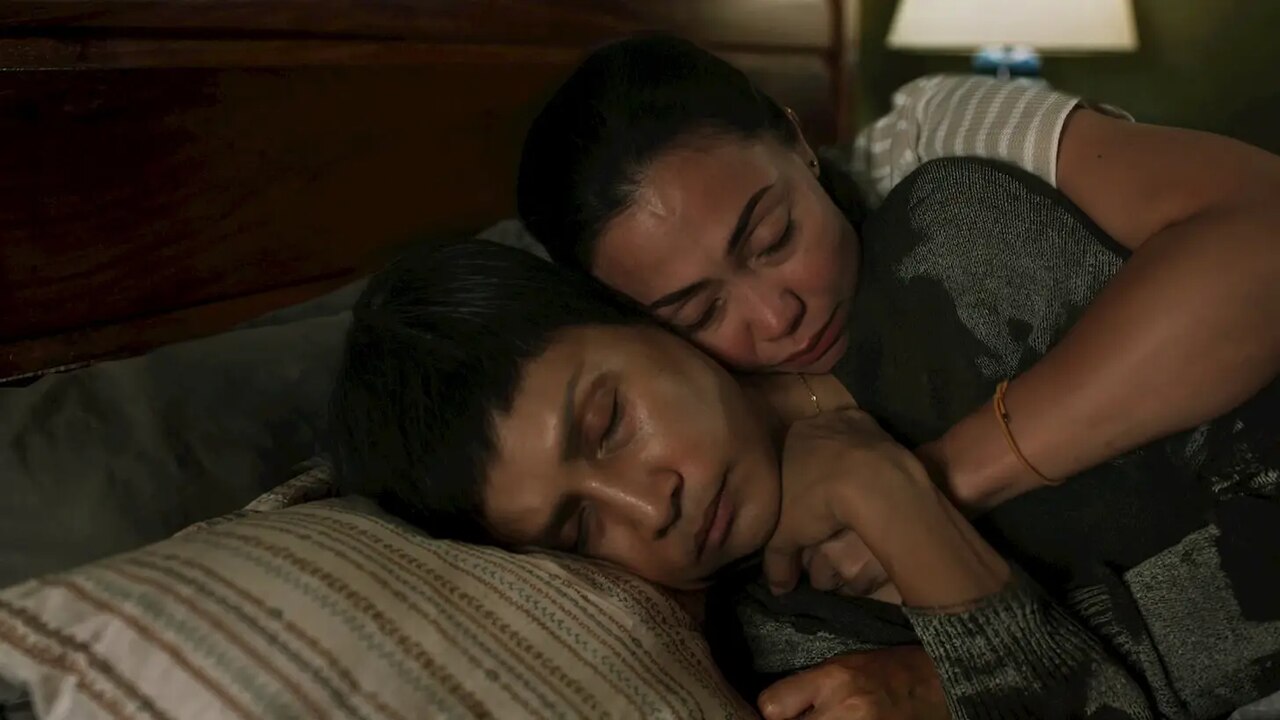
What begins as a family reunion quickly turns into an excavation of abandonment, rejection, old grievances and the secrets that have kept this family apart. Family dramas tend to announce their themes very loudly. This, That and Everything in Between doesn't exactly whisper either. But beneath all the tears, arguments and long-suppressed resentment, there's something more interesting happening: the film is asking what happens when the person you spent your entire childhood trying to understand finally walks back into your life—and you realise you may not actually want the answers. Joanne has built a successful life for herself. She's intelligent. She's accomplished. She's independent. But it doesn't reduce Joanne to a victim of her childhood. Her experiences have shaped her, but they've also given her a particular way of dealing with people—one that isn't always pleasant, reasonable or emotionally healthy.
Sta. Maria is excellent in that space between those two things. Joanne isn't written as the endlessly patient daughter waiting for her mother to apologise. There is anger here, and sometimes it's ugly. She has spent years constructing an identity that doesn't require Paz, so Paz's return isn't simply an opportunity for reconciliation. It's an intrusion. And that makes the central relationship considerably more interesting.
Agot Isidro's Paz is equally resistant to easy categorisation. She's not simply the terrible mother who abandoned her child and has returned expecting forgiveness. The film gradually allows more complexity into the character, particularly around the insecurities and frustrations that sit underneath her behaviour. Isidro has described Paz as complicated rather than simply bad, and that distinction comes through in the character. That's probably the film's most mature choice. It doesn't ask us to decide who is right. It asks us to understand why both women think they are. And those are very different things.
The family itself provides the film with another layer of tension. This isn't just a mother-and-daughter confrontation happening in an empty room. The story places Joanne and Paz within a larger Filipino family environment, where affection, obligation, memory and interference exist almost simultaneously. Everyone knows something. Everyone remembers something differently. Everyone has an opinion. And, naturally, nobody has any intention of keeping those opinions to themselves. That's where the film's humour becomes particularly useful.
Director Cholo Laurel has said that the comedy wasn't inserted simply to make the heavy material easier to swallow; family conflict can genuinely be funny because families themselves are absurd. That feels true to the film. Some of its funniest moments emerge precisely because the characters are taking their family drama extremely seriously. Someone is having an emotional crisis. Someone else is eating. Someone is offended. Someone starts talking about something completely unrelated. And suddenly you're laughing at a situation that, five minutes earlier, seemed devastating. That's a very Filipino quality of family storytelling, and This, That and Everything in Between understands it well.
The film's greatest strength, however, is that it doesn't confuse forgiveness with reconciliation. Those aren't automatically the same thing. You can understand why someone hurt you without deciding that the relationship should return to what it was. You can recognise someone's pain without excusing what they did. And you can love someone while still acknowledging that they were not good for you. The movie is at its best when it sits inside those contradictions rather than trying to resolve them with one grand emotional speech. There are times, unfortunately, when it does exactly that.
At 112 minutes, the film has a lot of emotional territory to cover, and some of the revelations arrive with the unmistakable feeling of a screenplay announcing, This is the part where you cry now. The writing occasionally pushes the emotional point a little too hard. Some confrontations feel designed to produce catharsis rather than arising completely organically from the characters. And the supporting ensemble, while strong, doesn't always receive enough room to develop beyond their relationship to the central mother-daughter conflict. That becomes particularly noticeable because the film clearly wants to portray the family as a larger ecosystem rather than merely a backdrop for Joanne and Paz. Still, the emotional performances largely compensate.
Sta. Maria and Isidro understand that the most painful scenes don't necessarily require screaming. Sometimes the better performance is the person who doesn't say what they're thinking. A glance can carry twenty years of resentment. A pause can contain an entire childhood. And sometimes the most devastating thing someone can say is something completely ordinary. The film also benefits from refusing to turn Joanne's career into the central conflict. She's a successful TV writer, but the story isn't really about whether she can balance work and family or whether her career has made her selfish. Her professional success functions more importantly as evidence of the life she's constructed away from Paz. Joanne has built something. Paz's return threatens to make her question what that something was built on.
The title, This, That and Everything in Between, ultimately feels appropriate because the film isn't really interested in neat categories. Real families are rarely that tidy. And neither is this one. It is an emotionally grounded Filipino family drama that understands that some wounds don't disappear simply because the person who caused them comes home. Jodi Sta. Maria and Agot Isidro are the film's greatest assets, giving Joanne and Paz enough complexity to avoid turning their conflict into a simplistic battle between right and wrong. The supporting family dynamics and carefully placed humour keep the film from becoming relentlessly heavy, while Cholo Laurel's direction allows its emotional material to remain intimate rather than melodramatic for most of its runtime. It occasionally pushes its revelations and confrontations harder than necessary, and not every supporting character receives the depth the larger family story promises, but its understanding of abandonment, inherited hurt and the uncomfortable possibility that reconciliation doesn't have to mean forgetting is genuinely affecting.
Final Score- [8/10]
Reviewed by - Anjali Sharma
Follow @AnjaliS54769166 on Twitter
Publisher at Midgard Times



Hi Everyone, after a due consideration, we have decided that we will be open for donations to help us in managing our website. We will be greatful for any kind of amount we receive. Thanks!
— Midgard Times 🎬 (@Moviesr_net) January 4, 2026
PayPal- [email protected] pic.twitter.com/DlNNz5Npm5
Get all latest content delivered to your email a few times a month.
Bringing Pop Culture News from Every Realm, Get All the Latest Movie, TV News, Reviews & Trailers
Got Any questions? Drop an email to [email protected]



 © Copyrights MOVIESR.NET All rights reserved