


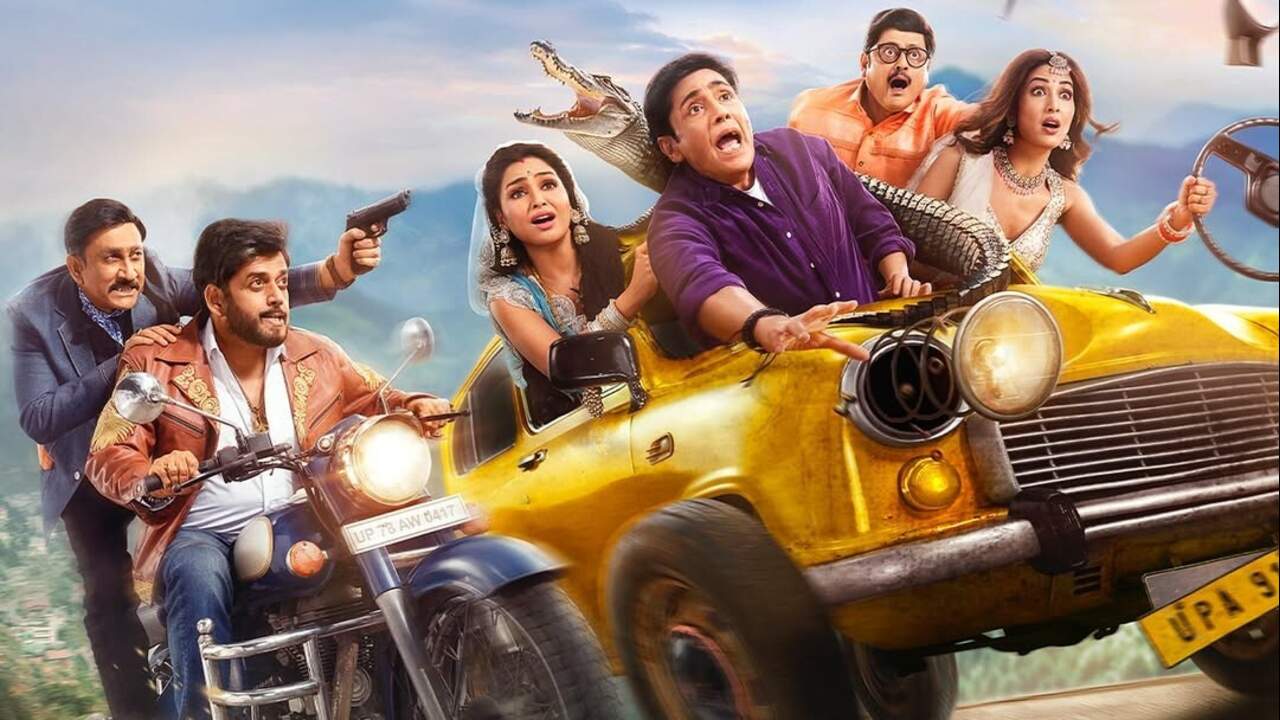
Look at the title of the film: Bhabiji Ghar Par Hain! Fun on the Run. It’s not “Bhabiji Ghar Par Hain?” but “Bhabiji Ghar Par Hain!” That exclamation point conveys the excitement of Manmohan Tiwari (Rohitashv Gour) and Vibhuti Narayan Mishra (Aasif Sheikh), two men who find themselves ecstatic when they look at the other person's wife. The movie opens with Manmohan entering Vibhuti's home and finding Anita (Vidisha Srivastava), Vibhuti's wife, doing stretching exercises. Vibhuti, on the other hand, enters Manmohan's house and finds Angoori (Shubhangi Atre), Manmohan's wife, washing clothes in a sensual way. The sensuality, of course, lies in the eyes of the beholder. Vibhuti is turned on by the force with which Angoori hits the clothes to clean them, while Manmohan is excited by Anita's yoga poses.
The women, though, are incredibly faithful to their husbands. They are also very, very innocent; they are unable to distinguish between genuine care and flirtatious language or sexual advances. This is bad news for the husbands, as all their attempts to woo the women they lust after are automatically thwarted.
With this feature, Bhabiji Ghar Par Hain takes the leap from television to movie theaters. The Khichdi franchise has already made this leap twice, and Mirzapur will do the same later this year. I have never watched the Bhabiji series, though I am familiar with the "Sahi pakde hai" catchphrase. These are the words Angoori speaks when someone corrects her English, as when she says "alligator" instead of "accelerator." Angoori's thin voice, with its childlike sweetness, is naturally comical. It's a pity that she isn't given memorable lines. Whatever little she's given—like "Hain, kya bole?" and "Sahi pakde hai"—quickly becomes monotonous. Anita, meanwhile, is given even less to work with. She is supposed to be a strong woman, but her role is little more than that of eye candy, and unfortunately, she isn't provided with scenes or dialogues funny enough to elicit chuckles from the audience.
Even Manmohan is stuck with fart jokes that peak during a wobbly scooter ride, after which they turn repetitive. The only person who emerges with his humor and dignity intact is Sheikh. He made me smile every time; he bounces on the screen with spring in his steps. His posh English and jesterly gestures, crossed with a gentlemanly demeanor, make him instantly likable. Sheikh's Vibhuti is the film's comic spirit. He lights up every frame. What the actor has done here is not easy to pull off. He not only becomes part of the trash; he infuses the trash with some aroma, some magnetism. Most actors would have immediately sunk to the bottom. Sheikh, on the other hand, shows that it's possible to stand out in dumb material with sheer talent.
To be fair, I don't think the actors deserve any blame. Not everybody is as excellent as Sheikh, but that doesn't mean they are exceptionally bad. Bhabiji Ghar Par Hain is packed with actors who are willing to polish detritus and present it as a diamond. One feels like thanking—or consoling—them for their dedication. It's just that the movie sorely lacks laugh-out-loud moments. Except for a scene where a video is interrupted by an advertisement and another where Brijendra Kala's Master Jee hides food in, um, unhygienic places, no other joke lands. What's worse are the missed opportunities sprinkled throughout: a video call in the middle of a shootout involving Soma Rathod's Ramkali, or a secret passage that leads the good guys toward the bad guy. The movie doesn't exploit these situations for maximum humor. It leaves them plain—their power more sensed than felt. It doesn't help that the passage scene is predictable. And that video call? It just... ends.
Bhabiji Ghar Par Hain may have made its way to the big screen, but it's still designed like something meant for television. I'm not merely referring to its aesthetics; I'm also referring to the jokes, whose setup and payoff sit side by side, as TV viewers don't have the patience to hold something in mind. When characters stranded in the middle of a jungle say they want bananas to fuel their vehicle, a woman selling bananas suddenly arrives at their location. When a snake bites Manmohan and Vibhuti sucks the poison out of his ass, a man appears and announces that the snake isn't poisonous. Perhaps these low-level, lowbrow gags are digestible.
What's offensive—and absurd—is the film's decision to turn emotional near the end. Suddenly, Bhabiji Ghar Par Hain preaches that mutual consent and love are crucial in a marriage, and that one should look for a partner who isn't attracted to superficial things like hair. I think we can all agree that the only lesson this movie truly dispenses is that it's okay to love your sister-in-law—or rather, it's okay to hit on your sister-in-law. Such attractions are neither new nor abnormal. Man has always lusted after another man's wife; he has merely shifted from caves to colonies (or Modern Colony, in this case). Beneath the suits, jeans, pants, and Lux Nitro undergarments, man remains a sexual animal.
Who knew Bhabiji Ghar Par Hain offered such deep enlightenment? Maybe it was made by a thoughtful paint. Oh—did I mean to say "saint," you say? In the words of Angoori bhabhi, "Sahi pakde hai."
Final Score- [2.5/10]
Reviewed by - Vikas Yadav
Follow @vikasonorous on Twitter
Publisher at Midgard Times


Hi Everyone, after a due consideration, we have decided that we will be open for donations to help us in managing our website. We will be greatful for any kind of amount we receive. Thanks!
— Midgard Times 🎬 (@Moviesr_net) January 4, 2026
PayPal- [email protected] pic.twitter.com/DlNNz5Npm5
Get all latest content delivered to your email a few times a month.
Bringing Pop Culture News from Every Realm, Get All the Latest Movie, TV News, Reviews & Trailers
Got Any questions? Drop an email to [email protected]


 © Copyrights MOVIESR.NET All rights reserved