


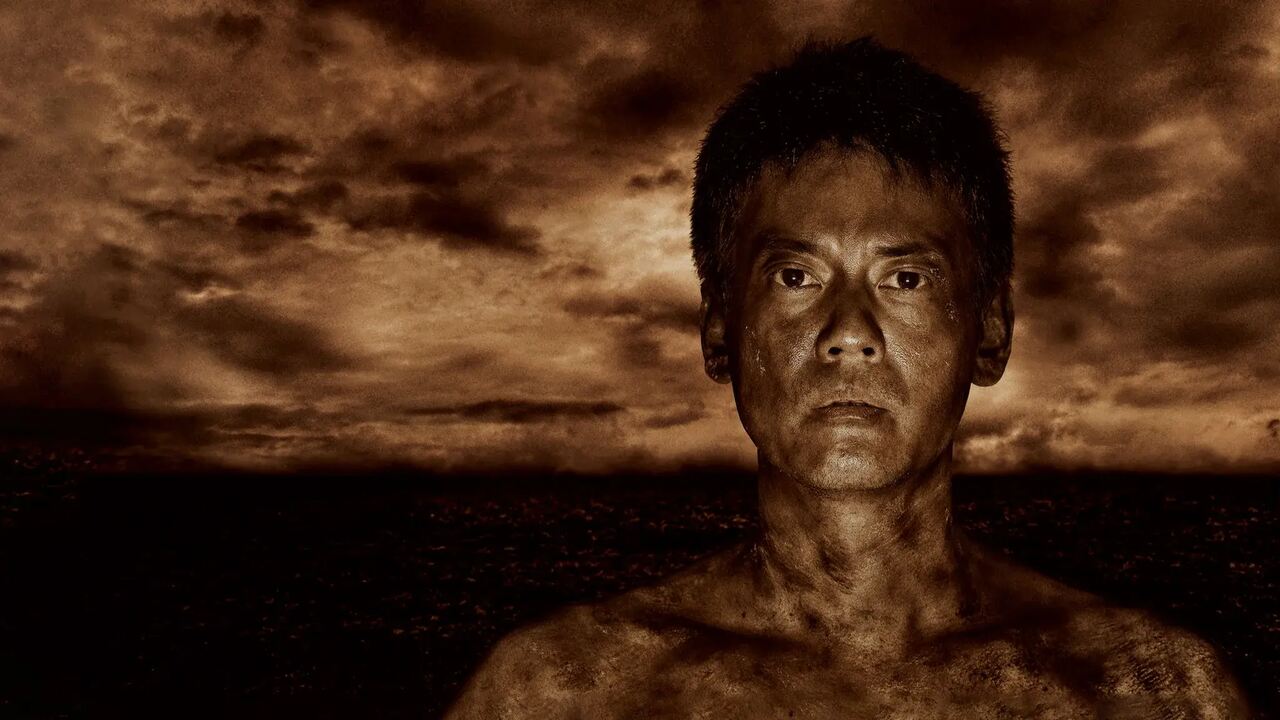
The Japanese show Fumo Chitai, based on a novel by Toyoko Yamasaki, aired in October 2009 on Fuji TV. Released weekly, it ran for 19 episodes until March 11, 2010, and has now finally dropped on Netflix. This means that people outside Japan (like me) can now go through all 19 episodes to witness the arduous journey of Tadashi Iki (Toshiaki Karasawa). Who's he? A soldier who, during World War II, served as a staff officer at Imperial Headquarters, planning military operations. At the end of the war, when the Soviet army broke the neutrality pact, Iki was captured in Manchuria and sent to a Siberian prison camp. There, he spent 11 years doing forced labor and watching his comrades succumb to death. After returning to Japan, he vowed never to rejoin the Defense Agency, choosing instead to live as an ordinary civilian—a decision welcomed by his family.
And so Iki joins a trading company called Kinki Trading on the condition that he won't be asked to exploit his military contacts for the organization's benefit. The company's president, Ichizo Daimon (Yoshio Harada), accepts this condition, but unsurprisingly, Iki goes back on his word during his first assignment. "Unsurprisingly" is the keyword here. Nothing in Fumo Chitai ever shocks you, stuns you, or leaves you anxious. The characters engage in high-risk business deals that threaten to make or break both their reputations and the organization's standing in the market, but the outcomes rarely put much of a professional or personal dent in these businessmen. The loser sulks; a tear rolls down his face (I am looking at you, Tatsuzo Samejima [Kenichi Endō]).
In Fumo Chitai, everybody is a stock character. A journalist (Abe Sadawo) flashes a slimy smile so we know he's not Iki's well-wisher—that is, until the smile softens when he starts taking Iki's side. One of Iki's colleagues, Koide (Matsushige Yutaka), beams so widely it almost threatens to tear the skin off his face because...he's comic relief, I guess (the fact that he never actually makes you laugh is another problem altogether). Then there is the Vice President of Kinki Trading, Tatsuya Satoi (Ittoku Kishibe), who looks like one of those scheming soap-opera antagonists perpetually up to no good. In the same vein, there is Samejima, who smiles like a devious snake. Not everybody is stabbing and scheming against poor Iki. His wife, Iki Yoshiko (Emi Wakui), loves him unconditionally, even though she knows he doesn't reciprocate her feelings. She's practically angelic, which is why she's bathed in bright white light (thanks to a mirror behind her) just before a fatal accident. This devoted wife, who always wears a gentle smile, is sent to heaven.
These stick figures never generate enough complications. There is no push and pull between us and them. The series hands them neat labels so we know who is good and who is bad—or who has crossed over to the side of good after initially seeming bad (I am looking at you, dear hungry-for-scoop journalist). Given how tightly structured for television Fumo Chitai is, there is no scope for nail-biting tension. Iki's entire journey can be reduced to "one battle after another." At Kinki Trading, he fights economic wars by procuring fighter jets for Japan's Second Defense Plan, securing tankers during the Middle East war, expanding the company overseas, brokering a partnership between two automotive companies, and winning a tense oil-bidding war. These conflicts unfold familiarly: Iki encounters a problem, Iki brainstorms a solution, Iki executes the solution, and Iki (mainly) defeats his opponents. After a while, it becomes clear that nothing can stop this ex-soldier. This stench of predictability, alas, isn't even masked by thrilling exchanges. The dialogue, like the imagery, is plain and merely informational. All you can do is sit passively and wait for Fumo Chitai to complete its 19-episode run (well, unlike me, you're not obligated to finish it).
There is one interesting thread involving Iki and Chisato Akitsu (Koyuki). What makes it intriguing is the age gap between them—Chisato is significantly younger than Iki. For the most part, the series handles this angle without excessive melodrama. I liked how a maid quietly understands these lovebirds. She displays more maturity and openness than the younger characters, like Iki's daughter (Tabe Mikako). Then again, Iki never openly confesses what he feels for Chisato in front of his friends and family. He is embarrassed by the relationship; he knows it won't be fully accepted. On top of that, he carries considerable guilt—guilt that he is betraying the wife who raised their children while he was at war. In these intimate tensions, Fumo Chitai finds a spark by revealing Iki to be flawed. His self-centeredness surfaces during his interactions with Chisato, especially when he casually dismisses the demands of her profession. He meets her covertly and sometimes overexplains why he is with her, as if she were a guilty secret. Iki's love life is more compelling than his professional life. Unfortunately, the show is more invested in the latter, which only reiterates what we know from the outset: he is a fighter fiercely dedicated to his tasks. And in the end, the Iki—Chisato angle builds toward the most predictable climax. There is a faint whiff of tragic romance, but Fumo Chitai is too busy following a formula. Instead of grand passion, we are served a boilerplate template of TV melodrama, where the background score dutifully weeps during weepy moments, and the story unfolds in the unremarkable rhythm of "this happened, then this happened."
There is some promise in the idea of watching a man who triumphs not merely because he is competent but because he is exceptionally talented. How talented? Talented enough to overshadow his rivals—both inside and outside the company—and swiftly ascend the corporate ladder. A Samejima or a Satoi doesn't stand a chance against Iki because he is not driven by wealth; he seeks a form of success that elevates both the organization and the individuals within it. He sees the trading company as a vehicle for patriotism. A soldier at heart, he carries his devotion to Japan into his role as a businessman. This is what separates him from the Satois and Samejimas of the world. They hunger for money and fame; Iki seeks Japan's welfare, even if that means stepping aside to make room for the younger generation. Yet Fumo Chitai remains so entrenched in its mechanical problem-solution storytelling that it never fully explores this potential. It offers only a glimpse of what lies beneath its surface, which hovers somewhere between chintzy and serviceable. A glimpse is all you get because Fumo Chitai is not conceived as art; it is engineered as television designed to occupy viewers while they eat dinner. Why blame streaming services for feeding us second-screen content when such material existed long before streaming? Just look at Fumo Chitai. It is the perfect example.
Final Score- [3.5/10]
Reviewed by - Vikas Yadav
Follow @vikasonorous on Twitter
Publisher at Midgard Times


Hi Everyone, after a due consideration, we have decided that we will be open for donations to help us in managing our website. We will be greatful for any kind of amount we receive. Thanks!
— Midgard Times 🎬 (@Moviesr_net) January 4, 2026
PayPal- [email protected] pic.twitter.com/DlNNz5Npm5
Get all latest content delivered to your email a few times a month.
Bringing Pop Culture News from Every Realm, Get All the Latest Movie, TV News, Reviews & Trailers
Got Any questions? Drop an email to [email protected]



 © Copyrights MOVIESR.NET All rights reserved