


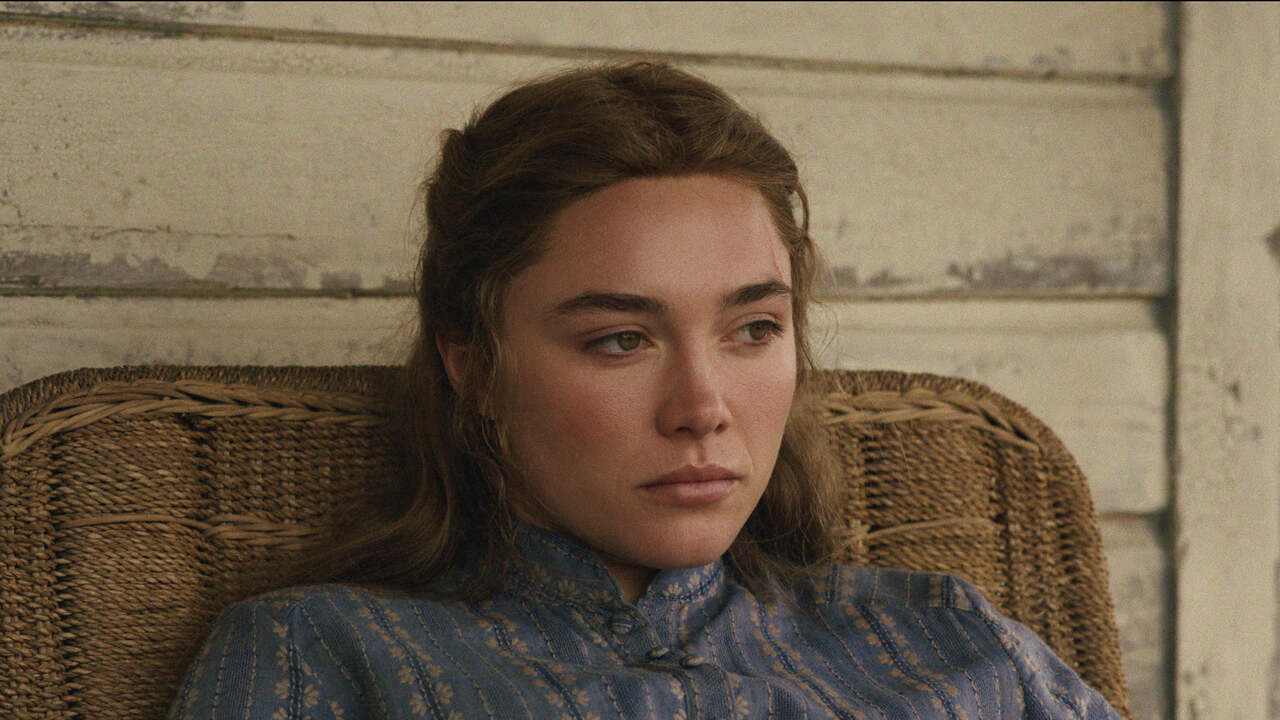
In 1955, Elia Kazan brought John Steinbeck's novel East of Eden to the big screen. Seventy-one years later, in 2026, his granddaughter Zoe Kazan has adapted the same novel for the small screen. Sentimentalists can get all gooey-eyed about this, um, family business or taking-the-baton moment or whatever, and cheer for the 43-year-old Kazan, expecting a modern take with a female gaze on the source material (or simply pure professionalism). But alas, this new East of Eden is dreadfully boring and a chore to watch.
Going through the Wikipedia page for Steinbeck's novel, I realized that the Netflix adaptation is not too different from the website's synopsis section. Yes, the story is bound to be the same because...duh! But I am not talking in the obvious sense that this is an adaptation, so it's identical to the source. No, what I mean is that the series moves, looks, and narrates its events almost as if it were a visual interpretation of the one-line sentences that can be found under the "Plot/Synopsis" section. Take this line, for instance: "Cathy gives birth to twin boys, shoots Adam in the shoulder after convincing him to unlock the bedroom door, and flees. Adam survives and falls into a deep depression."
Whatever you feel while reading that line is what you feel while watching the scene, too. It unfolds as directly and plainly as the sentence above. Well, almost as directly and plainly as the sentence above. You get shots of Cathy (Florence Pugh) sitting around the house, all sad and muted, but the directors, Garth Davis and Laure de Clermont-Tonnerre, don't inject any verve or visual style into their images. They obediently and faithfully go through Kazan's text, and this sense of "sacredness" yields a torpid directorial hand that proceeds to translate the page to the screen with literal-mindedness. This is why, rather than feeling as if you have been transported into a fictional world, as if you have been placed in the company of greedy, destructive, loyal characters, all you receive is a set of bullet-point-like highlights that simply convey that a particular incident happened. Hence, you can print out a transcript of this Netflix show, bind it into a book, and read it at your own pace. The experience would not be any different from that of watching the series itself.
Kazan surely doesn't seem to have been short on budget, nor does it look as if she had to settle for hiring talentless actors. Pugh, especially, digs into her role with wicked pleasure, and as the brothel owner going by the name of Kate, she looks like a nocturnal witch who hasn't slept in ages. But since Davis and Clermont-Tonnerre don't exhibit an eye for drama, and the scenes, as a result, lack dramatic vigor, all we can do is look at the actors' expressions, which end up calling attention to themselves. What's more, there is little to feast your eyes on here, so you do continuously gaze at the performances for almost seven long hours. Watching East of Eden, then, is a tiring expedition—an expedition without any reward at the end.
This is a very tragic and romantic story on paper. A mother abandons her children and shoots her husband so that she can pursue economic freedom, which she gets by betraying a woman who considers her to be her daughter. The story also contains a curious symmetry: two brothers in the 1800s are treated unequally by their father, with one favored over the other, and one of them punches the other at one point. Later, the same pattern repeats itself with another pair of siblings. They, too, are treated differently by their father, with one favored over the other, and one of them punches the other at one point. These are the kinds of recurring familial patterns that could give the material a sense of mythic repetition, but the series simply registers them as events that happen.
Nonetheless, what you finally see on the screen fogs your brain and numbs your senses. East of Eden is thuddingly sober when it should be as crazy and volatile as its characters. On top of this, Kazan severely trims the narrative to its bare plot function, which is why every scene progresses along the lines of "this happened, then this happened, then this happened." When Lee (Hoon Lee), the Chinese-American servant of Adam (Christopher Abbott), goes to San Francisco to follow his dream of opening a bookstore there, we get one shot of him inside a crowded boarding house, one shot of him facing rejection from a man unwilling to rent him a place, and one face-to-face conversation between him and his father, all of which merely tell you what happens in terms of plot details rather than infusing the scenes with an emotional force that would render the basic, straightforward information either tense or palpable. No wonder Lee's time in San Francisco goes by in a zip, and before you know it, we find him back with Adam. Hence, when Lee reunites with Adam and the latter says it has been a long time since he saw him and that he missed him almost every day, you don't believe his words because it doesn't feel as if the two of them were separated for even days, let alone months or whatever.
There will always be elisions and modifications whenever a book is adapted by filmmakers. The best of them know what to remove and what to retain and how to cast their own vision onto the newly developed material. Watching this version of East of Eden, I felt as if Kazan wanted to cover almost everything in the novel, so she compressed—or rather, slimmed down—the story to fit it into her Netflix creation. And so, if Steinbeck considered his work a magnum opus, then Kazan's output comes across as a minor opus. The characters have nothing substantial to say about the war or anything insightful to say to each other about themselves, their society, their routines, or everyday matters—they are curiously perspectiveless puppets who simply deliver exposition. The show never grips you feverishly; it never consumes you in its madness.
Some might be tempted to ask Cathy for morphine, which she uses on her wedding night to drug Adam. Others might say that the show itself works like morphine. It doesn't merely leave you drowsy; it dulls the senses, slows the pulse of the drama, and leaves you drifting through scenes that should have gripped you in their arms. This East of Eden, unfortunately, is a waste of its terrific story and its superb actors. It wouldn't be a stretch, then, to say that we all deserved better.
Final Score - [3/10]
Reviewed by - Vikas Yadav
Follow @vikasonorous on Twitter
Publisher at Midgard Times
Hi Everyone, after a due consideration, we have decided that we will be open for donations to help us in managing our website. We will be greatful for any kind of amount we receive. Thanks!
— Midgard Times 🎬 (@Moviesr_net) January 4, 2026
PayPal- [email protected] pic.twitter.com/DlNNz5Npm5
Get all latest content delivered to your email a few times a month.
Bringing Pop Culture News from Every Realm, Get All the Latest Movie, TV News, Reviews & Trailers
Got Any questions? Drop an email to [email protected]

 © Copyrights MOVIESR.NET All rights reserved