


As I reached the closing moments of the final episode of How to Get to Heaven from Belfast, the only words that came to mind were these: I love Lisa McGee. This was by no means a late realization. The show had me in its grasp from the beginning. I simply kept expecting it to fall apart at any moment somewhere in the middle. The fact that it doesn't—that McGee's ingenious plotting remains consistently engaging, unpredictable, and entertaining—is no small feat.
"Unpredictable" may be the most fitting word to describe this series. Just when I thought I had a handle on where the story was headed, McGee would gleefully pull the rug out from under me. How does she do it? How does she take the generic template of a typical Netflix crime thriller and infuse it with a delightfully dark sense of humor and a genuinely gripping mystery?
The world McGee brings to life in Belfast is vibrant and funny, yet she never punches down on her characters for the sake of a joke or cheap sensationalism. They may be placed in absurd situations and made to do absurd things, but they are never reduced to caricatures. McGee loves them; she, with care and affection, reveals them gradually.
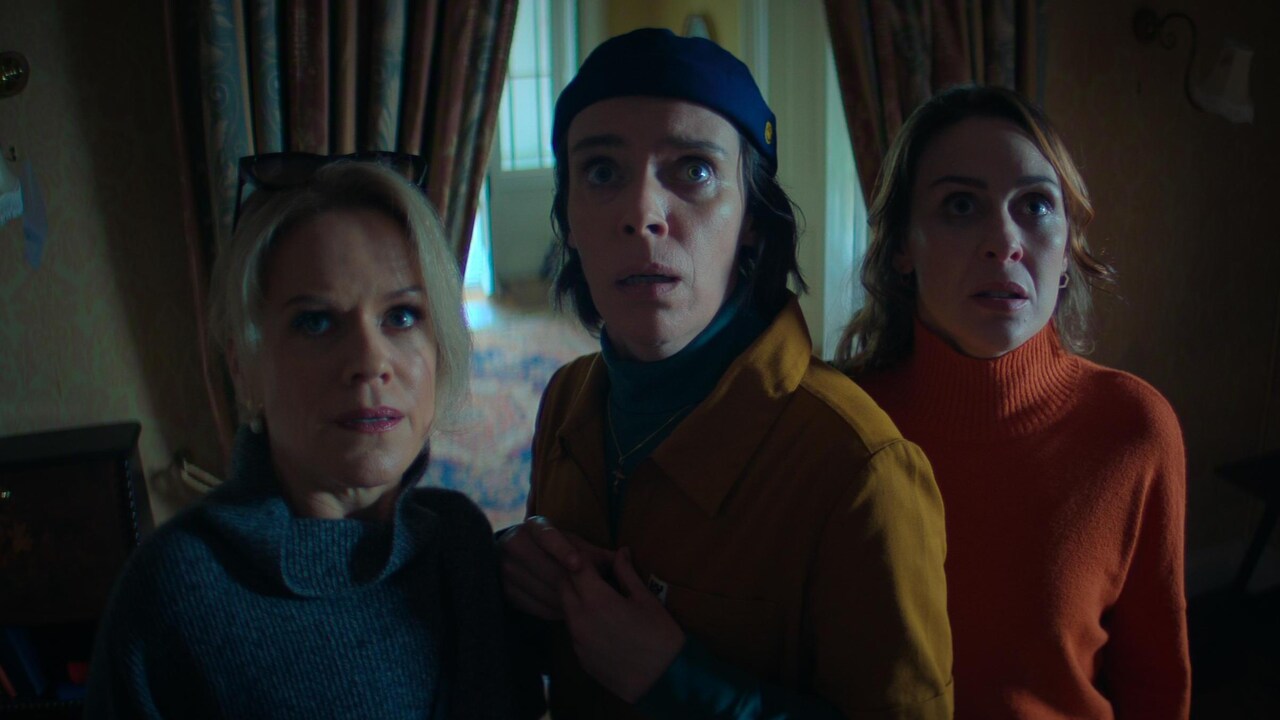
Booker (Bronagh Gallagher), for instance, initially appears to be the familiar stoic, hyper-competent hitwoman—the kind who "takes care" of business without flinching. But she emerges as a woman governed by a strict moral code, working for a secret agency, her principles lending her a surprising humanity. Feeney (Saoirse-Monica Jackson), one of her colleagues, first registers as a chaotic killer type, yet she turns out to be as sweet and vivid as candy. She has the manic spark of a Harley Quinn, and one suspects the costume and makeup departments had tremendous fun crafting her look, her outfits.
Jackson clearly relishes the role. She delivers her lines with playful precision; I found myself smiling every time she said "Babes," which happens often. If Feeney evokes Harley Quinn, then it is fitting that Robyn (Sinéad Keenan) mentions that she feels like Batman at one point.
Who is Robyn? A housewife who accuses her one-and-a-half-year-old son of gaslighting. She is friends with Dara (Caoilfhionn Dunne), a lesbian, and Saoirse (Roisin Gallagher), a television writer. Their dynamic is one of the show's quiet pleasures: they love one another, tease one another, quarrel, and yet can never stay angry for long. I especially enjoyed the detail that Dara and Robyn have never watched Saoirse's hit series, Murder Code—a murder mystery, obviously. Equally amusing is the lead actress's demand that Murder Code become more "personal," more emotionally charged. She wants it to focus less on the murder and more on the female experience. This exasperates Saoirse—understandably, given the title.
Saoirse, being a writer, constantly mines her own life for story material, a habit that earns her accusations of self-absorption. It is hard not to see fragments of McGee herself in this portrayal. What McGee also does in Belfast is subtly explore the difference between a story shaped by a male sensibility and one emerging from a woman's perspective. The clearest example is the thread involving Saoirse and Liam (Darragh Hand). She is engaged; he is younger. A lesser writer might have exploited the relationship for titillation and illicit thrills. Instead, Belfast generates a sustained sexual tension rooted in emotional infidelity. McGee delays physical consummation for a long time—and when it finally arrives, it isn't...satisfying. Nonetheless, these emotional undercurrents are rendered with remarkable precision; few writers capture this particular shade of longing so convincingly.
Morwenna Banks achieved something similar in Down Cemetery Road. That Apple TV+ series, like Belfast, bore a distinctly feminine touch and aspired to be an unpredictable ride. But its unpredictability often led to predictable outcomes; it lacked genuine surprise. Belfast, by contrast, toys with expectations and overturns them with style. Its images are distorted, canted, bursting with color—they feel alive. And McGee has more than enough twists to sustain suspense throughout the runtime. I do not mean only plot revelations but character revelations as well. A minor figure—a quirky shop owner, for instance—can suddenly reveal such warmth and understanding that he becomes startlingly human. Then there are the setups and payoffs (an inflatable banana, a guard's ID, a cow) that McGee cleverly disguises beneath the tone of comedy. They seem incidental at first, only to return at precisely the right moment.
If the series has a flaw, it is that it occasionally loses momentum when focusing on Greta (Natasha O'Keeffe), the victim. Her scenes lack the effervescence of the others. The gloom of her personal life intrudes upon the show's tonal balance, and while O'Keeffe's restrained performance makes narrative sense, it does not always translate into something appealing. Still, this is a minor quibble rather than a serious defect.
What remains undeniable is McGee's exceptional talent. This is not merely a slick, competent streaming thriller. It is a comic crime series infused with a distinct authorial voice. If those at Netflix have any discernment, they will renew How to Get to Heaven from Belfast swiftly—and grant McGee full creative freedom. She has earned it. Belfast is compulsively watchable—it's very, very addictive.
Final Score- [8.5/10]
Reviewed by - Vikas Yadav
Follow @vikasonorous on Twitter
Publisher at Midgard Times





Hi Everyone, after a due consideration, we have decided that we will be open for donations to help us in managing our website. We will be greatful for any kind of amount we receive. Thanks!
— Midgard Times 🎬 (@Moviesr_net) January 4, 2026
PayPal- [email protected] pic.twitter.com/DlNNz5Npm5
Get all latest content delivered to your email a few times a month.
Bringing Pop Culture News from Every Realm, Get All the Latest Movie, TV News, Reviews & Trailers
Got Any questions? Drop an email to [email protected]

 © Copyrights MOVIESR.NET All rights reserved