


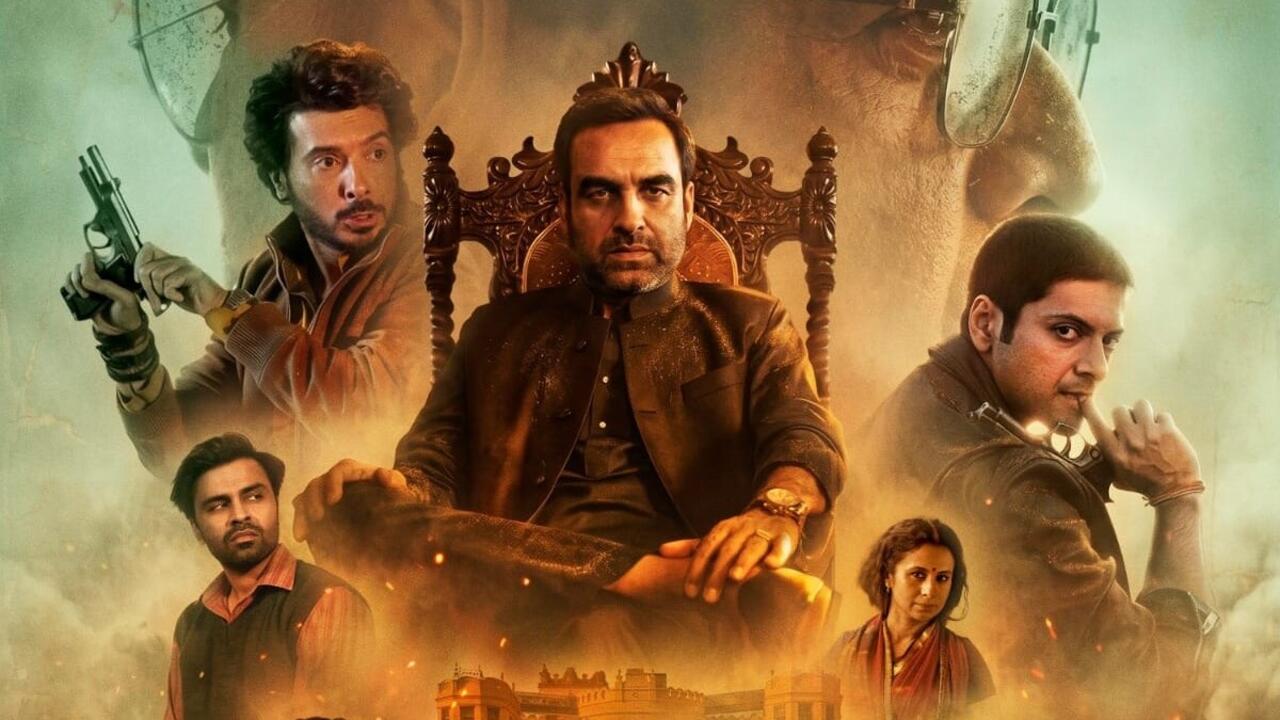
That Mirzapur theme song, composed by John Stewart Eduri, is the very epitome of gooseflesh. If director Gurmmeet Singh had simply played that music over visuals of characters walking, smoking, and posing, it would have made for a very thrilling, very satisfying showreel. But Singh, along with his writer Puneet Krishna, is no hack looking to make a quick buck through lazy fan-pleasing. And lazy fan-pleasing is what it initially seemed he might be doing by reviving characters who died in the Mirzapur series. Well, obviously, Singh doesn't resurrect dead bodies. He merely turns the clock back in time for Mirzapur: The Movie. Yet the fact remains that it initially felt as if the filmmakers were opting to milk easy money by choosing to bring the fan-favorite Munna Tripathi (Divyenndu) to the big screen. I admit I went in with low expectations, given that I am wary of movies that, like a PR machine, attempt to target a specific demographic. Is Mirzapur: The Movie, then, a product of the creators' self-doubt and fear that they made the wrong decision by killing off Munna in the series? Did they succumb to the irrational complaints of fans instead of trusting their own instincts?
Probably, though that doesn't mean this movie is shallow or thin by any stretch. That's perhaps the biggest surprise you will get in the theater: the realization that this Mirzapur runs on the logic of storytelling. At its best, it reminds you why you became a fan of this crime drama when it debuted on Prime Video in 2018. At the same time, don't take this as a declaration that the movie towers over the first season of the series. Hell, that's a feat that even the subsequent seasons failed to achieve. Nonetheless, Mirzapur: The Movie is a real treat—or shall I say, a real masala treat. It has been a long time since I watched a movie that does justice to the masala genre with such lip-smacking glory. Sure, I enjoyed Gopichand Malineni's Jaat, but the flavor of Mirzapur offers its own kind of high. And "high" is a word I am not using lightly because Mirzapur pumps up your blood and makes your heart race from the beginning, sustaining this feeling all the way to the finish line. Singh presents his images with a deliciously lurid sensibility. It's not just the testosterone that runs across the screen. There is also a steady flow of pulpy juice and lovey-dovey longing mixed with a stroke of familial drama and some vengeful spirit. And since Mirzapur essentially is about the desire of men to sit on a powerful seat, there are some very, very entertaining backstabbings and secret schemes.
What's also worth noting is that Singh and Krishna don't entirely depend on you having watched the Prime Video series. It helps if you at least know the basics, but it's okay if you go in blind. You can still see Guddu (Ali Fazal) and Bablu (Jitendra Kumar) as ambitious pawns who want to be kings. As for Munna, he seeks the approval of his father, Akhandanand "Kaleen" Tripathi (Pankaj Tripathi), and is deeply jealous of Bablu and Guddu Pandit, who are left and right hands of Kaleen. Kaleen gives his fatherly approval to the Pandit boys—something Guddu doesn't receive from his own dad and Munna doesn't receive from his own dear daddy. It's evident, then, why Munna is so rowdy. The respect that Kaleen doesn't shower on him is what he ends up looking for in people outside. Munna wields his gangster image and influential name as threatening tools to extract from common citizens the reverence he never finds in his domestic life. Sex, too, then becomes a temporary distraction for him—a distraction from the fact that his father trusts Bablu and Guddu more than him. It's also the kind of distraction that he uses to pour out his frustrations on a woman's body. The rough sex that he indulges in comes across as his way of massaging his own ego, of self-establishing his own superiority (a woman counts as he thrusts into her body, with the unusually high number itself becoming a measure of his endurance and dominance, while another—a maid at her house—is scared of him because of the very roughness with which he attacks her sexually). In both instances, sex becomes less about pleasure than about Munna asserting power and proving his superiority.
But this doesn't mean Munna is a misogynist. He becomes a puppy dog in front of Sweety (Shriya Pilgaonkar), and he terribly misses his mommy. Both, alas, are out of his reach. One is in love with Guddu, while the other is no longer alive. Munna quietly weeps during his mother's birthday—which he alone celebrates in the family—and when he sees Guddu's mother, Vasudha (Sheeba Chaddha), ready to take a bullet to protect her son's life, Munna turns emotional and envious at the same time. All this buildup leads to a terrific payoff in which Kaleen stands in defense of his son in front of Jai Prakash Yadav (Pramod Pathak), giving rise to a "high moment" that also scratches an emotional itch, albeit temporarily. Munna's proud, happy expression here is palpably alive. We know what this moment means to him, and so we are able to experience firsthand the joy on his face and trace the spring in his steps as he bounces around ecstatically. Munna is a character of many layers, and Divyenndu commits to all of them with a temper that is both sincere and comic. No wonder he is a fan favorite—a darling for all the Mirzapur devotees.
And yet, Mirzapur wouldn't have been such a massive hit if it only had one good actor or character in it. It's one of those rare shows/movies where almost every actor seems to have been provided with an author-backed role. Not a single performance sticks out like a bad tune. Jitendra Kumar replaces Vikrant Massey in the movie, but he, too, very effortlessly slips into both the role and the setting. I think I liked Kumar as Bablu a little more than Massey. There is something very "human" about Kumar's face—he emanates kindness quite naturally. In the middle of various types of animals, corrupt politicians, and greedy gangsters, Kumar's Bablu looks like a perfect counterweight to all the hormonal drive. I am surprised now that the filmmakers didn't cast Kumar from the very beginning. He also acts as a nice balance against Guddu's bulky frame, built on steroids. Fazal can really look like a beast. It does, then, seem natural—and, of course, funny—that he injects himself with a drug meant for camels later in the film. That moment comes when Kaleen and his team go to Jaisalmer to do a deal with Babban Yadav, a character whom Ravi Kishan plays rather splendidly.
The filmmaker could just as well have shown Kaleen and everybody hopping into their cars in Mirzapur and then, with a cut—or rather, a few shots of cars driving at high speed—planted them in Jaisalmer for the deal. But Krishna and Singh fill this journey with a callback to Bablu's getting-petrol-at-a-cheap-price instinct, a testosterone-fueled car race, a fan meeting, and that camel-injection scene (maybe not in this particular order). This is precisely what makes Mirzapur distinct from other wannabe crime/gangster/masala movies. The filmmakers of Mirzapur love spending time with their characters. Singh and Krishna, before working the audience, first immerse themselves in their movie and then bring the sensational flavor of their story out from within. They commit to the masala template with affection and give it their own spin, which is why they are able to revitalize the "tearing off the clothes to fight the main villain" trope so effectively.
Hot blood runs in the veins of Mirzapur, but its heart is definitely pink. Between all the serious threats, ego-driven face-offs, and drug deals, there are scenes where, say, Babban would make tea for his lover (Sonal Chauhan) or sew a bra to fit her size. A beast like Guddu turns into a cat in the presence of Sweety, and beneath all the apparent machoness, Munna is simply a lonely guy who craves validation, love, and friendship. He glows when he gets a facial with his new friend during a post-credit scene. These tough men are actually fragile from the inside, which renders them quite adorable and sweet. But Mirzapur has little time for sentimentality in a world where everybody is power-hungry. Even the mother sentiment, a bona fide staple of masala movies, comes with an amusing twist in this amusing movie. Vasudha doesn't make her children promise that they will stay away from a life of crime. Instead, she enjoys reaping the benefits of being the mother of a son who can wield his power and influence to protect her dignity. I had a good laugh during the scene in which Vasudha smashes valuable items at a shop where she is disrespected by somebody, thanks to Guddu, who, in his own style, makes the shopkeeper pay for not taking Vasudha's side. Why should only men take advantage of their position? Women, too, should reap the rewards of raising and/or living with "baahubalis." But then, maybe the real "baahubalis" are women themselves, who drive men to walk on the path of vengeance and/or make them weak in the knees. They also have cunning survival instincts. But don't just take my word for it. Go and ask Beena Tripathi (Rasika Dugal). She will tell you all about it.
Final Score - [8/10]
Reviewed by - Vikas Yadav
Follow @vikasonorous on Twitter
Publisher at Midgard Times



Hi Everyone, after a due consideration, we have decided that we will be open for donations to help us in managing our website. We will be greatful for any kind of amount we receive. Thanks!
— Midgard Times 🎬 (@Moviesr_net) January 4, 2026
PayPal- [email protected] pic.twitter.com/DlNNz5Npm5
Get all latest content delivered to your email a few times a month.
Bringing Pop Culture News from Every Realm, Get All the Latest Movie, TV News, Reviews & Trailers
Got Any questions? Drop an email to [email protected]


 © Copyrights MOVIESR.NET All rights reserved