


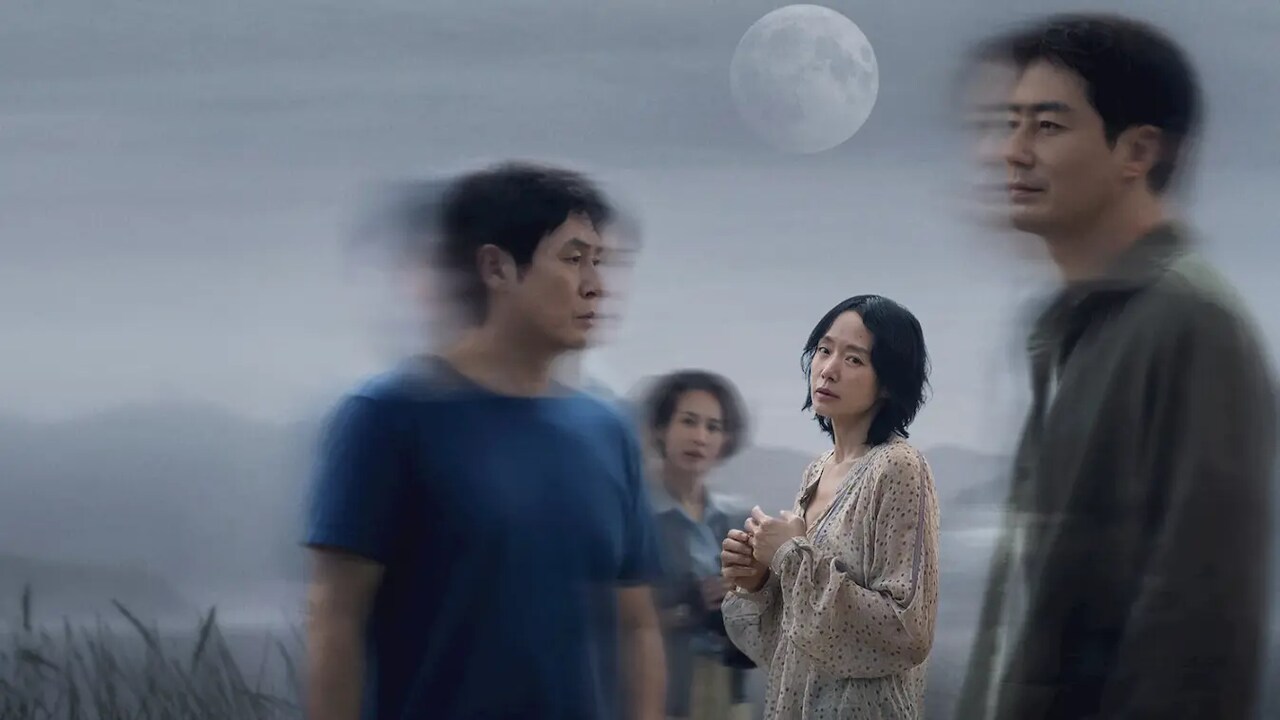
People rarely understand how much of their lives has been shaped by circumstances they never chose. Financial security can create an entirely different understanding of what other people struggle with. Even affection can become complicated when one person has the means to offer help, and the other has little choice but to accept it. Lee Chang-dong's Possible Love is interested in these imbalances, and in the damage that accumulates when people mistake their own understanding of the world for someone else's reality. It is a demanding, frequently uncomfortable drama, but one that rewards patience.
The film follows two married couples living markedly different lives. Mi-ok (Jeon Do-yeon) lives with her husband Ho-seok (Sul Kyung-gu), a laid-off factory worker struggling with depression, and their young son. Their financial and emotional difficulties have gradually altered the atmosphere of their household. Mi-ok remains hopeful, trying to find ways to help her husband recover. Her circumstances bring her into contact with Ye-ji (Cho Yeo-jeong), a documentary filmmaker interested in the lives of workers affected by unemployment. Ye-ji lives comfortably with her wealthy husband, Sang-woo (Zo In-sung). When Mi-ok agrees to participate in the documentary, the two couples begin spending time together, and the differences between their lives become increasingly difficult to ignore.
The documentary premise gives the film an especially interesting direction. Ye-ji approaches Mi-ok's family with the apparent intention of understanding their struggles, but the relationship between filmmaker and subject is never entirely equal. One woman has the resources to observe, interpret, and eventually turn another family's hardship into a film. The other is hoping that being seen might somehow improve her husband's situation. Their interactions raise an uncomfortable question: when does genuine empathy become an instrument for obtaining access to someone else's pain?
Mi-ok's willingness to participate in the documentary comes from a place of desperation as much as openness. She wants Ho-seok to receive the help he needs, and Ye-ji's attention offers the possibility that someone might finally recognise what her family is going through. Yet the filmmaker's presence also introduces a complicated dynamic. A documentary requires a subject, and a subject's suffering can become material. The person holding the camera retains a degree of control over what is recorded, what is omitted, and how another person's life is presented.
Lee Chang-dong does not reduce this relationship to a simple accusation of exploitation. Ye-ji is not merely a manipulative outsider, and Mi-ok is not simply an innocent victim. Their connection contains genuine warmth, but that warmth exists alongside unequal circumstances and competing interests. This ambiguity makes their relationship considerably more compelling than a straightforward story about wealthy people failing to understand the working class.
Class is central to the film, although it rarely announces itself through speeches. The two couples inhabit different realities, and their interactions reveal how easily privilege can disguise itself as generosity. Sang-woo's wealth and apparent kindness make him an object of fascination for Mi-ok, who sees in him a version of life far removed from the one she knows. His relationship with Ye-ji also appears markedly different from the strained marriage she has at home. Yet the film is careful about appearances. Comfort does not necessarily indicate emotional maturity, just as financial hardship does not automatically make someone morally superior.
The contrasting portrayals of Ho-seok and Sang-woo are particularly revealing. Ho-seok's identity has been deeply affected by losing his job. His sense of responsibility towards his family, once a source of pride, has become entangled with humiliation and helplessness. Sang-woo, by contrast, appears gentle, attentive and secure. He represents a different model of masculinity, one that seems less burdened by traditional expectations. But Lee gradually complicates this distinction. The film is interested in what people conceal beneath socially acceptable behaviour, and its treatment of masculinity refuses to offer easy reassurance.
The performances are essential to making these contradictions believable. Jeon Do-yeon gives Mi-ok an affecting mixture of optimism, vulnerability and longing. She understands that her character's hope is not necessarily evidence of naivety; sometimes it is simply what allows someone to continue living with circumstances they cannot change. Sul Kyung-gu is equally compelling as Ho-seok. His portrayal captures the psychological consequences of unemployment without turning the character into a symbol of economic hardship. There is a wounded sense of identity beneath his behaviour, and the performance gives that internal struggle considerable weight.
Cho Yeo-jeong brings an intriguing mixture of warmth and ambiguity to Ye-ji, while Zo In-sung plays Sang-woo with a restraint that gradually becomes more unsettling. The four performances work because none of the characters can be understood entirely through their public behaviour. Their relationships are full of contradictions, and the actors allow those contradictions to remain visible.
The film's greatest challenge is its pace. At 164 minutes, Possible Love asks for a substantial investment from its audience. Lee is not interested in rushing towards dramatic revelations. Conversations, silences and seemingly ordinary interactions are allowed to linger, sometimes long after their immediate purpose has become clear. This approach gives the characters room to develop, but it can also make the film feel repetitive. Viewers expecting a tightly structured domestic drama may find its deliberate rhythm frustrating.
There is also a certain emotional distance to the filmmaking. The subject matter is deeply personal, yet Lee resists turning every difficult moment into an invitation for sympathy. He observes his characters with considerable attention, allowing their choices to remain uncomfortable even when their circumstances are understandable. That restraint is one of the film's strengths, although it occasionally comes at the expense of momentum.
What makes Possible Love worth the commitment is the way its different strands eventually speak to one another. Marriage, labour, class and the ethics of storytelling are not separate concerns here. They influence how people love, how they judge one another and how they respond when their own lives become difficult to recognise. The title itself carries an uncertainty that suits the film. Love may be possible, but the ability to recognise another person's needs is considerably harder to establish.
Lee Chang-dong's return is a serious, accomplished work that refuses to make its characters convenient or its themes comfortable. It is occasionally overlong, and its measured approach will not appeal to everyone. But the performances, moral complexity, and sustained attention to ordinary human contradictions make it a rewarding experience. Possible Love understands that people can hurt one another without always intending to, and that good intentions are rarely enough to overcome the inequalities shaping their lives.
Final Score- [8.5/10]
Reviewed by - Anjali Sharma
Follow @AnjaliS54769166 on Twitter
Publisher at Midgard Times



Hi Everyone, after a due consideration, we have decided that we will be open for donations to help us in managing our website. We will be greatful for any kind of amount we receive. Thanks!
— Midgard Times 🎬 (@Moviesr_net) January 4, 2026
PayPal- [email protected] pic.twitter.com/DlNNz5Npm5
Get all latest content delivered to your email a few times a month.
Bringing Pop Culture News from Every Realm, Get All the Latest Movie, TV News, Reviews & Trailers
Got Any questions? Drop an email to [email protected]


 © Copyrights MOVIESR.NET All rights reserved