


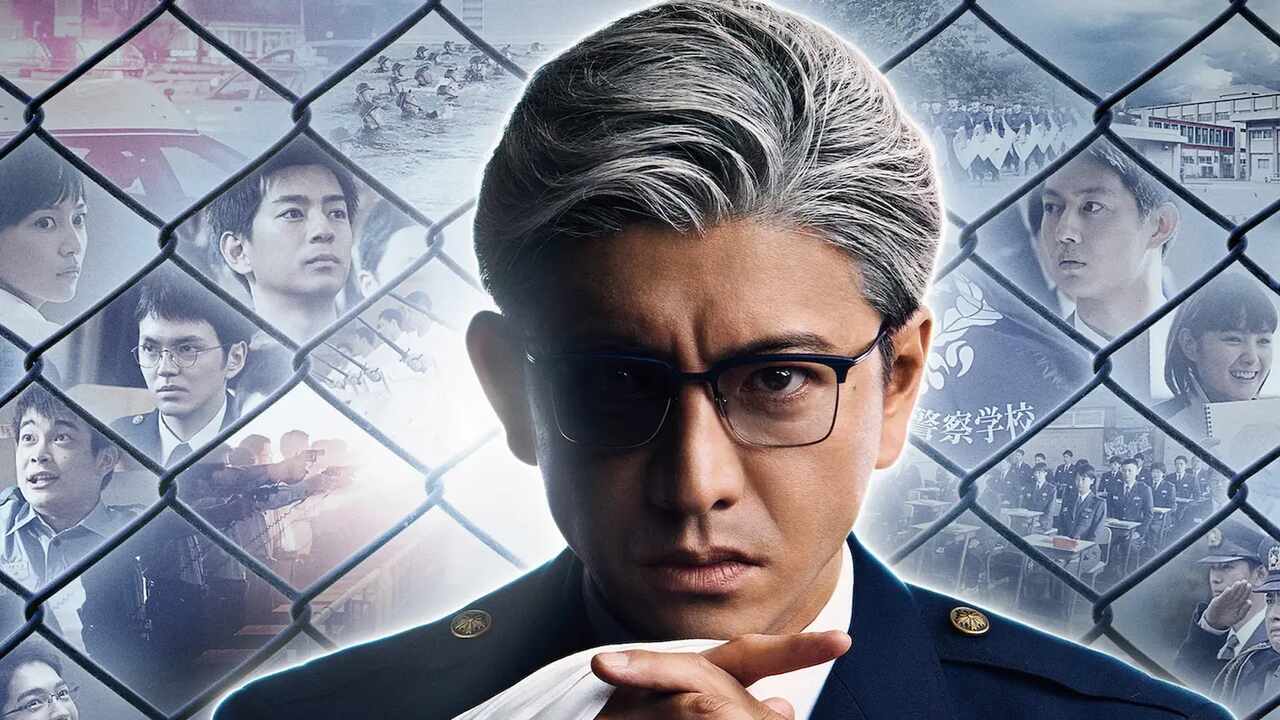
Jumping into Season 3 of Kyojo on Netflix felt like stepping back into a world I both knew and wanted to see expanded. This installment brings back Takuya Kimura’s Kazama Kimichika, a character whose presence alone defines much of what makes this franchise compelling. Over the course of about seventy minutes, we’re reintroduced to the rigorous world of the 205th police academy class and reminded why this drama has maintained such a devoted following. From the moment the episode opens, it’s clear the show hasn’t lost sight of its core identity: raw training sequences, psychological tension between instructor and cadet, and the careful unveiling of each character’s backstory and inner motivation.
Kazama remains the center of gravity here. His sharp observation skills and unyielding standards are as intense as ever, and Kimura’s performance anchors the entire episode with astonishing control and subtlety. He’s quiet in a way that screams; his restraint is his force. Watching him dismantle a cadet’s façade with just a glance or half-sentence is still one of the show’s greatest pleasures. At the same time, Season 3 pushes us to empathize more with Kazama’s own psyche. We get just enough insight into his internal conflicts to complicate our admiration, which adds layers to a character that, up until recently, could have felt impossibly stoic.
The new cadets are the lifeblood of this season. Their varied personalities and reasons for joining the academy create a rich tapestry of ambition, fear, hope, and insecurity. Some stand out more than others — Hazuki Hishinuma and Yota Tsuzuki, for example, show significant depth as they wrestle with Kazama’s harsh methods and their own ideals of justice. The show doesn’t shy away from its missteps or insecurities, and it’s refreshing to see characters who react to pressure in realistically flawed ways rather than instantly morph into exemplars of resolve.
The writing, overall, is sharp. Dialogue is measured and often economical, with exposition delivered through performance rather than heavy speech. The pacing of the episode works, too: intense sequences alternate with quieter moments that let you breathe and really observe the emotional landscape of each character. There’s a definite rhythm to the way information is revealed and relationships develop, and it feels intentional rather than rushed. For anyone invested in character-driven storytelling and slow-burn narratives, this pace is satisfying.
Visually, Season 3 lives up to what the franchise has shown before. The cinematography captures the claustrophobic environment of the academy — narrow hallways, echoing classrooms, and stark outdoor spaces that emphasize isolation as much as discipline. Lighting and composition often reflect the emotional stakes on screen, with shadowed faces and tight framing reinforcing the psychological intensity of Kazama’s tests. Small visual details — the way a uniform hangs, the angle of a camera during a confrontation — underscore just how carefully crafted this world is.
The direction keeps the episode grounded even when the stakes feel high. Action isn’t overblown, and when physical confrontations or drills occur, they feel impactful without slipping into melodrama. The episode’s structure allows each subplot its moment while still feeling cohesive as a whole. Credit should go to the creative team for balancing so many elements without letting any single thread dominate or overwhelm.
That said, the episode isn’t without its imperfections. A few secondary characters feel underdeveloped, which is understandable given the limited runtime, but still noticeable. There’s a sense that some of them are there to be obstacles or foils rather than fully realized individuals with their own arcs. A couple of emotional beats don’t land as powerfully as they should simply because we haven’t spent enough time with certain cadets to invest in their journeys. It’s a minor hiccup in an otherwise solid narrative, but there are moments when the story’s ambition slightly outstrips the time it gives itself to tell that story.
Another area that felt uneven was the tonal shift at times. Kyojo has always balanced psychological drama with procedural elements, but in this season’s opener, a few scenes felt abrupt as the transition between introspection and plot-driven beats. It didn’t derail the episode for me, but it might pull some viewers out of the emotional flow if they’re particularly sensitive to shifts in pacing or tone.
Still, what Season 3 does exceptionally well is its treatment of thematic complexity. This episode isn’t just about cadets getting yelled at or pushed to their limits. It probes deeper into ideas about why people choose to serve, how trauma shapes our choices, and what it means to endure hardship without losing one’s humanity. The show trusts its audience enough to let the emotional ramifications of its scenes settle rather than spinning every conflict into a climactic event. That restraint is one of the reasons Kyojo stands out in the crowded field of police dramas.
Performances beyond Kimura’s are strong, too. Haruna Kawaguchi brings nuance to Hazuki’s struggles, making her a compelling emotional core during key moments. Ryosuke Mikata and Shohei Miura each carve out memorable turns, and the ensemble feels solid enough that even the smaller roles contribute to the world’s texture.
In the end, Kyojo Season 3 doesn’t just retread familiar ground; it refreshes and reinvigorates it. There’s an exciting momentum that makes me want to see how the rest of the story unfolds, and the balance between character work and thematic reflection is impressively mature. It’s not flawless; a few rough edges around supporting cast development and tonal shifts stop it from being absolutely pristine. But those concerns are relatively minor compared to the strengths on display.
For longtime fans and newcomers alike, this season’s opening episode is worth your attention. It’s thoughtful, well-crafted, and propelled by a leading performance that remains one of the most compelling in contemporary drama. Kyojo Season 3 reminds us why this story has endured and why Kazama Kimichika remains a figure worth watching.
Final Score- [7/10]
Reviewed by - Anjali Sharma
Follow @AnjaliS54769166 on Twitter
Publisher at Midgard Times


Hi Everyone, after a due consideration, we have decided that we will be open for donations to help us in managing our website. We will be greatful for any kind of amount we receive. Thanks!
— Midgard Times 🎬 (@Moviesr_net) January 4, 2026
PayPal- [email protected] pic.twitter.com/DlNNz5Npm5
Get all latest content delivered to your email a few times a month.
Bringing Pop Culture News from Every Realm, Get All the Latest Movie, TV News, Reviews & Trailers
Got Any questions? Drop an email to [email protected]



 © Copyrights MOVIESR.NET All rights reserved