


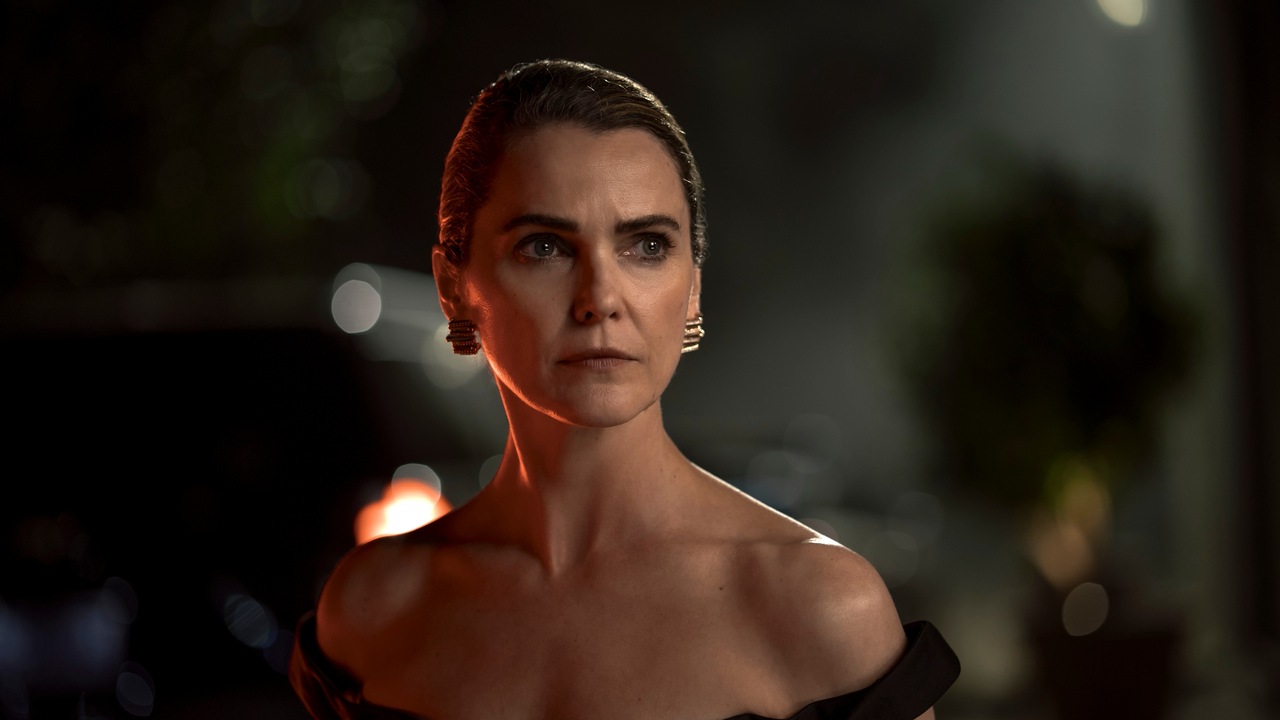
It didn't take long for me to feel welcomed by the fourth season of The Diplomat. I have always enjoyed the sharpness, wit, fluidity, and professional polish with which the actors on the screen deliver their lines. One scene from the show that has been permanently etched into my brain involves Kate (Keri Russell) and her husband, Hal (Rufus Sewell), arguing about, well, something, only to pause their argument so that she can pee and he can brush his teeth. Unsurprisingly, then, the scene from Season 4 that made me feel welcome involves Kate and Hal in verbal conflict. Near the beginning of Episode 1, we find the couple heatedly debating America's secret acquisition of Poseidon, a nuclear weapon, from a Russian submarine submerged in British territorial waters. In the middle of their argument, a splinter gets stuck in Kate's finger, and Hal removes it with his teeth. This is what's so appealing about the series: it changes the tone or breaks the rhythm of a moment through sudden gestures, incidents, or lines. The Diplomat is a dialogue-driven political thriller, and its dialogue not only moves the story forward through fast-paced exposition but also reveals or reaffirms particular traits and qualities of the characters on screen.
In the case of Kate and Hal, for instance, what comes through is the idea that no matter how angry or irritated they might be with each other, they love one another so passionately that they can set aside their tempers and differences to support each other in moments of need. Sure, Kate and Hal have sometimes talked about separating, and she, in particular, has found herself attracted to other men she meets while performing her professional duties, prompting Hal to display unmistakable signs of seething jealousy. Yet the two eventually fall into each other's arms, as if the universe itself is cheering for them and their love story. This is why I wasn't exactly holding my breath when Hal and Kate once again found themselves embroiled in a stressful conflict later in Season 4, when he chose to prioritize his career, along with his "candor" and "friendship" with Grace Hagen Penn (Allison Janney), the President of the United States, over his relationship with his wife. All I did was wait for him to change course and return to Kate's side. This marriage has become rather predictable to me. Have I evolved into the third wheel in their relationship, someone who has spent so much time hanging out with and observing this couple that he knows everything about them?
If being a third wheel here means being in Keri Russell's company, I think that's fine. I have always found her very charming. In particular, I like how her face lights up like a megawatt bulb when she smiles. Russell also brings subtle comic shades to her performance, evident in scenes such as the one where Hal is on a video call with Grace and Kate, sitting on the floor away from the screen, feeds him key phrases such as "No Alt" (Alt means "alternative"). Now that's a supportive couple, right? Then again, one of the things this fourth season is concerned with is couples—their personal issues, private lives, and intimacy. If Kate and Hal are hot and cold, intense and volatile, Grace and Todd (Bradley Whitford) are simply cold and distant, with few overlapping interests or hobbies. Todd can't even talk to Grace about her work because he knows nothing about it. Grace has a friendlier relationship with Hal, which makes Todd envious of him. Then we have Eidra Park (Ali Ahn) and Stuart Hayford (Ato Essandoh), who start dating and decide to move in together. As they gradually get to know each other's routines and habits, they discuss what bothers them about each other and what they must do to sustain their relationship. They have their own share of arguments and conflicts, but both of them, especially Stuart, seem hellbent on making their relationship work. All these couples fight, talk, make out, and try to understand each other better, which is why an alternative title for the show could have been Couples Therapy.
But thanks to the politicians and their politics, the show's focus is constantly redirected towards diplomats and other government figures. This time, the story introduces geopolitical tensions through an American president who doesn't mind flexing her political muscle to make others bend to her will and whims. Season 4, in other words, tries to imitate reality, but in doing so, unfortunately loses some of its bite. If a bullet grazed Donald Trump, a bullet hits Grace in the series. This becomes the starting point of her drastic transformation, as she begins to behave in an almost Trump-like style. Grace stops listening to sensible advice, acts like a bully, punishes her critics, and pulls off baffling stunts, such as announcing her aggressive plans concerning Russia in front of other world leaders during a G7 meeting. The apparent jibe at a real-life politician isn't the problem here. The problem is that The Diplomat doesn't adequately explain this drastic shift in Grace's demeanor. Everyone agrees that there was one version of Grace before she was shot at Windsor Castle and another after the shooting. But what exactly accounts for this change? Does her wounded ego tell her, "How could anyone shoot me so brazenly? Am I so weak?" Does she fear that her physical wounds might be interpreted as signs of inner weakness by both her allies and her enemies, prompting her to work extra hard to project an image of toughness? Or does Grace simply resent having to bow before a newcomer, Bethan Vaughn (Jodie Whittaker), who has become prime minister only recently?
The series offers no concrete explanation. It seems more preoccupied with remaining relevant to the times. This is a peculiar flaw in a series so dependent on its characters constantly interacting with one another. Why not give Grace the chance to articulate what's going on inside her head and what's making her so combative? The Diplomat also has a problem with its tone: there is very little tonal variety. The story touches on the melodramatic aspects of its characters' lives and their emotional worlds. Yet, across its eight episodes, the dominant sensation is one of mounting tension, as though the show is perpetually trying to get your heart racing. Consequently, when Eidra and Stuart discuss complications in their relationship or Todd struggles to connect with his wife, the show comes across as aloof and frigid. The pace is so relentless that even the romance feels tinged with the mood of a thriller. Emotional conversations, too, begin to resemble expository passages to be digested for the sake of the plot rather than intimate exchanges that reveal romance or vulnerability within the characters and their relationships. The Diplomat is blessed with sharp dialogue and a talented cast that delivers it with sincerity and feeling, but the show synchronizes everything into a single momentum and tone, robbing these exchanges of their distinctive emotional qualities.
On the bright side, creator Debora Cahn attempts to steer the series away from the banality of "you go, girl" and other female-empowerment slogans by suggesting that women occupying positions of political power doesn't inherently mean everything will be better, brighter, all right. When Bethan wins the election, everyone heaves a sigh of relief because she is a leftist. But there is another reason for celebration, one hinted at more subtly: a woman has defeated a man to claim the office. Kate even tells Bethan that she finds her victory inspiring. Cahn, however, eventually dampens the fanfare by suggesting that it isn't a politician's gender but their intelligence that should make them worthy of admiration. A woman can be as cruel and tyrannical as a man; what we need are intelligent individuals who can run a country with compassion, sound judgement, and acuity. I will drink to that anytime.
Cahn also offers another thought before drawing the curtain on this season: a bad leader is, after all, just one bad person making terrible decisions according to their own warped logic. The others don't necessarily have to follow them; they can undermine such a leader's influence simply by withdrawing their backing. We all have free will. Go on, make your own morally sound choices instead of sticking with an idiot for the sake of the power and privileges you gain by supporting their authority. It's a great reminder, and I'll drink to that anytime, too. Hangover be damned. I'll cure it simply by thinking about Keri Russell's lovely smile.
Final Score - [7/10]
Reviewed by - Vikas Yadav
Follow @vikasonorous on Twitter
Publisher at Midgard Times
Hi Everyone, after a due consideration, we have decided that we will be open for donations to help us in managing our website. We will be greatful for any kind of amount we receive. Thanks!
— Midgard Times 🎬 (@Moviesr_net) January 4, 2026
PayPal- [email protected] pic.twitter.com/DlNNz5Npm5
Get all latest content delivered to your email a few times a month.
Bringing Pop Culture News from Every Realm, Get All the Latest Movie, TV News, Reviews & Trailers
Got Any questions? Drop an email to [email protected]

 © Copyrights MOVIESR.NET All rights reserved