


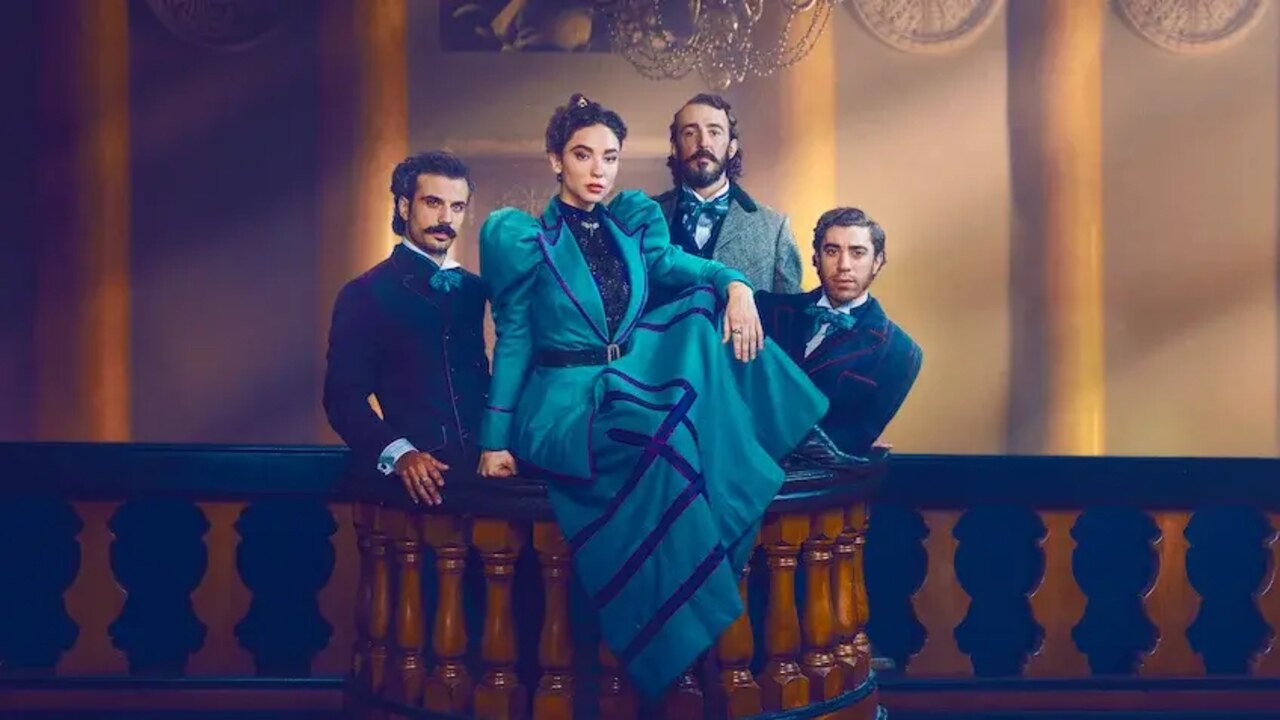
The third and final season of The Law According to Lidia Poët opens with what could have been the most promising and intriguing case the titular lawyer has handled in the series. This is how things could have unfolded if creators Guido Iuculano and Davide Orsini had made an effort to break the show's formulaic monotony. The case in question deals with the death of a trapeze artist, and what might have made it riveting was a simple decision: to have Lidia (Matilda De Angelis) take up the challenge of proving that the performer meant to catch the trapeze artist but let her fall intentionally. That would have been a difficult task—one that could have severely tested Lidia's professional capabilities.
It brings me no pleasure to say that Lidia Poët displays no inclination to be imaginative. By introducing a supposedly jealous lover and a syringe, the case is made to resemble others in the series. The problem is that Lidia's investigations look the same every time: she confronts potential suspects, follows leads, bickers with her brother Enrico (Pier Luigi Pasino), stumbles upon a crucial object, word, or piece of information before the episode's end, considers it with a face that shouts, "Voilà, I got it!," lays out all the facts before the culprit, and sometimes we see the innocent victim exiting prison and hugging loved ones tightly with a happy smile. The beats have now turned extremely predictable—the series might as well be sleepwalking. As a result, the investigative portions resemble table reads. What's always in the foreground is the actors' lines. There is neither an atmosphere of suspense nor mystery—no tension, no sense of urgency—and yet Lidia Poët insists that the lead character has little time.
Lidia, in Season 3, is under pressure to prove her best friend, Grazia (Liliana Bottone), not guilty. She is arrested for murdering her abusive husband, and while she admits that she stabbed him, she also asserts that she was acting in self-defense. Had Grazia not taken this drastic step, she might have been killed. Certainly, the court and the public would have shown considerable leniency if the husband had been found guilty. At the very worst, the husband might have escaped with a six- or seven-year prison sentence. But since it is Grazia, a woman, on trial, the newspapers assassinate her character, and men everywhere jeer at her, shame her, and demand that she be hanged, as anything less would be considered, by them, a grave injustice.
In theory, the idea of ending the show by dramatizing a woman's trial—a trial that lies at the center of Season 3—sounds interesting. The real Lidia was officially recognized as a lawyer in 1920 at the age of 65. This season, though, is set in 1887, and it uses Grazia's case to gesture toward the future—not just of Lidia, but of women in general. It is disappointing, then, that the series does not fully trust its own creative choice. At one point, it awkwardly jumps forward in time in a dreamlike sequence. Nonetheless, Grazia's case is more compelling than anything else in the series because of what it reveals about the struggles and prejudices women faced and how much they had to fight to overcome them. Enrico's closing arguments, written by Lidia, are, on their own terms, quite moving. Even if the case works more in theory than in execution—it does not have much narrative weight—its underlying message is sufficiently effective.
Yet, taken as a whole, Lidia Poët can feel bland and repetitive. Its biggest failing is that it cannot imagine Lidia beyond the dictates of the plot, beyond the confines of the script. It is true that she dedicated her life to fighting for women's rights, but what did she think of the politics, the art, the scientific advancements of her time? A brief look at 1887 in Italy reveals that Francesco Crispi took office and brought a more aggressive approach to foreign and domestic policy. The Battle of Dogali took place on January 26, when Ethiopian forces under Ras Alula Engida ambushed and nearly annihilated Italian troops, marking a significant early defeat for Italy. The 1887 Liguria earthquake, with a magnitude of 6.8-6.9, resulted in 600–3,000 deaths and generated a two-meter tsunami. Meanwhile, Emil Berliner patented the gramophone, and Heinrich Hertz discovered electromagnetic waves—a major achievement in the field of science and technology.
Was Lidia unaware of these developments? The series could have used its creative license to imagine a Lidia who was aware of and engaged with the world around her. She must have had strong views, and the show could at least have allowed her to express them on science, art, theater, and politics. That would have made the character feel alive, alert, and intellectually rich. That version of Lidia Poët would have been far more compelling than this Netflix adaptation, which, apart from being a crime drama, is also a love story. The only good thing that emerges from it is the scene where a woman calls out to her partner with her singing skills.
De Angelis is a fine actor, and whenever I see her, the word "charming" comes to mind. She has an almost movie-star presence that makes even the weakest material watchable. In Citadel: Diana, she was the sole highlight. She is clearly capable of challenging herself as a performer and deserves better roles and better shows/movies. In Lidia Poët, she does find a potentially great character. It is just that the series does not do full justice to either the real-life figure or the wonderful De Angelis.
Final Score- [4.5/10]
Reviewed by - Vikas Yadav
Follow @vikasonorous on Twitter
Publisher at Midgard Times



Hi Everyone, after a due consideration, we have decided that we will be open for donations to help us in managing our website. We will be greatful for any kind of amount we receive. Thanks!
— Midgard Times 🎬 (@Moviesr_net) January 4, 2026
PayPal- [email protected] pic.twitter.com/DlNNz5Npm5
Get all latest content delivered to your email a few times a month.
Bringing Pop Culture News from Every Realm, Get All the Latest Movie, TV News, Reviews & Trailers
Got Any questions? Drop an email to [email protected]



 © Copyrights MOVIESR.NET All rights reserved