


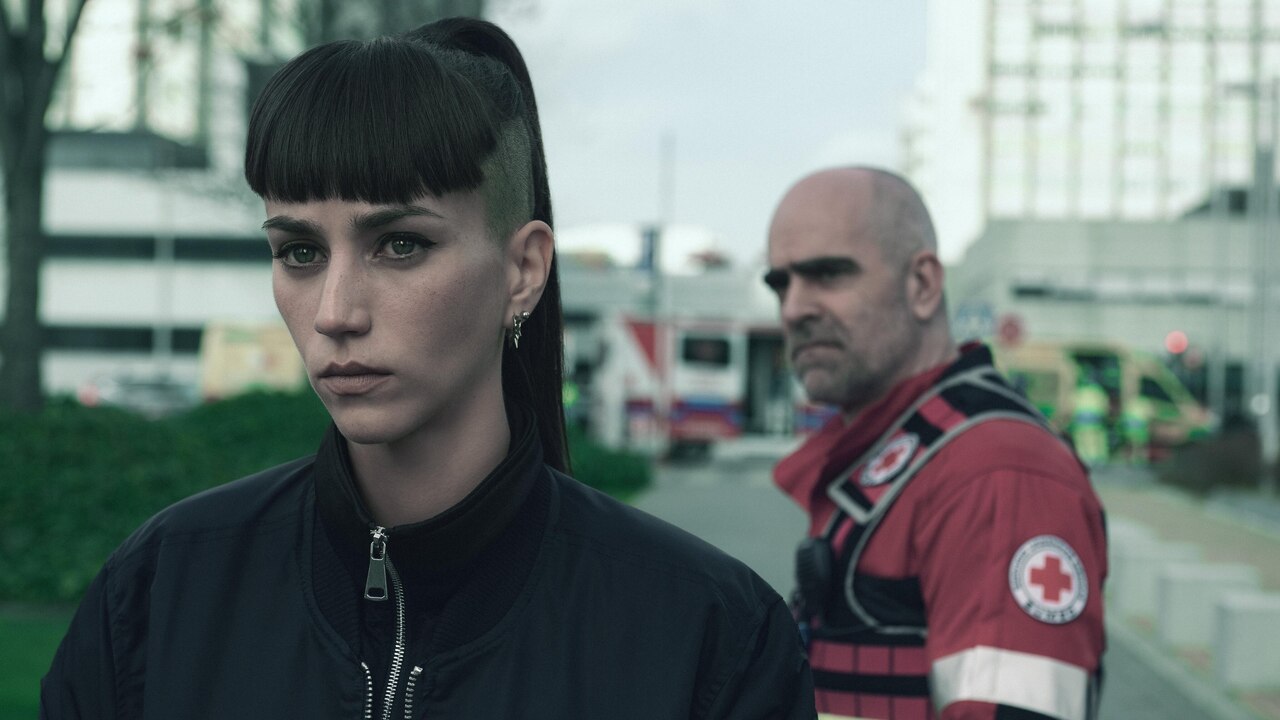
The new Netflix action drama "Salvador" opens with familiar images. We see a neo-Nazi group, White Souls, terrorizing, abusing, and assaulting Arab immigrants. Replace this conflict with Black vs. White in America, Hindu vs. Muslim in India, or any other X vs. Y as per your region, and you will recognize the show's intentions. Fret not: "Salvador" isn't interested in scoring easy points by claiming that every far-right individual is completely, irredeemably an asshole. Yes, many members of White Souls are reproached through their ugly actions, but the series also offers a warm, beating heart to some of them.
The first episode plunges you directly into utter chaos and violence to show the repulsive consequences of fanaticism. After that, the series slowly zooms in to reveal the inner workings of a neo-Nazi group—how they operate, where they get their funds from, and why the members are able to evade the justice system (spoiler alert: some of them are part of the justice system).
What's more, through characters like Julia (Claudia Salas) and Carla (Leonor Watling), we learn that not everyone in these groups has a heart of stone. Julia might worship Adolf Hitler to the point that she has an "18" tattoo (1=A and 8=H). However, nothing beats the love she has for her daughter, who lives in a child-care home. It is this love that makes her accept an offer to become a mole; it is this love that makes her realize the consequences of the group's hateful actions.
Carla, on the other hand, is like a mother figure—or, at least, that's how she sees herself within White Souls. She even considers Milena (Candela Arestegui) to be her daughter. Who's Milena? The titular character's (Luis Tosar) daughter. Milena's mother is dead, and she hates Salvador. Why? Because he was never there for her. Salvador, in the past, was an alcoholic, which meant he spent more time in bars than with his daughter. Because of this negligence, Milena was once raped by a man—someone Salvador would have saved as an ambulance driver (he doesn't care about left- or right-wing politics when it comes to treating patients).
Did you notice a pattern in the paragraph above? There is a separation between biological parents and children. Julia does not live with her daughter, Milena's mother is dead, and Salvador is unable to reconnect with his daughter. Hence, Salvador finds a daughter in Julia, and Carla finds a daughter in Milena. Extend the logic further, and you can say that, in the absence of her parents, Milena discovers a family among the members of White Souls.
In fact, most Spaniards join this fascist group because they find support and comfort there. White Souls provides its people with food and shelter—it functions like a charity organization for lost Spaniards. No wonder Salvador, too, comes close to joining them, driven by grief, frustration, and a sense of loneliness. "Salvador," through this ambulance driver, makes you understand why people end up joining such organizations. Everybody wants to feel as if they belong, and groups like White Souls are experts at making one feel at home.
This is why the solution to eradicate hate and fascism, the show suggests, is to have a family that eats together, sleeps together, and stays together. A dysfunctional family causes its children to seek companionship elsewhere, leaving them vulnerable to groups like the White Souls. Some of these kids can also grow up to become criminals, robbers, or incels. The lesson, basically, is that we could use more kindness. It's an urgent message—one that needs to be realized as soon as possible if we want to stop the world from heading toward total disaster.
Intentions, though, are one thing. How is "Salvador" in terms of filmmaking? It exists somewhere between a typical Netflix offering and something slightly different. There are not many flashbacks here; details—whether related to character history or plot—are delivered through dialogue. "Salvador" chooses to remain firmly in the present, yet it fails to generate great drama or suspense.
Take Salvador, for instance. When he confronts his daughter in Episode 1, she quickly and angrily accuses him of being a bad father while simultaneously dispensing their entire shared history. The series then doesn't bother expanding on these details through flashbacks or reminiscences. It's as if it props its characters up with ready-made traits—crutches designed solely to move the story toward its destination.
What this means is that Salvador is nothing more than a grieving father seeking revenge. His likes, dislikes, and lived experiences are filtered out for the script's convenience. Toni (Guillermo Lasheras), Salvador's colleague, is revealed to be a drug addict, but it's never mentioned what led him down this path. Is he a long-time addict or a recent convert? Is this addiction related to familial problems? Most characters, after all, suffer from familial issues, including another colleague, Marjane (Fariba Sheikhan), who is frustrated with her mother.
Is this the general frustration kids feel toward overbearing parents, or is there a deeper story here? Marjane's mother looks... normal. Nothing indicates why Marjane would find her an inconvenience. The blame is placed on her methods of contacting her daughter, but this happens only once, just so a character can be offered a safe place with Marjane's parents.
"Salvador," in the end, is the kind of show that makes you nod your head in agreement. You respond to bullet points—fascists are also humans; right-wing groups are bad; good guys will never truly win as long as evil exists—not events. Still, there is no denying the satisfaction one feels when members of White Souls are arrested during the climax. The victory is temporary, as the devil continues to ascend the justice ladder, but an optimist might say, "Hey, it's possible to put a hole in the enemy's armor. Shoot enough holes, and the enemy might sink in the end."
During such bleak times, that's not a bad thought to hold on to. It's good enough to help you get out of bed every day.
Final Score- [6/10]
Reviewed by - Vikas Yadav
Follow @vikasonorous on Twitter
Publisher at Midgard Times



Hi Everyone, after a due consideration, we have decided that we will be open for donations to help us in managing our website. We will be greatful for any kind of amount we receive. Thanks!
— Midgard Times 🎬 (@Moviesr_net) January 4, 2026
PayPal- [email protected] pic.twitter.com/DlNNz5Npm5
Get all latest content delivered to your email a few times a month.
Bringing Pop Culture News from Every Realm, Get All the Latest Movie, TV News, Reviews & Trailers
Got Any questions? Drop an email to [email protected]

 © Copyrights MOVIESR.NET All rights reserved