


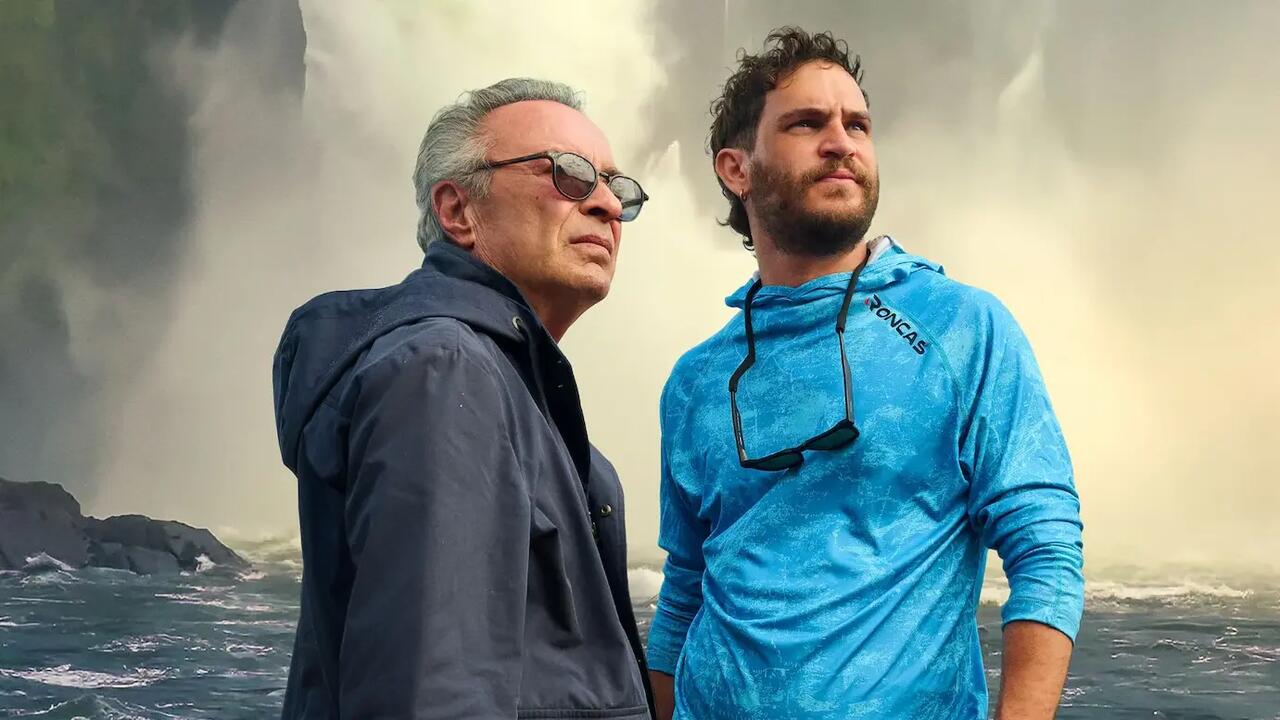
I went into The Giant Falls expecting a fairly standard father-son reconciliation drama, and for the most part, that’s what it is on paper. But what surprised me is how committed the film is to sitting inside uncomfortable emotional spaces rather than rushing toward easy resolution. It’s not a loud film, and it doesn’t try to impress through plot twists or spectacle. Instead, it leans heavily on performance, tone, and long, sometimes awkward conversations that feel closer to real life than most scripted dramas are willing to risk.
At the center is Boris, a tour guide who initially comes across as charming, slightly performative, and emotionally guarded. His profession is not incidental; the film uses his job cleverly as a subtle metaphor for how he navigates life. He knows how to present stories, control narratives, and keep things moving, but struggles when things stop and become personal. When Julián, his long-absent father, resurfaces, that controlled rhythm breaks. The film builds its core tension not from what happened in the past, but from how little is said about it at first. There’s a restraint in the writing that I genuinely appreciated.
Oscar Martínez as Julián brings a grounded, almost disarming presence. He doesn’t play the character as overtly remorseful or defensive. Instead, he exists in a kind of ambiguous emotional space, which makes every interaction feel slightly unpredictable. You’re never entirely sure whether he deserves sympathy, and the film doesn’t push you in either direction. That ambiguity becomes one of the film’s strongest assets.
Matías Mayer’s Boris, on the other hand, carries the emotional weight of the story. His performance is detailed without being showy. There are small shifts in body language and tone that signal his internal conflict, moments where he wants to connect but instinctively pulls back. Some of the best scenes are the quietest ones: a car ride that stretches a little too long, a conversation that circles the real issue without addressing it directly, a pause that says more than any line of dialogue.
The pacing is deliberately measured. At times, it almost feels like the film is daring you to lose patience, especially in the first half, where the emotional payoff is intentionally delayed. I found myself slightly restless early on, waiting for the story to reveal its core conflict more clearly. But in hindsight, that slow build is essential. When the emotional turning points finally arrive, they feel earned rather than manufactured.
Visually, the film keeps things simple but effective. There’s a noticeable emphasis on naturalistic settings—streets, interiors, and landscapes that feel lived-in rather than stylized. The cinematography doesn’t call attention to itself, but it consistently frames characters in ways that emphasize distance or proximity, depending on the emotional state of a scene. There’s a recurring use of physical space that mirrors the evolving dynamic between Boris and Julián.
Where the film really succeeds is in its dialogue. Conversations feel organic, occasionally messy, and sometimes frustrating in a very human way. People interrupt each other, avoid answering questions, or say things that don’t quite land. This gives the film a level of authenticity that elevates otherwise familiar material. The script prioritizes emotional truth over dramatic convenience.
That said, the film isn’t without its shortcomings. The most noticeable issue is that some of the supporting characters feel underdeveloped. They exist primarily to support Boris’s journey, and while that’s not unusual for this kind of story, it does make certain interactions feel one-sided. There are moments when I wanted the world around the central relationship to feel a bit more textured.
There’s also a slight inconsistency in how the film handles its emotional peaks. A few key scenes arrive with significant buildup but resolve a bit too quickly, as if the film is hesitant to fully lean into its own intensity. Given how patient the earlier sections are, I expected those moments to stretch a little further, to sit with the discomfort instead of easing out of it. Another minor issue is that the narrative occasionally leans on familiar beats. Estranged parent returns, reluctant child resists, gradual softening—it’s a structure we’ve seen before. What makes The Giant Falls stand out is not what happens, but how it happens. Still, there are times when the predictability of the arc slightly undercuts the emotional impact.
Despite these flaws, I found myself increasingly invested as the film progressed. By the final act, it becomes clear that the story isn’t really about reconciliation in the traditional sense. It’s more about acceptance, accepting what can’t be changed, what can’t be fully understood, and what can’t be neatly resolved. The ending reflects that philosophy. It doesn’t offer a grand emotional release or a definitive sense of closure. Instead, it lands on something quieter and more honest. What stayed with me after the credits rolled wasn’t a specific scene or line, but the overall tone of the film. It has a kind of emotional restraint that feels deliberate and thoughtful. It trusts the audience to sit with ambiguity, to interpret silences, and to draw their own conclusions about the characters’ choices.
In a streaming landscape filled with high-concept premises and fast-paced storytelling, The Giant Falls feels refreshingly grounded. It’s not trying to reinvent the genre, but it approaches familiar territory with enough care and nuance to make it worthwhile. The performances, particularly from Martínez and Mayer, carry the film through its slower moments and elevate the material beyond what it might have been in less capable hands. I wouldn’t call it a perfect film, and it occasionally tests your patience, but it rewards attention. If you’re willing to engage with its pace and sit with its emotional ambiguity, there’s a lot to appreciate here. It’s a quiet film, but not an empty one.
Final Score - [7/10]
Reviewed by - Anjali Sharma
Follow @AnjaliS54769166 on Twitter
Publisher at Midgard Times

Hi Everyone, after a due consideration, we have decided that we will be open for donations to help us in managing our website. We will be greatful for any kind of amount we receive. Thanks!
— Midgard Times 🎬 (@Moviesr_net) January 4, 2026
PayPal- [email protected] pic.twitter.com/DlNNz5Npm5
Get all latest content delivered to your email a few times a month.
Bringing Pop Culture News from Every Realm, Get All the Latest Movie, TV News, Reviews & Trailers
Got Any questions? Drop an email to [email protected]

 © Copyrights MOVIESR.NET All rights reserved