



I went into The Last Beergin expecting a casual, dialogue-heavy dramedy, and that’s exactly what I got, but in a way that felt more deliberate and emotionally observant than I anticipated. It’s one of those films that doesn’t rely on plot twists or spectacle; instead, it leans fully into conversation, character, and the slow, often awkward rhythm of people learning to trust each other. By the end, I felt like I had spent an entire evening sitting at that table with them, listening more than watching.
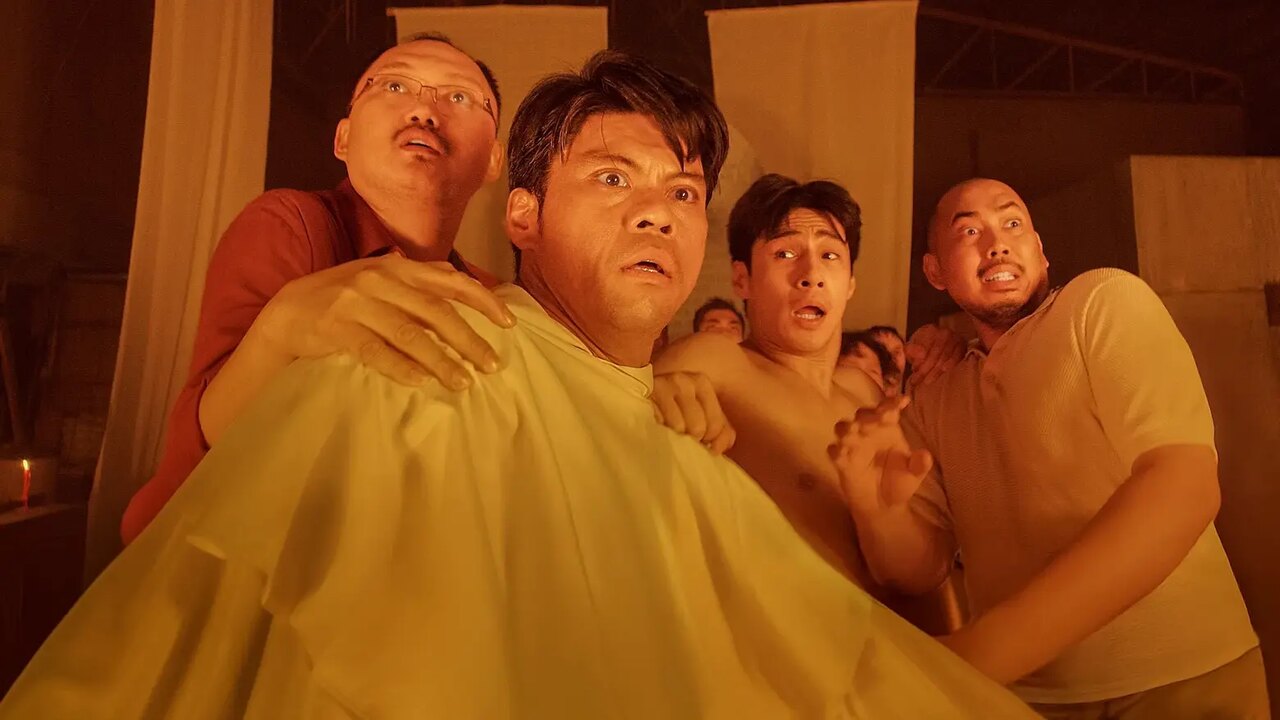
The premise is simple: five people from completely different walks of life—RG, Tere, Hilario, Sandy, and Isaac—cross paths and decide to share drinks. What begins as small talk gradually evolves into confessions. The structure mirrors an actual drinking session remarkably well. At first, everyone is guarded, sticking to surface-level conversation, occasionally joking to fill the silence. Then, almost without warning, someone says something slightly too honest, and that opens the door. From there, the film moves into deeper emotional territory, one character at a time.
What impressed me most was how naturally the writing handles this progression. There’s a clear understanding of conversational pacing. People interrupt, hesitate, deflect, and sometimes say the wrong thing. It feels messy in a very controlled way, which is difficult to pull off. The screenplay doesn’t rush emotional reveals; it allows them to emerge gradually, which makes the eventual breakdowns feel earned rather than engineered.
The characters themselves are well-defined without being overly stylized. RG is the most restrained, carrying a sense of internal conflict that unfolds subtly. Tere stands out as someone who has spent so long taking care of others that she has almost forgotten how to articulate her own needs. Hilario initially presents as loud and confident but reveals a more fragile emotional core as the night progresses. Sandy, on the surface, seems to have the least serious problems, yet the film treats her perspective with surprising empathy. Isaac, meanwhile, embodies a quiet longing that never turns melodramatic. What I appreciated is that the film avoids ranking their struggles. It doesn’t suggest that one character’s pain is more valid than another’s. Instead, it explores how different people experience and express distress, which gives the ensemble a balanced emotional weight.
Performance-wise, the cast carries the film entirely. There’s no hiding in a story like this; if the acting doesn’t work, nothing works. Fortunately, the performances feel grounded and consistent. The actors maintain a believable group dynamic, especially in moments where humor and vulnerability overlap. There are scenes where a joke lands, and almost immediately, the tone shifts into something more serious, and the transition feels smooth rather than jarring.
I also found the direction quite confident in its restraint. The film is mostly contained in a limited setting, yet it never feels visually stagnant. Subtle camera movements and framing choices help maintain engagement. Close-ups are used effectively during emotional peaks, but they’re not overused. The cinematography doesn’t try to draw attention to itself, which suits the tone of the film. That said, the film’s commitment to realism occasionally works against it. There are stretches where the pacing slows down noticeably, especially in the middle portion. While this mirrors real-life conversations, it can feel slightly repetitive. Some exchanges circle the same emotional beats before moving forward, and I did find myself wishing for a tighter edit in a few scenes.
Another limitation is that not all character arcs feel equally resolved. While the film does a good job of building each individual’s story, a couple of them reach conclusions that feel more implied than fully explored. This isn’t necessarily a flaw—ambiguity can be effective—but in contrast to the depth of earlier scenes, it leaves a slight sense of incompleteness. I also think the film occasionally leans a bit too heavily on familiar emotional setups. Themes like unfulfilled love, family pressure, and personal regret are handled sincerely, but they aren’t particularly new. What elevates them is the execution, not the originality of the ideas themselves.
Despite these minor issues, the emotional payoff is strong. The final stretch of the film brings together everything that has been building throughout the night. It doesn’t offer dramatic resolutions or life-changing decisions. Instead, it focuses on small shifts—moments of understanding, acceptance, or simply the relief of being heard. That restraint works in its favor. The film respects the idea that not every problem needs to be solved immediately.
What stayed with me most is how the film captures a very specific kind of intimacy: the kind that exists between strangers who, for a brief moment, become important to each other. There’s something honest about the way these characters open up precisely because they don’t expect to see each other again. It removes the usual social filters and allows for a different kind of honesty. Tonally, the balance between humor and seriousness is handled well. The comedic moments feel organic, often emerging from personality clashes or awkward situations rather than forced punchlines. At the same time, the film doesn’t shy away from heavier emotional beats. It allows both to coexist without undercutting each other.
In the end, The Last Beergin is not a film that tries to impress through complexity or scale. Its strength lies in observation—in how it listens to its characters and trusts the audience to do the same. While it occasionally lingers longer than necessary and doesn’t fully satisfy every narrative thread, it succeeds where it matters most: it feels genuine. I walked away from it feeling quietly reflective rather than overwhelmed, which feels exactly right for a story like this. It’s the kind of film that doesn’t demand attention but earns it gradually, one conversation at a time.
Final Score - [7/10]
Reviewed by - Anjali Sharma
Follow @AnjaliS54769166 on Twitter
Publisher at Midgard Times



Hi Everyone, after a due consideration, we have decided that we will be open for donations to help us in managing our website. We will be greatful for any kind of amount we receive. Thanks!
— Midgard Times 🎬 (@Moviesr_net) January 4, 2026
PayPal- [email protected] pic.twitter.com/DlNNz5Npm5
Get all latest content delivered to your email a few times a month.
Bringing Pop Culture News from Every Realm, Get All the Latest Movie, TV News, Reviews & Trailers
Got Any questions? Drop an email to [email protected]


 © Copyrights MOVIESR.NET All rights reserved