


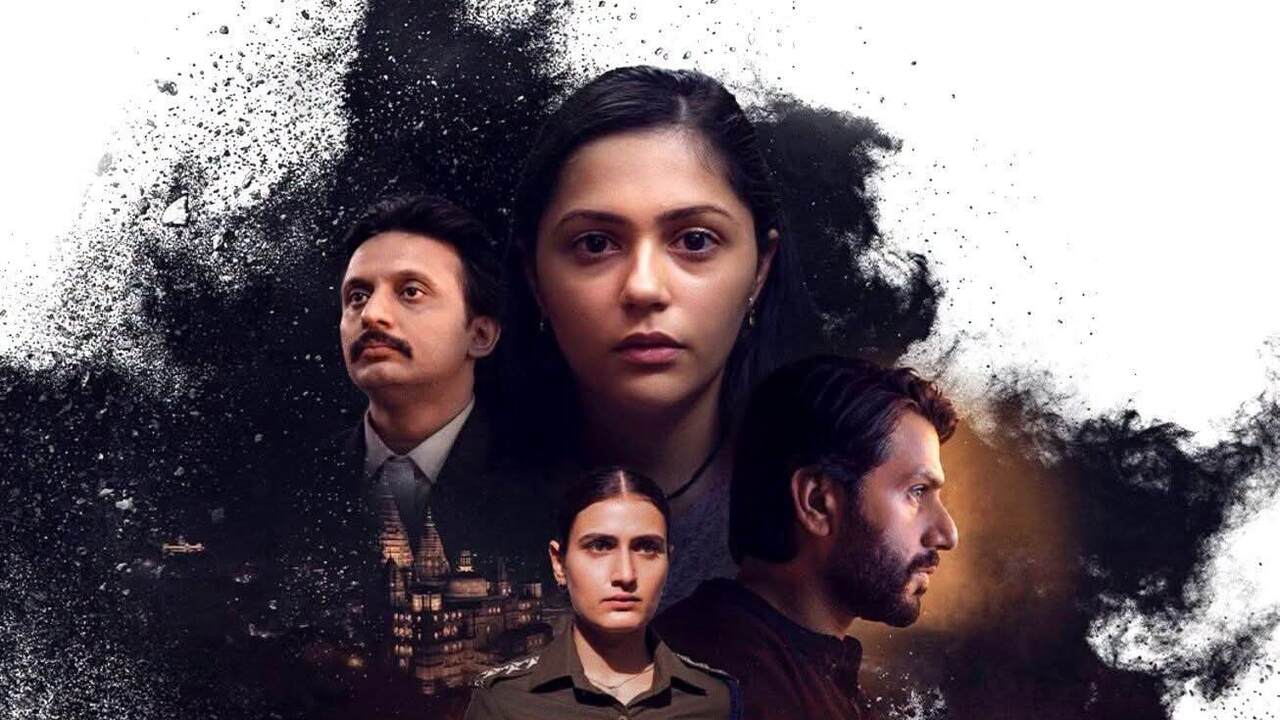
If I had been offered a nickel for every time I have said "bad/mediocre story with good intentions," I would have rejected the nickel and roared at the filmmakers' astonishingly low ambitions. Why do these directors or creators fail to look beyond their well-intentioned wishes? On one hand, there are godawful shows like Shaque: Trust No One that proudly declare that it is futile to expect them to be even remotely decent. On the other, there are movies like Daayra and shows like Hunkkaar: The Roar, directed by Nitya Mehra and Karan D. Kapadia, that attempt to conceal their mediocrity behind hot-button subjects, deflecting attention from their aesthetics by making audiences engage in heated discussions arising from the story's minor virtues and self-congratulatory substance. It's worth noting that both Daayra and Hunkkaar emerge from the minds of two women, with one (Meghna Gulzar) promoting instant justice/custodial encounters while the other (Mehra) supporting the judicial process. And yet, as filmmakers, both Gulzar and Mehra, through their respective works, end up sharing something in common: their uninspired, unremarkable style that yields textureless images.
These images see the characters but don't intimately observe them; they record the actors' performances but don't provide depth to their expressions. One of the best ideas in Hunkkaar involves the decision to follow Meenu (Aneet Padda), a 17-year-old girl, after she has been raped and has registered a case against Baapji (Raghubir Yadav), a powerful godman. She is seen eating paani puris, attending an army school, and starting a relationship with a new boyfriend. All of these activities are glimpsed for a second, merely indicating that they are happening or have happened. Why does Meenu make that boy her boyfriend? Just because he politely talks to her? On that basis, he could have simply been a good friend as well. And what about that boy? Does he genuinely like Meenu, or does he feel sorry for her? How is it that not a single girl in the class tries to socialize with Meenu? One of the boys insensitively mocks her by saying, "Tareekh pe tareekh," but Hunkkaar never gets into the gritty, uncomfortable details of how painful it is for a victim to live "normally" in a society after such a devastating event, no matter how brave they are. All the camera presents are one or two mild instances that merely point towards something discomfortingly vast and emotionally devastating, which Mehra and Kapadia keep out of their frame to avoid dealing with real, raw trauma.
No wonder, then, that the directors extract "emotional juice" from the speech Meenu gives in court in the last episode. They not only fix their gaze on Meenu's crying face but also use her "determined stares" to break the fourth wall. What comes through is the sincerity of an actor, not the troubles of a survivor. It's a major failure, and it's symptomatic of a half-baked and overstuffed screenplay that, apart from the rape, is also about journalistic integrity, courtroom drama, and a police investigation. If Arjun Mathur's Amitabh takes the series into the realm of journalism, then Mohammed Zeeshan Ayyub's Babanrao takes it into the courtroom, while Fatima Sana Shaikh's ACP Jasleen leads the investigation. All three characters are as thinly sketched as Meenu—Hunkkaar has nothing to say about their lives, their existence, or their experiences. Amitabh has a nine-year-old daughter so that someone can threaten him over a phone call when he begins to attack Baapji and his followers. Where is his wife? What measures does he take after this threat to ensure the safety of his young daughter? Does he at least consider softening his blows or holding himself back? Babanrao's father, we are told, was an exceptional lawyer. Does Babanrao stress over living up to his father's name? Does he feel burdened by his father's legacy? Are there nights when Babanrao lies sleepless and frustrated over the fact that he has not yet achieved a high level of excellence like his father? Jasleen has a brother who is in jail. Her father is dead, for which she blames her brother, and this is why she doesn't help him get bail. But by offering bits and pieces of her past through hazy conversations and hazy flashbacks, what we end up with is an outline waiting for specific, fleshed-out details that could turn a concept into a character.
One can use the words "outline" and "concept" to describe Hunkkaar as well. It's about an influential figure sexually exploiting his followers, but the directors have nothing to say about this figure's lifestyle or business. Godmen like Baapji can be well-connected to government officials and politicians, while politicians and their parties may rely on them for electoral support and other forms of influence. A daring and deep show would have been unafraid to cover the political angle instead of taking the easy, surface-level route of portraying Baapji as merely a sweet talker. How did he start this business? How did he grow his following? These are crucial questions because the answers could reveal a clear postmortem of a society whose blind faith is inextricable from its fears and psychological dependence. However, rather than a postmortem, Hunkkaar provides a two-minute-long crash course in which a cleaner, taunted by people in the society, finds solace in Baapji's arms after a single conversation. Sure, Mehra and Kapadia terribly fumble their many fascinating threads by not only combining them but also presenting them without extensive examination, but what's worse is that even after six long episodes, they prove inept at understanding who should be referred to as the real god.
When Meenu and her mother, Vaishali (Charu Shankar), visit a temple and Dharampal (Rajesh Sharma) refuses to enter the premises, Vaishali questions why he is turning his head away from the real god after being scammed by a fake one. Later, Amitabh writes, "God resides in our hearts, resides in temples. He never asks for anything, only gives." Don't these two scenes risk reinforcing the very conception of God as a wish-granting figure? Aren't such ideas precisely what can make people vulnerable to scammers-cum-priests who not only assert that they have a direct line to God but also that they will give you what you most desperately desire? After going through a lengthy justice process that is won with the help of facts and evidence, the series could have arrived at a more compelling conclusion: truth is God—the real God. Mehra and Kapadia, though, peddle broad, basic statements that could be easily distorted and have been distorted for ages. It only goes on to highlight their shortsightedness. It's as if they are unable to see the obvious. They miss out on doing justice to their ideas, and they miss out on arriving at more searching philosophical conclusions. What they don't miss out on is executing simple-minded scenes, such as cutting between Baapji killing mosquitoes and his goons killing witnesses, or Babanrao building a house of cards only to bring it up as an analogy a few seconds later in court. Even Baapji's successor is like a cartoon villain, and nothing really comes out of Dharampal's smuggling business—it merely lends itself to a moral statement.
During the initial stages, it seems as if Meenu might be lying or that her father might be taking vengeance for being fired from the ashram. Jasleen, too, appears hellbent on pursuing a single line of investigation, while Baapji's line, "Hum bhagenge toh aisa lagega ki humne kuch galat kiya hai," casts some doubt over his allegations. But Mehra and Kapadia are no Anurag Kashyap, and Hunkkaar is no Bandar. From the beginning, you are certain who is lying and who is telling the truth—neither the story nor the filmmaking is sophisticated enough to make you challenge your assumptions. Hunkkaar ultimately is a washout; it derives all its strength solely from its group of talented actors.
Also, why is the series titled Hunkkaar: The Roar and not either Hunkkaar or The Roar? Should I refer to it as Karyakram: The Show? A few months ago, I saw Indians on Twitter complaining that foreigners unnecessarily refer to tea as "chai tea." They were expressing their irritation over the redundancy. But why stop at condemning the foreigners? Look at the title of the series. What do you know, Indians, too, know how to be redundant.
Final Score - [4/10]
Reviewed by - Vikas Yadav
Follow @vikasonorous on Twitter
Publisher at Midgard Times



Hi Everyone, after a due consideration, we have decided that we will be open for donations to help us in managing our website. We will be greatful for any kind of amount we receive. Thanks!
— Midgard Times 🎬 (@Moviesr_net) January 4, 2026
PayPal- [email protected] pic.twitter.com/DlNNz5Npm5
Get all latest content delivered to your email a few times a month.
Bringing Pop Culture News from Every Realm, Get All the Latest Movie, TV News, Reviews & Trailers
Got Any questions? Drop an email to [email protected]



 © Copyrights MOVIESR.NET All rights reserved