


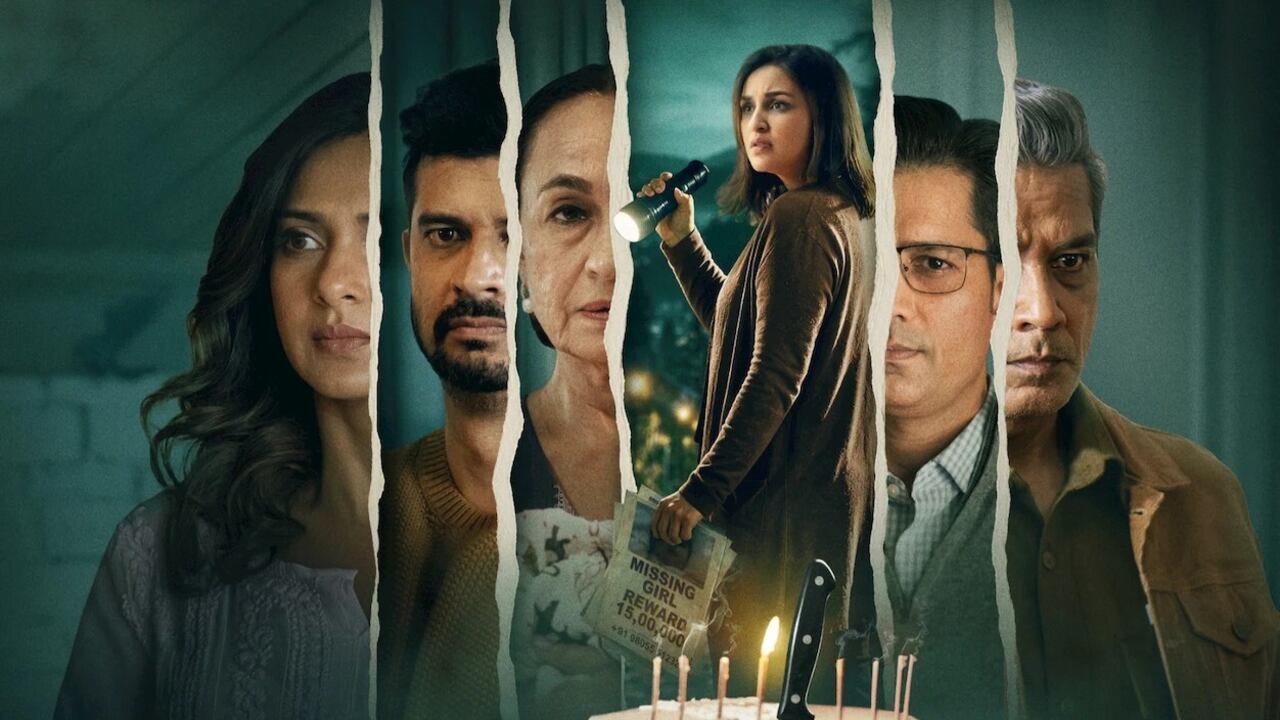
There is a good psychological thriller lurking within Shaque: Trust No One about a mother whose newborn baby gets kidnapped and who, as a result, begins to lose her grip on reality due to extreme mental stress. What's more, this mother is surrounded by a dishonest best friend, a backward-minded mother-in-law, and a cheating husband. The recipe is there for both social commentary and subjective experience, but to do justice to either of those elements, the show needed to be handled by a good director. Rensil D'Silva, the man behind such gems as Kurbaan, Ungli, and Dial 100, is certainly not the person one should rely on for subjectivity, style, or thought-provoking substance. I am not saying that a director must be judged solely on the basis of their past work or that they cannot evolve in the future. Look at Anubhav Sinha, for instance. Who in their wildest dreams would have thought that this man, responsible for trash like Cash, Tum Bin 2, and Ra.One, would eventually mature into an artist expressing himself so vigorously through films like Mulk, Thappad, Bheed, and Assi, the last of which is his greatest work yet?
This is why, no matter what the trailers or the PRs say, I go into any movie or show expecting at least some surprises. But with shows like Shaque, directors like D'Silva more or less leave me with a broken heart and plenty of disappointment. Maybe the title is communicating something to me; maybe I should be more suspicious. It's not easy to depict madness in a visual form, and most directors end up displaying something borderline ridiculous. D'Silva achieves a similar effect in Shaque. He uses Anvita's (Parineeti Chopra) mental health issues to generate images like a baby's hand emerging from a cake or a woman's hand being chopped by an axe, which are supposed to be nightmarish in nature, though what they really suggest is the presence of a director exploiting a story element to show off "cool stuff." In one scene, the lights change from red to blue. In another, Anvita comes across an animal's corpse arranged as a witchcraft-ish ritual. There are some things that Anvita doesn't really hallucinate. Someone very close to her is playing dirty tricks on her.
This provides D'Silva with an opportunity to blur the lines between reality and fiction—a task in which he gloriously fails, of course. Some of the blame also goes to Chopra, who is wildly unconvincing during these mental episodes. This nostril-flaring acting is all externalized in a way that screams "performance." Chopra labors even when asked to sit on a chair and listen to her best friend's (Harleen Sethi) confession. Rather than looking like a grieving mom, she comes across as a psychopath on the verge of transforming into a mad serial killer. When she forcibly tries to take a DNA sample from a girl, she makes you feel awkward and, at the same time, provokes unintentional laughter. Does D'Silva not want us to root for Anvita? Is she not meant to be a misunderstood victim? Are we meant to distance ourselves from her? If so, then why prove her right during the climax? Why not reveal her suspicions to be red flags originating from the mind of a desperate and sick mother?
Perhaps the most important question that deserves to be asked is this: does D'Silva himself know what he wants? I don't mind seeing Madhu's (Soni Razdan) blind faith in a baba as a comment on the widespread faith in fake godmen and babas. But to declare that Shaque, in any way or form, tackles superstition would be akin to making a fool out of yourself because the show contradicts itself by placing faith in—and proving right—the predictions made through tarot cards. Were D'Silva's eyes closed during the writing stage and the shooting process? Because it feels as if D'Silva never saw what he directed. Or perhaps he did see what a misfire he had created, and so, to cover up his flaws, he decided to titillate audiences through scenes such as the one where Sethi's Shreya and Tahir Raj Bhasin's Alok (Anvita's husband) make out on the top floor while their spouses talk with the guests in a room on the ground floor. When in doubt, excite the viewer with transgressive sex so that hormones can cloud their judgment. Sex sells, after all.
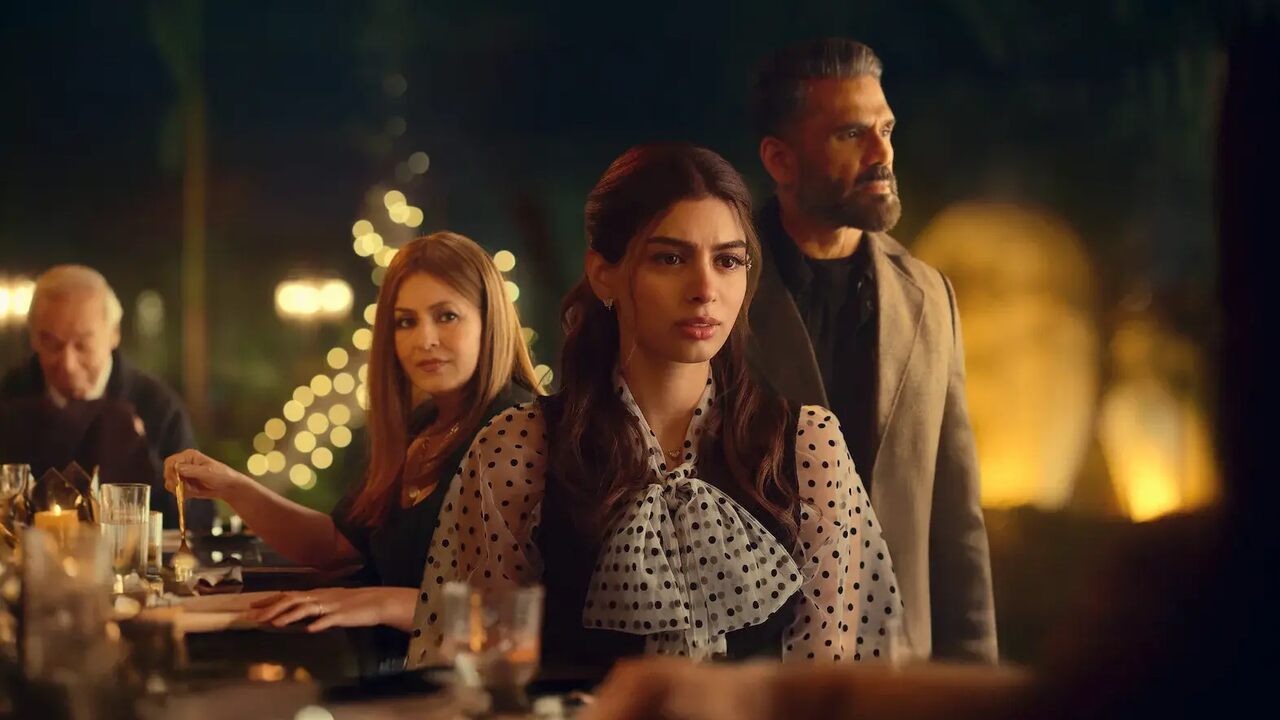
Then again, Shaque chugs along so perfunctorily that I doubt anyone would be too excited by the tame makeout here. Even the scenes that are supposed to be full of drama, like Anvita accusing Sakshi (Jennifer Winget) of stealing her baby at a birthday party, don't so much explode as peter out. The scenes have a swift, mechanical momentum. They glide smoothly; they don't stick around for long. Everything in Shaque, in this respect, is homogenized. It has one bland tone, which it sustains throughout. D'Silva, I guess, has more affection for monotony than either his story or his characters. No wonder Shaque is so dull. I think the "Trust No One" part of the title also extends to the director. The characters might be schemers, liars, and manipulators, but D'Silva, too, is no fun. Don't go to him expecting entertainment.
Final Score - [2.5/10]
Reviewed by - Vikas Yadav
Follow @vikasonorous on Twitter
Publisher at Midgard Times
Hi Everyone, after a due consideration, we have decided that we will be open for donations to help us in managing our website. We will be greatful for any kind of amount we receive. Thanks!
— Midgard Times 🎬 (@Moviesr_net) January 4, 2026
PayPal- [email protected] pic.twitter.com/DlNNz5Npm5
Get all latest content delivered to your email a few times a month.
Bringing Pop Culture News from Every Realm, Get All the Latest Movie, TV News, Reviews & Trailers
Got Any questions? Drop an email to [email protected]

 © Copyrights MOVIESR.NET All rights reserved