


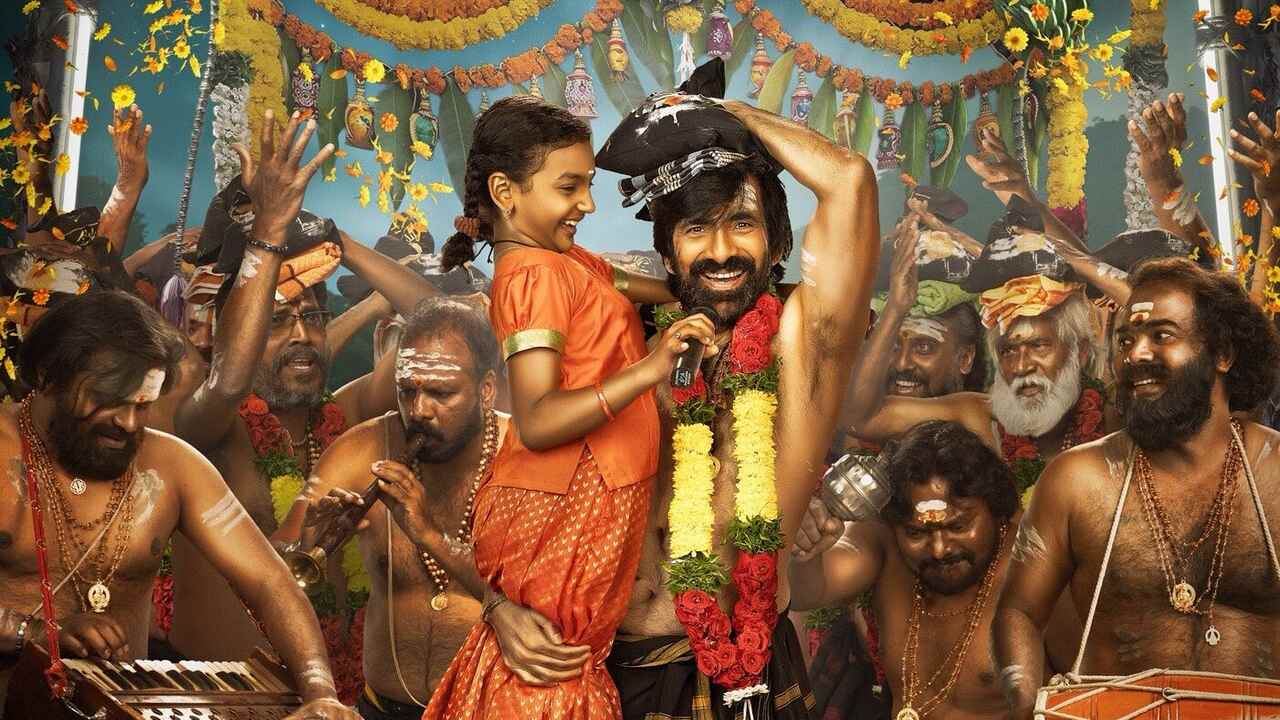
There is a better Irumudi lurking in the shadow of the one we get, like a mirage. It's about a man named Trinadh Rama Kasu (Ravi Teja) who brutally beats up rapists and womanizers and who eventually finds himself up against a sexually abusive woman named Dhanalakshmi (Swasika), a high school teacher. Will Trinadh hit Dhanalakshmi in the same way he attacks lecherous men? Or will he use his brain and give rest to his brawn? The movie that we actually get has nothing to do with these questions, yet, in the end, it answers them in a straightforward fashion.
This movie is also quite unsure of itself. It's like one of those people who so firmly, so incessantly affirm a certain virtue or characteristic about themselves that the more they speak, the more unconvincing they appear. For instance, it's not enough that Trinadh is Manikanta's (Baby Nakshathra) father and that their names have mythological associations. He has to be introduced as a man slapping truck drivers who dare to honk on the road and disturb a sleeping Manikanta, who is suffering from a fever. Trinadh also has to be shown taking Manikanta to a nearby village (Donkarayi) because the fritters she wants to eat are poorly made in their own village (Polluru). Trinadh ignores his wife Kaveri's (Priya Bhavani Shankar) concerns and orders another cup of ice cream for Manikanta because she wants it. And Trinadh permanently gives up alcohol as soon as Manikanta asks him to make a promise to her.
Still not convinced? After thrashing misogynist goons, Trinadh talks about his "weakness": he sees every woman as his daughter. And when he has to, albeit temporarily, live separately from his own daughter, Kaveri mentions how Manikanta was constantly missing her father. Even a side character remarks on how much Trinadh loves Manikanta, and Trinadh, too, explicitly says how much he loves her. Given all this intense father-daughter affection, I wouldn't have been surprised if one of the twists in Irumudi were that Manikanta came into this world from Trinadh's stomach. It was Trinadh who was pregnant, while Kaveri might as well have been hired later to provide better care for his daughter (Trinadh, after all, has to go out and work as well). Kaveri is the third wheel in this love triangle. Her presence doesn't really matter. Manikanta discloses all the secrets to Trinadh, and Trinadh spends little to no time with his wife and more with his daughter. Irumudi could have been a drama about an emotionally neglected wife from a different angle.
But at its core, Irumudi does, in fact, have something significant to say. The men in the movie hire goons to assault female athletes so that the women of their village can win a kabaddi game. There are four terrible men in the forest who ogle female students. The suggestion at first is that the outside world is a terrible place for women. However, Irumudi, after a while, expands the scope of this message by entering institutions and domestic spaces to reveal that authority figures, including those found in schools and homes, can be as dangerous as the goons who attack the athletes and the forest-dwelling men who harass students. Someone like Dhanalakshmi uses her position for exploitation (she selects some girls for "extra classes"), while someone like Goparaju (Sai Kumar) hands power over to those very abusers by conditioning his daughter to be a meek coward. Goparaju might be a revered Guru Swamy, but he instills in his daughter, Gayathri (Sam), what he refers to as a "healthy fear." Irumudi, thus, is about two kinds of perpetrators: ones who can be easily identified by their obvious behavior and ones who quietly nurture timidity at home, which ends up providing a free hand to sexual offenders.
Still, if Irumudi proves inept at generating a vision fueled by frustration and rage, that's because Shiva Nirvana reduces the characters to their functions in the screenplay. Their purpose is to stand in as examples and statements, and they speak and do only as much as the movie requires of them to fit their actions alongside the story's subtext and intentions. It's a simple-minded film that gets the job done rather than one that leaves your very soul disturbed and shaken. It's mediocre in both style and substance, and Nirvana misses out on creating a genuine emotional or cathartic experience by flattening the potent message into a series of plot twists that offer temporary jolts instead of making you sick to your stomach. That's the primary problem with movies like Maharaja, Maareesan, and now Irumudi: they convert sexual assault into a game of twisty crime thriller, thereby placing more emphasis on the structure of the screenplay than on the pain of the victims/survivors. It's sad that the directors fail to make both go hand in hand.
It's interesting that after his daughter's death, Trinadh doesn't immediately set out to throw the world on fire. He goes into denial mode; he is mentally affected. Nirvana, expectedly, doesn't explore this new zone. He soon returns to blood and violence. Teja, however, is able to conjoin his internal wounds with his external actions. It's a thrilling performance that keeps you absorbed, engaged, invested.
I also liked the fact that Trinadh's alcoholism results in the continuation of Gayathri's sexual exploitation. She comes to him for help, but he is so inebriated that she isn't able to tell him about her ill-treatment. However, there is something else that happens in the film, and I am not sure if Nirvana is fully aware of its implications. In a movie about characters who rigidly follow all the rituals, in which rituals are seen as something sacred, it's the execution of a ritual that results in Manikanta's death. When Manikanta hits puberty, Trinadh has to live away from home at a temple. This means Manikanta isn't able to inform Trinadh about Gayathri's sexual harassment. This means Manikanta ends up putting herself at risk and eventually meets her maker.
A natural conclusion, then, is that rituals can be injurious, but Nirvana, I guess, is blind to these implications. Can you blame him, given the sugary sentimentality with which he sees the relationship between Trinadh and his daughter? I bet the director's eyes were wet throughout the making of the film. No wonder he displays such a hazy vision.
Written by - Vikas Yadav
Follow @vikasonorous on Twitter
Publisher at Midgard Times



Hi Everyone, after a due consideration, we have decided that we will be open for donations to help us in managing our website. We will be greatful for any kind of amount we receive. Thanks!
— Midgard Times 🎬 (@Moviesr_net) January 4, 2026
PayPal- [email protected] pic.twitter.com/DlNNz5Npm5
Get all latest content delivered to your email a few times a month.
Bringing Pop Culture News from Every Realm, Get All the Latest Movie, TV News, Reviews & Trailers
Got Any questions? Drop an email to [email protected]



 © Copyrights MOVIESR.NET All rights reserved