


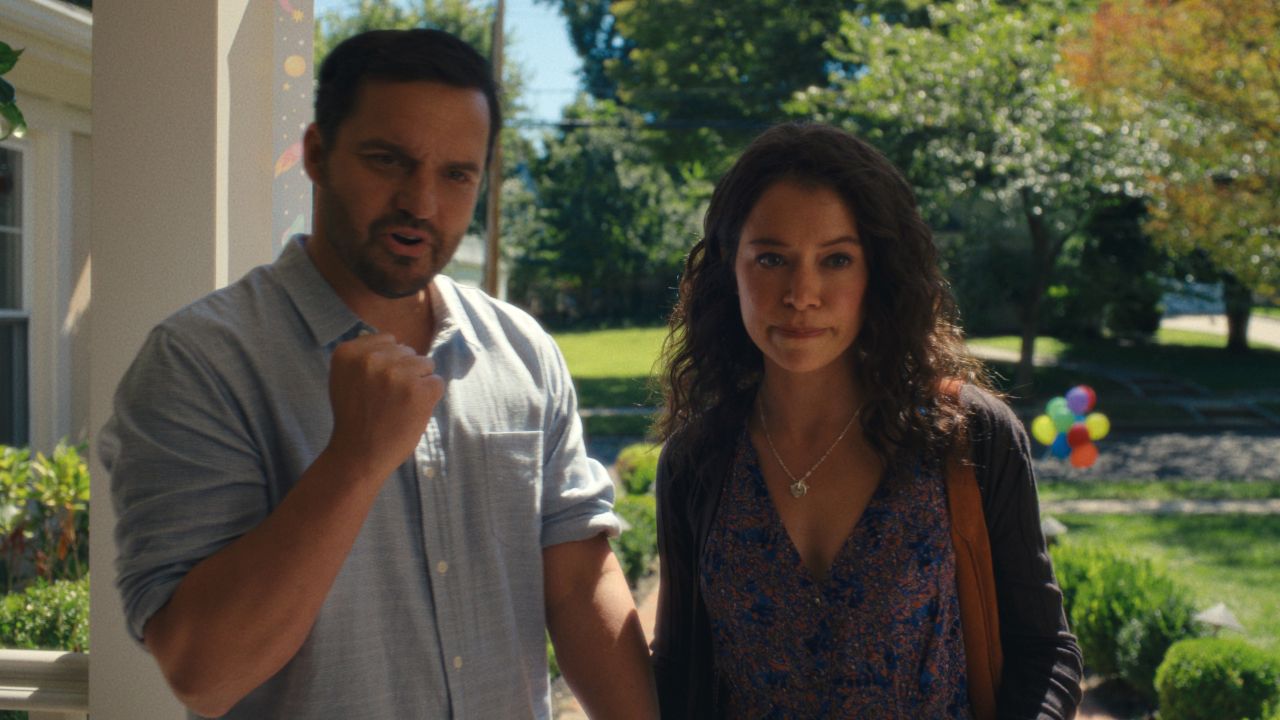
By episode four, Maximum Pleasure Guaranteed has fully committed to a very specific type of storytelling: Making Tatiana Maslany suffer. And occasionally, in ways that feel so aggressively stressful, I started wondering whether the writers had a personal grudge against her. “Raisins” continues the show’s strongest trend so far, which is taking relatively ordinary fears—divorce, custody battles, loneliness, financial pressure, embarrassment—and slowly mutating them into something much darker and more psychologically consuming. What makes the episode work is that it never loses sight of Paula’s emotional reality even as the thriller elements become increasingly complicated.
Tatiana Maslany remains the main reason this show is as effective as it is. Paula could have easily become frustrated by now. On paper, she’s constantly making questionable decisions, hiding information, escalating situations, and drifting deeper into a crisis she’s clearly not equipped to manage. Yet Maslany makes her feel painfully understandable.
The series has done an excellent job portraying Paula as someone whose life was already unstable long before the criminal elements entered the picture. The blackmail, the investigation, and the danger are making things worse, but they aren’t creating her emotional problems from scratch. They’re exposing vulnerabilities that were already there. That emotional foundation gives the episode weight.
“Raisins” continues exploring how isolated Paula has become. The more pressure builds around her, the harder it becomes for her to explain her situation honestly to anyone else. That growing disconnect fuels much of the episode’s tension. Paula increasingly feels trapped between different versions of herself—the responsible parent she wants people to see, the impulsive choices she keeps making, and the increasingly dangerous reality she’s trying to contain.
One of the strongest aspects of the performance is how physically stressed Paula always seems. Even in quieter scenes, she often looks like someone mentally processing six separate emergencies simultaneously. The show understands that anxiety is not always dramatic. Sometimes it’s just someone trying very hard to appear functional while internally collapsing.
Jake Johnson also continues doing strong work as Karl. I appreciate that the series refuses to simplify him into a stereotypical ex-husband antagonist. Karl can be dismissive, frustrating, and stubborn, but he also feels grounded in recognizable concerns. His conflicts with Paula work because both characters are operating from emotional wounds rather than simple right-versus-wrong dynamics.
The dynamic between Paula, Karl, and Mallory remains one of the most believable parts of the series. Jessy Hodges continues bringing a quiet confidence to Mallory that makes the character more interesting than she initially appeared. The show wisely avoids turning her into a villain simply because she represents stability in areas where Paula is struggling. Dolly de Leon also remains excellent as Detective Sofia Gonzalez. One of the smartest choices the show makes is allowing Gonzalez to remain competent and skeptical without becoming a narrative obstacle for the sake of suspense. She feels like an actual investigator rather than a plot device. Every appearance adds pressure because the audience understands she’s asking reasonable questions.
The episode’s biggest development involves new information emerging outside New York, a storyline that begins expanding the scale of the mystery without completely abandoning the show’s character-driven focus. What I appreciated is that “Raisins” doesn’t suddenly transform into a giant conspiracy thriller. Instead, it gradually widens the scope while keeping Paula’s emotional perspective at the center. That balance works well.
Visually, the series continues looking fantastic. The New York setting remains one of the show’s strongest assets. Everything feels crowded, noisy, and emotionally claustrophobic. Apartments, offices, soccer fields, streets, and restaurants all carry a subtle sense of pressure, as though Paula can never fully escape being observed or judged. The direction also deserves credit for understanding restraint. The tension rarely comes from large action sequences or dramatic reveals. Instead, it emerges through awkward conversations, incomplete information, suspicious timing, and the growing feeling that Paula is losing control of the story around her.
The writing remains strongest when it explores loneliness and digital intimacy. One of the most interesting ideas in Maximum Pleasure Guaranteed is that Paula’s involvement with Trevor was never really about recklessness alone. It was about emotional need. The show consistently examines how vulnerable people become when connection, validation, and attention start filling emotional gaps left by divorce, disappointment, or isolation.
The dark comedy continues working too, although more subtly than in earlier episodes. Much of the humor now comes from Paula’s increasingly impossible attempts to maintain normal life while carrying enormous secrets. The series understands that embarrassment is often funnier than punchlines. And Paula is almost permanently embarrassed at this point.
The episode contains several strong character moments; parts of the middle section feel slightly transitional. The story spends a lot of time moving pieces into position for future developments, and occasionally you can feel the narrative doing setup work rather than generating its own momentum. There are also moments where the mystery remains intentionally vague in ways that slightly test patience. I generally enjoy the show’s slow-burn approach, but by episode four there are one or two threads where I wanted a little more clarity rather than another layer of uncertainty.
The episode also risks becoming emotionally repetitive in places. Paula’s anxiety remains compelling largely because of Maslany’s performance, but there are stretches where the show circles similar emotional beats of panic, isolation, and desperation without adding much new insight. Fortunately, the performances are strong enough to carry those sections.
What continues to impress me most about Maximum Pleasure Guaranteed is that it never forgets its emotional core. The mystery matters. The danger matters. The investigation matters. But the real story remains Paula herself. Every development is filtered through her loneliness, her fear, her mistakes, and her search for some version of stability. That focus keeps the series grounded even when the plot becomes increasingly complicated.
Episode four is tense, funny, emotionally grounded, and once again anchored by an outstanding performance from Tatiana Maslany. While the pacing occasionally slows under the weight of setup and some mystery elements remain a little too opaque, the episode succeeds because it continues developing Paula as a fully realized person rather than simply a thriller protagonist. The result is an hour that deepens both the emotional and narrative stakes while reminding viewers that the most dangerous thing in this story may not be the crime itself. It may be how badly Paula wants her life to make sense again.
Final Score- [8/10]





Hi Everyone, after a due consideration, we have decided that we will be open for donations to help us in managing our website. We will be greatful for any kind of amount we receive. Thanks!
— Midgard Times 🎬 (@Moviesr_net) January 4, 2026
PayPal- [email protected] pic.twitter.com/DlNNz5Npm5
Get all latest content delivered to your email a few times a month.
Bringing Pop Culture News from Every Realm, Get All the Latest Movie, TV News, Reviews & Trailers
Got Any questions? Drop an email to [email protected]



 © Copyrights MOVIESR.NET All rights reserved