



The biggest surprise about Leanne Season 2 is how little it feels like a sitcom trying to prove that it has something new to say. It simply picks up its protagonist's life and keeps finding comedy in what happens after the supposedly dramatic part is over. The divorce was the inciting event of Season 1; now Leanne has to deal with the considerably less glamorous business of figuring out what comes next. And, as it turns out, starting over in your 60s involves considerably more family interference, dating disasters and parental chaos than anyone puts on the inspirational poster.
That is still the show's strongest quality: it is unusually comfortable making middle age the actual subject rather than treating it as the punchline. Leanne Morgan's character isn't suddenly transformed into a younger, cooler version of herself because she is single again. She is still recognisably the same Southern woman, just with a little more freedom and a lot more experience. The series continues to find humour in dating, aging, appearance, family obligations and the strange process of discovering that your life can change dramatically even when you thought you were already finished changing.
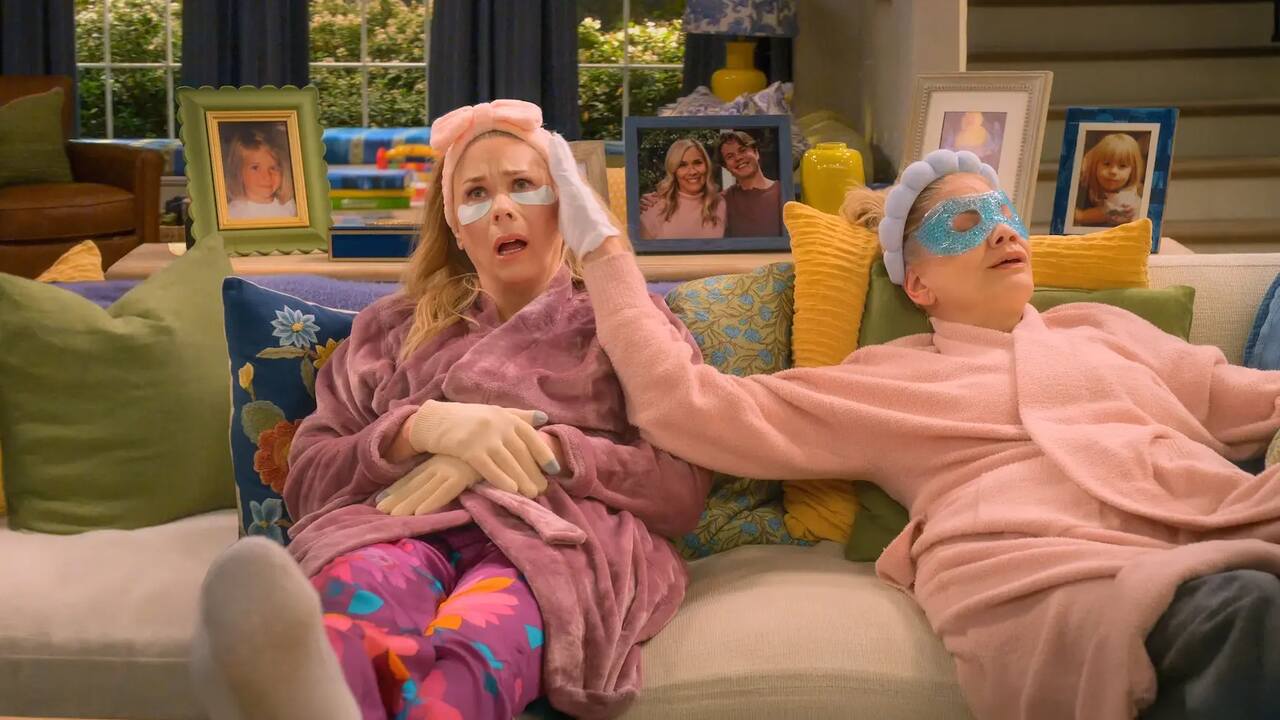
Season 2 also gives the family more room to become the comedy engine. Carol remains the perfect counterweight to Leanne, with Kristen Johnston delivering the wonderfully unfiltered performance that makes even relatively ordinary conversations feel like they could become a minor emergency. The relationship between the sisters remains one of the show's best features because they don't behave like sitcom best friends who exist purely to validate each other. They can be affectionate, irritating, judgmental, and completely ridiculous within the same conversation.
The parents becoming more central is an especially good move. The season's premise involves Leanne dealing with aging parents and the complications of having them closer to her life, which gives the show another version of the family responsibility it explored through Leanne's own children. There is something inherently funny about a woman who has spent years being a mother suddenly discovering that she may have to parent the people who raised her. And Leanne is smart enough to find the comedy without pretending that aging is inherently hilarious. That's important.
The show's humour comes from the specific absurdities of family life rather than from simply announcing that its characters are old. That distinction makes the material considerably warmer than the average sitcom built around age-based jokes. Leanne Morgan is also increasingly comfortable in the role. The first season occasionally felt like a comedian being asked to inhabit a sitcom character; here, the distinction has blurred. Her delivery has the conversational rhythm of stand-up, but she has become better at letting scenes play rather than constantly reaching for the next laugh. That gives some of the more emotional material room to exist without turning the series into a sentimental drama.
The supporting cast helps enormously. Celia Weston and Blake Clark bring an easy familiarity to Margaret and John, while Tim Daly's Andrew gives Leanne's romantic life a storyline that doesn't simply reduce her dating experience to a succession of jokes. The season also adds guest appearances from Lainey Wilson, Jaime Pressly, Billy Gardell and Tyne Daly, giving the show some fresh comic personalities without dismantling the established ensemble.
Lainey Wilson in particular is a fun addition as Leanne's cousin Jessie. Her presence makes sense within the show's Southern-family ecosystem rather than feeling like a celebrity cameo inserted purely for publicity, and she fits surprisingly comfortably into the show's comic rhythm. There is, however, a slight feeling that Season 2 is playing things safer than it could. The first season had the advantage of a very clear premise: a woman whose husband suddenly leaves her after 33 years has to reconstruct her entire identity. That provided an immediate emotional engine. Once that crisis has passed, the show necessarily becomes more episodic, and some storylines consequently feel like sitcom situations rather than meaningful developments.
That isn't necessarily a criticism of the format. Leanne is a traditional multi-camera comedy, filmed in front of a live studio audience, and it wears that identity proudly. The warm lighting, Knoxville setting, and audible audience laughter give it the unmistakable feel of an old-school network sitcom—almost bizarrely so in an era when most streaming comedies seem determined to look like miniature prestige dramas. One recent review noted exactly that quality, describing the set's bright, four-wall aesthetic and live-audience atmosphere as a deliberate throwback to traditional television. And honestly, that's refreshing. Not every comedy needs to look expensive. Not every joke needs to be followed by an existential crisis. Sometimes a woman can walk into a kitchen, say something completely unhinged about her family, and hear 300 people laugh. Leanne understands the assignment.
The reduced episode count also helps. Season 1 ran for 16 episodes; Season 2 has 10, which gives the second season a slightly tighter feel. The show doesn't have to stretch every minor family problem into an entire week of television, and the shorter run makes the season feel more purposeful even when individual episodes remain fairly lightweight. What ultimately makes Season 2 work is that the series has found a surprisingly specific emotional territory. It isn't really about divorce anymore. It is about reinvention after the life you thought you were going to have has already happened. Leanne isn't trying to become a completely different person. She's trying to figure out which parts of herself she wants to keep now that she has the opportunity to choose. That gives the comedy a little more substance than its premise initially suggests.
It also makes the show's refusal to make Leanne miserable surprisingly important. There is sadness here, certainly, but the series doesn't treat divorce as the end of a woman's story. It treats it as an enormous inconvenience that happens to come with some excellent material for jokes. That's probably the most Leanne thing imaginable.
Season 2 isn't a radical reinvention, and it doesn't need to be. It expands the show's strongest relationships, gives Leanne new complications to navigate, and continues its unusually warm examination of dating, aging, and family life after a major personal upheaval. Leanne Morgan remains effortlessly watchable, Kristen Johnston is still a comic weapon, and the addition of new guest stars adds variety without distracting from the core ensemble. Some of the storylines are inevitably lighter and more sitcom-shaped than the material in Season 1, but the show's warmth, specificity, and old-fashioned commitment to simply being funny carry it through. Leanne has discovered that starting over isn't necessarily dramatic. Sometimes it's just your parents moving in, your sister meddling in your love life, and everybody having an opinion about what you should do next. Which, frankly, sounds considerably more realistic.
Final Score- [7/10]
Reviewed by - Anjali Sharma
Follow @AnjaliS54769166 on Twitter
Publisher at Midgard Times



Hi Everyone, after a due consideration, we have decided that we will be open for donations to help us in managing our website. We will be greatful for any kind of amount we receive. Thanks!
— Midgard Times 🎬 (@Moviesr_net) January 4, 2026
PayPal- [email protected] pic.twitter.com/DlNNz5Npm5
Get all latest content delivered to your email a few times a month.
Bringing Pop Culture News from Every Realm, Get All the Latest Movie, TV News, Reviews & Trailers
Got Any questions? Drop an email to [email protected]


 © Copyrights MOVIESR.NET All rights reserved