


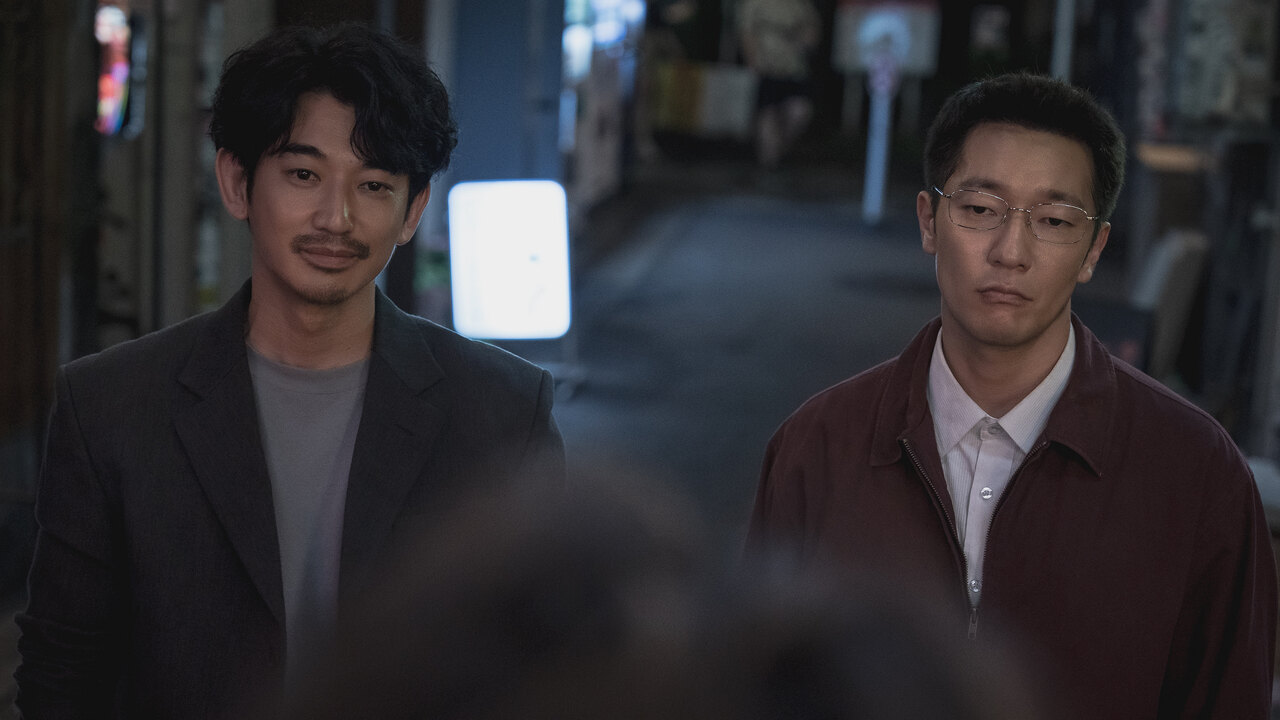
In The Blue Road, writer-director Han Jun-hee, along with co-writer Cho Yu-jin, crafts a twisty story that spans years, characters, and multiple plot twists. It's a dizzying experience with a vast narrative scope, one that seems especially interested in pulling the rug out from beneath your feet. But at first, Jun-hee and Yu-jin lure you into a fairly straightforward serial-killer story. A body is discovered in Tokyo with a cryptic message written in blood: "One fear breeds infinite fear and all methods shall be concealed." Who is this deranged psychopath, and why is he on a killing spree? Also, does the fact that the victim is a woman mean that he is some sort of sexually repressed, misogynistic creep? Before you can draw your conclusions, it's revealed that another body, similarly dispatched with bones twisted and broken mercilessly, has been found somewhere else. This generally wouldn't have been surprising, but this is a series that might as well have the word "surprise" carved into its middle. The second corpse was—wait for it—found in Seoul, which does complicate things. Did the killer travel from one place to another to commit the murders? Or are there two of them unleashing mayhem in two different places like dysfunctional buddies?
Before proceeding, it would only be fair to give a spoiler warning. I won't get into too many plot details, but it's best if you watch the series firsthand without reading anything about it. Bookmark this page and return later after completing all eight episodes on Netflix.
Still here? Did you watch it? Let's proceed.
During their investigation, Kim Seok (Son Suk-ku), the detective from Seoul, and Inose Hiroshi (Eita Nagayama), the Tokyo detective, eventually zero in on an artist. But before that, they uncover a secret room filled with paid commenters who take money to post comments online according to the requirements of their clients. These comments manufacture a particular perception and generate hype, allowing customers to promote an event, make something go viral, or artificially boost whatever else they want on the Internet simply by paying these guys. Initially, this comes across as nothing more than a failure on the police department's part: instead of catching the murderer, they have taken some cybercriminals in. However, the idea of (fake) perception pops up here and there, including in scenes where the head of the Tokyo police department tries to present his team as competent and welcoming in front of Kim, while the head of the Seoul department does the same with Inose. The year is 2002, and the FIFA World Cup match between Japan and South Korea is about to take place, so the tension and competitive spirit are even higher. The people of both countries are not exactly friendly toward one another, and to one-up the other side, they put on artificial smiles in front of their guests—Inose in Seoul and Kim in Tokyo—so that they can return home and tell their own police departments how warm, confident, and friendly their rivals are. It's another matter, though, that they curse the guests in their mother tongue to cover up their real feelings.
History is another major point that runs through the series. There is the characters' history, like Kim's, which informs you why he is so hellbent on solving the murder mysteries. There is the artist's history, which tells you how he ended up liking the sound of crunchy bones as much as he likes music. And then there is the mysterious message that the killer leaves behind, which turns out to have been taken from a military strategy book written by a fictional 16th-century Japanese samurai named Emiri. This aspect of the story feeds into the history of the Japan-Korea rift. Emiri, appalled by the brutality of Toyotomi Hideyoshi's invading forces, begins to defend Korea, thus betraying his own army. The consequences of his actions are echoed in the present as his descendants, too, pay a hefty price by being similarly rejected by both nations and both societies. So it's not simply a text from a book that finds its way back into the present. The wounds of the past are also out in the present for all to see. Oh, and about that serial killer, there was another killer like him in the 1980s. He is the original "influencer," while the criminals of the present merely copy him.
I won't go into specific details, but everything connects with everything, either directly or indirectly. It's an almost fussy script. You never know in which direction the story will go at any point. Yet this is also where the cleverness overwhelms other aspects of the story. The series is a clever jigsaw puzzle, all right, with plenty of reveals that throw it into ever more complicated territory, but this comes at the cost of rich characters and an evocative sense of mood, texture, and feeling. The backstories of the characters, like Inose's, are either pasted in as sentimental, simplistic blanks or used as incomplete pieces that will be filled in later. The result is akin to watching chess pieces being manipulated from above, with the same unseen hand arranging and rearranging scenes like mosaic tiles. This drains any sense of joy or exhilaration from the narrative. The only source of suspense becomes how everything will eventually come together. Even that is accomplished through some lazy tactics, like bullets not hitting their targets even when the shooters are at close range, or characters wasting their time talking to the culprits instead of shooting them or arresting them quickly.
Beneath all these eye-rollingly bad strategies, though, lies a message in the form of a box of treasure: people sometimes become too attached to the past without knowing the full story. There is also something about embracing what's in front of you and letting go of historical enmities. Does it matter which country you belong to? Does it matter what your ancestors did? If Kim and Inose can get over the whole Japan-Korea rivalry to work together to eliminate the evil lurking and festering in society, why can't we? It's a utopian message, quite relevant to contemporary society. If only it had also been packaged in a show that knew how to be as clever with its mechanisms as it is with its message of peace. The Blue Road does go big; on the way, however, it slips and dips, and though admirable and watchable, it doesn't leave you speechless exactly.
Final Score - [6/10]
Reviewed by - Vikas Yadav
Follow @vikasonorous on Twitter
Publisher at Midgard Times




Hi Everyone, after a due consideration, we have decided that we will be open for donations to help us in managing our website. We will be greatful for any kind of amount we receive. Thanks!
— Midgard Times 🎬 (@Moviesr_net) January 4, 2026
PayPal- [email protected] pic.twitter.com/DlNNz5Npm5
Get all latest content delivered to your email a few times a month.
Bringing Pop Culture News from Every Realm, Get All the Latest Movie, TV News, Reviews & Trailers
Got Any questions? Drop an email to [email protected]

 © Copyrights MOVIESR.NET All rights reserved