


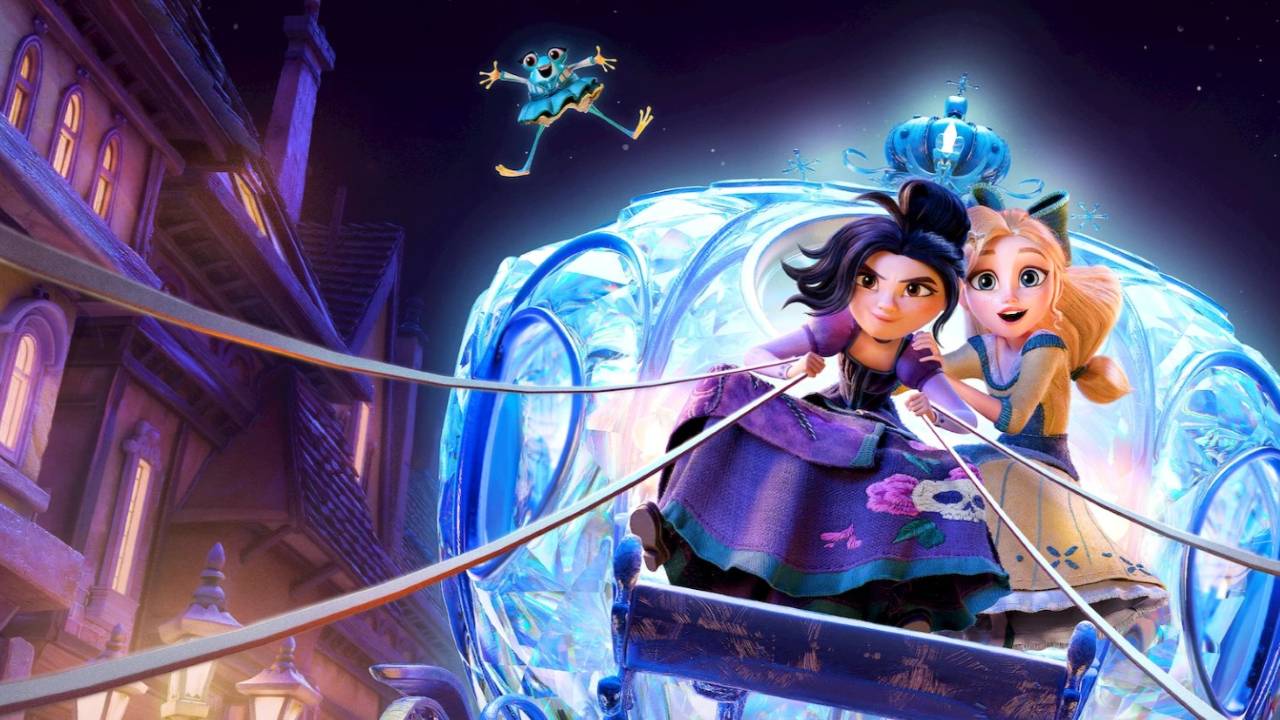
I have always found the stepsisters in Cinderella rather interesting. Imagine being introduced to an audience through someone else's happily-ever-after, assigned the role of the unpleasant obstacle, and then expected to remain grateful for the occasional invitation to the royal ball. You don't get a backstory. You don't get a particularly sympathetic explanation. You're simply the ugly, jealous, thoroughly disagreeable stepsister, and generations of children grow up knowing exactly what to think of you. Steps has a rather sensible question: what if they had been allowed to speak?
Netflix's animated feature takes the familiar Cinderella story and shifts the focus to Lilith (Ali Wong) and her younger sister, Margot (Stephanie Hsu). Tired of living in the shadow of their seemingly perfect stepsister, Cinderella (Amanda Seyfried), Lilith steals the Fairy Godmother's (Bette Midler) wand and disrupts the royal ball. The consequences are considerably worse than anticipated. Margot is transformed into a frog, the wand falls into the hands of the scheming Priscilla (Nikki Glaser), and the kingdom finds itself threatened by a new ruler. Lilith must eventually join forces with Cinderella, embarking on an adventure that involves biker trolls, dangerous woods, and a rather urgent effort to put things right.
It's a wonderfully mischievous premise, but what makes Steps work for me is that it understands the difference between rewriting a fairy tale and simply changing its protagonist. Giving the stepsisters a different perspective would have been easy enough. Making us understand why they became the people everyone remembers is the more interesting task. Lilith, in particular, is not especially interested in being liked. She is defensive, sarcastic, occasionally difficult, and quite visibly tired of being compared with someone who seems to receive affection without having to ask for it. There is a little more going on here than a misunderstood villain wanting an apology.
What struck me was how much of Lilith's resentment comes from the experience of being made to feel like an outsider. The film gives this an additional dimension through the sisters' Asian heritage and their struggle to assimilate into a predominantly white community. Cinderella's position as the beloved, seemingly perfect girl is complicated by the fact that she is also the person whose acceptance appears to come so effortlessly. Lilith, meanwhile, has to contend with being different, being judged, and being expected to accommodate a world that doesn't quite know what to do with her. The film's treatment of identity and belonging gives the familiar fairy-tale conflict a much more personal meaning.
I particularly appreciated that it doesn't require Lilith to become a completely different person to deserve understanding. She can be prickly. She can be wrong. She can make an extraordinarily bad decision with a stolen magical wand. None of that makes her feelings irrelevant. Something is reassuring about a film that allows a character to be imperfect without treating imperfection as evidence that they are undeserving of affection. Sometimes people develop difficult personalities because they have spent a long time feeling unwelcome. That doesn't excuse everything they do, but it does make their behaviour worth understanding.
And Cinderella? Well, it is rather fun to discover that even the girl with the glass slipper has some explaining to do. The film doesn't simply reverse the original arrangement and declare the supposed villain good and the princess bad. Cinderella has her own grievances, her own understanding of what happened and her own responsibility within the fractured relationship. Her privilege is an important part of this examination. She may not have deliberately set out to hurt Lilith, but being the person everyone adores can make it remarkably easy to overlook the person who feels excluded. The film is at its most thoughtful when it allows both sisters to have legitimate feelings without pretending that their experiences have been identical.
For me, though, the relationship between Lilith and Margot is the emotional centre. Younger siblings often occupy a rather complicated position in family relationships: they can be the person you protect, the person who understands you, and occasionally the person whose presence makes you feel responsible for holding everything together. Margot's role in the sisters' lives is particularly interesting because she is initially the connection keeping the family together. The directors, Alyce Tzue and John Ripa, have spoken about deliberately removing her from that position so that Lilith and Cinderella must confront their relationship themselves. It is a smart storytelling decision. Reconciliation means very little if someone else is continually doing the emotional work on your behalf.
The voice cast gives these characters plenty of personality. Ali Wong is an especially good fit for Lilith, bringing the character's defensive humour and frustration into the performance without losing the vulnerability underneath. Stephanie Hsu gives Margot a warmth that balances her older sister's more combative temperament, while Amanda Seyfried brings an appealing lightness to Cinderella. Bette Midler's Fairy Godmother is also a particularly entertaining reinterpretation, with good intentions and a rather unreliable relationship with the practicalities of magic. Daniel Radcliffe, Peter Dinklage, Nikki Glaser and Young Mazino round out an energetic ensemble.
Visually, the film has a personality of its own. Its character designs and aesthetic choices give this fairy-tale world a slightly rebellious, punk-inflected quality, particularly through Lilith's appearance and the environments the sisters encounter. I enjoyed the contrast between the familiar softness of Cinderella's world and the sharper, more unconventional visual identity associated with Lilith. The animation doesn't simply reproduce the imagery we already associate with the fairy tale; it gives the reinterpretation its own visual vocabulary. Kris Bowers' music also contributes to the film's playful atmosphere, while the musical elements add another layer to its emotional storytelling.
The adventure itself is lively, sometimes wonderfully silly, and full of the sort of absurdity that makes animated fantasy enjoyable across age groups. The trolls, magical mishaps and escalating complications keep the story moving, while the humour is willing to be a little irreverent. I also appreciated that the film doesn't take itself so seriously that its underlying message becomes burdensome. It can be funny, chaotic and emotionally sincere without constantly reminding us that it has something important to say.
There are a few moments when the number of characters, subplots and action sequences threaten to pull attention away from the sisters. Some developments move rather quickly, and I would have liked a little more space for certain emotional transitions to settle. The film occasionally seems eager to get to its next adventure before fully exploring the consequences of the previous one. It doesn't undermine the central relationship, but it does make parts of the storytelling feel slightly crowded.
Still, I came away genuinely fond of Steps. Its greatest achievement is not that it gives Cinderella's stepsisters a sympathetic backstory. It is that it makes us reconsider how easily we accept the roles stories assign to people. The villain, the princess, the difficult sister, the perfect girl: these labels are convenient because they save us the trouble of understanding anyone. Real relationships are considerably less tidy. People can hurt one another without being entirely bad, and being loved by everyone doesn't necessarily mean you have been fair to the people closest to you.
I also think there is something lovely about a children's film making room for that kind of ambiguity. Children are often introduced to stories with very clear moral divisions. There is the good person, the bad person, the right choice and the wrong one. Steps gently complicates that arrangement. It suggests that sometimes the person we have been taught to dislike is simply someone whose story we haven't heard. And sometimes, listening requires us to reconsider the person we have always assumed was right.
Perhaps the glass slipper was never the most interesting part of Cinderella's story. Perhaps it was the people standing outside the ballroom, watching someone else's life unfold and wondering when they would get their turn.
Final Score- [8/10]
Reviewed by - Anjali Sharma
Follow @AnjaliS54769166 on Twitter
Publisher at Midgard Times




Hi Everyone, after a due consideration, we have decided that we will be open for donations to help us in managing our website. We will be greatful for any kind of amount we receive. Thanks!
— Midgard Times 🎬 (@Moviesr_net) January 4, 2026
PayPal- [email protected] pic.twitter.com/DlNNz5Npm5
Get all latest content delivered to your email a few times a month.
Bringing Pop Culture News from Every Realm, Get All the Latest Movie, TV News, Reviews & Trailers
Got Any questions? Drop an email to [email protected]

 © Copyrights MOVIESR.NET All rights reserved