


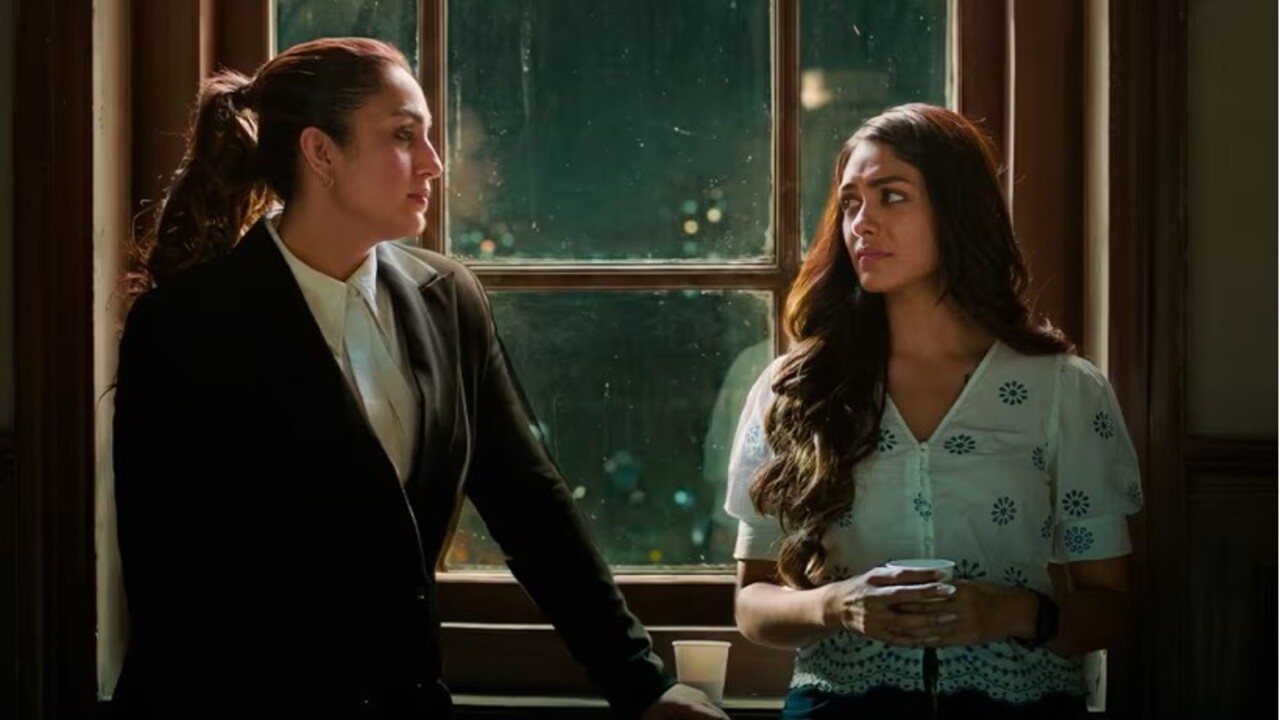
God knows that Indian men can be idiots and assholes when it comes to their relationships with the women around them. As a man who has spent countless hours in the company of other men in schools, colleges, and hostels, I know firsthand how desperate and sexually frustrated many of them can be and how stupid they sound when they romantically reminisce about their one-sided relationships. Ideally, then, I should be one of the perfect candidates to give my enthusiastic approval to a film like Pooja Meri Jaan, which basically talks about toxic men and their toxic relationships: how many of them are unable to handle rejection and how they romanticize their inanity with a heavy diet of inane Bollywood films. And yet, I don't think Pooja Meri Jaan is a good or even a watchable movie. It has some promise, but directors Vipasha Arvind and Navjot Gulati, who co-wrote the story with Kanishka Singh Deo, prioritize empty provocations over smart, complex storytelling. The directors are so tickled by the idea of their movie serving as a catalyst for social-media outrage that they sacrifice intelligence and craft at the altar of rage-bait, likes, and retweets.
Things do start on a promising note. Theater actor Aniket (Vikram Singh Chauhan), through a grand gesture, proposes to his co-actor Pooja (Mrunal Thakur) in front of the audience after finishing their Romeo and Juliet play. But inside the makeup room, when they are alone, she rebukes him, returns his ring to him, and tells him to die and go to hell. If you are not as blind as Aniket, you will notice that after the play, when Aniket extends his hand towards Pooja to help her get up from the ground, she doesn't accept his help. That small action should tell you everything you need to know about their so-called relationship status. Nonetheless, Aniket is so consumed by Pooja and so affected by her rejection that he takes her words to heart and hangs himself. What follows are media trials and online rants that quickly label Pooja a gold digger, a witch, a criminal. Both men and women express their hatred and hurl abuses at Pooja in an attempt to assassinate her character. Jatin (Vijay Raaz), a lawyer, decides to drag Pooja to court, for which he gets all the blessings from Aniket's family members.
During the trial, it's revealed that Aniket was too sensitive, too kind, too helpful, and probably a bit mentally unstable, which is why, according to the witnesses, Pooja shouldn't have friend-zoned him or kept him as a "backup." She should have outright rejected his advances. But did Pooja actually keep him as a "backup"? Did she encourage him to keep pursuing her? A sophisticated, complicated movie would have entered psychologically grey areas in order to leave you with uneasy, unresolved answers. It would have found fault with both sides because all humans are messy in their own ways. But not everybody can be Anurag Kashyap, and not everybody can pull off a Bandar. That's understandable, and it's okay if Pooja Meri Jaan wants to bat for one side to expose the flaws of Indian men. Given how the real world treats its women, we do need to show society a mirror. What's not okay is to make a film solely to push the buttons of the audience. Instead of well-rounded characters and emotionally rich incidents, we are left with shallow mouthpieces and scenes and dialogues that function as placard slogans.
It doesn't occur to the directors that they could generate palpable drama out of the conflict within Sana (Huma Qureshi). A corporate lawyer, she is the mutual friend of Aniket and Pooja, and like others, she too initially considers Pooja to be a villain. She fumbles terribly during the first hearing, leading to Pooja being thrown inside prison. Sana's boss gives her an analogy involving a doctor and a cancer patient, and the directors could have created a discomforting drama from this notion: a movie where the lawyer betrays her client to take revenge (talk about "unethical vengeance"). Never mind. At the very least, Gulati and Arvind could have shown Sana changing drastically in tandem with her investigations. That is, the more she digs into the case, the more her beliefs should shake. But the directors aren't even curious about this transformation. They merely change Sana later, as if she were a switch waiting to be flicked as per convenience. And when that switch is flicked, Sana throws terms like "toxic masculinity," "social conditioning," and "macho image of men" into the courtroom in the form of ranty lessons directed at the viewers.
Then again, it's also true that other characters, too, somewhat speak in the same language. Every line has all the subtlety of a sledgehammer. Gulati and Arvind don't make points; they hammer them into your heads. Also, what was the point of putting Pooja in prison? When Kashyap took Samar inside the jail in Bandar, he exposed the rot and routine within the walls with raw energy and a dramatically charged, crystal-clear lens. Here, Pooja meets a psycho killer, but nothing comes out of this encounter. We also don't get to see how the prison psychologically or physically affects the character. Gulati and Arvind did have the ammunition to make something tense, terrifying, and memorable. Still, the fact that they went for the lowest-hanging fruit only accentuates their lack of imagination. I mean, what's the point in expecting competence from a movie where a character shares posts like "Truth can be troubled, but it cannot be defeated?" And even after all this, if the directors' "message" somehow ends up going over your heads, don't worry because Pooja gives a speech to her audience that, of course, is meant for the movie's audience. Even the flashbacks related to Pooja and Aniket's past are treated as red herrings so that the story can pull the rug from beneath you later. What's funny is that the real flashbacks arrive when Sana speaks of Pooja's perspective, but the earlier flashbacks, too, only arise whenever we watch Pooja contemplating a certain moment.
Perhaps the more appropriate title for Pooja Meri Jaan could be Engagement Bait. The name is as, um, subtle as this crime thriller, which is why it suits it best. It's the kind of film that doesn't need anti-smoking stickers in the frame. What it needs is the "Trigger Warning" text. Will it succeed in its intention? Will it give rise to online rants? I don't know, and I don't care. What I would encourage instead is to leave this film behind and search for Bandar. It exists on the same platform where Pooja Meri Jaan will be released this Friday. See for yourself the difference between a great film and an exercise in empty manipulation, a director's personal vision and a hack job begging for attention, an artist and a hollow provocateur. Needless to say, Kashyap and Bandar are the real winners here. He made cinema, while Gulati and Arvind manufactured clickbait.
Final Score - [2.5/10]
Reviewed by - Vikas Yadav
Follow @vikasonorous on Twitter
Publisher at Midgard Times




Hi Everyone, after a due consideration, we have decided that we will be open for donations to help us in managing our website. We will be greatful for any kind of amount we receive. Thanks!
— Midgard Times 🎬 (@Moviesr_net) January 4, 2026
PayPal- [email protected] pic.twitter.com/DlNNz5Npm5
Get all latest content delivered to your email a few times a month.
Bringing Pop Culture News from Every Realm, Get All the Latest Movie, TV News, Reviews & Trailers
Got Any questions? Drop an email to [email protected]



 © Copyrights MOVIESR.NET All rights reserved