


The general (and unwise) consensus about movies is that cinema is a visual medium. This is only half the truth: cinema is an audiovisual medium, and sound is just as important as, if not more important than, images. Yet discussions about cinema often privilege visual spectacle, celebrating elaborate compositions and technical bravura while paying comparatively little attention to how sound contributes to the cinematic experience. The problem isn't that these films are visually elaborate, but that visual elaboration is too often mistaken for cinematic achievement in itself. It doesn't help that many filmmakers treat the "sound" part as little more than dialogue and manipulative or heart-thumping soundtracks. But what's more troubling is the constant reassertion—in film criticism, social media discussions, and interviews—that writing is the primary virtue of this audiovisual medium. To be a cinephile in India is to hear variations of the argument that "a good script is the foundation of a good film" being mindlessly recycled by prominent film journalists and the people they interview on their channels. It's as if directors, actors, and other technicians have nothing left to do once they're handed a well-written script, as if all they need to do is point the camera at their sets and actors while the latter deliver their theatrical performances.
It's quite possible that many Indian filmmakers actually make movies this way, which might explain why so many of them seem to flaunt their "writing" as an accomplishment in itself. The problem isn't that good writing is unimportant, but that a screenplay's cleverness is too often mistaken for cinematic achievement. Things wouldn't be so bad if the writing, more often than not, offered striking insights or stories that dared to challenge the audience's preconceptions. Sadly, what we mostly get are romantic cliches, hollow good intentions, or a succession of twists designed to convince us that the screenplay is indeed "clever." These filmmakers seem so heavily influenced by other movies that their work rarely gives the impression of having emerged from an engagement with the real world. Their ideas often appear borrowed from other mainstream vehicles. The one area in which they seem willing to invest considerable effort is research, which often becomes the most conspicuous thing distinguishing one genre film from another. Take Pradhama Drishtiya Kuttakkar, in which Shahad Nilambur, working with writers P. S. Subramanian and Vijesh Thottungal, tries to outwit Jeethu Joseph and his Drishyams.
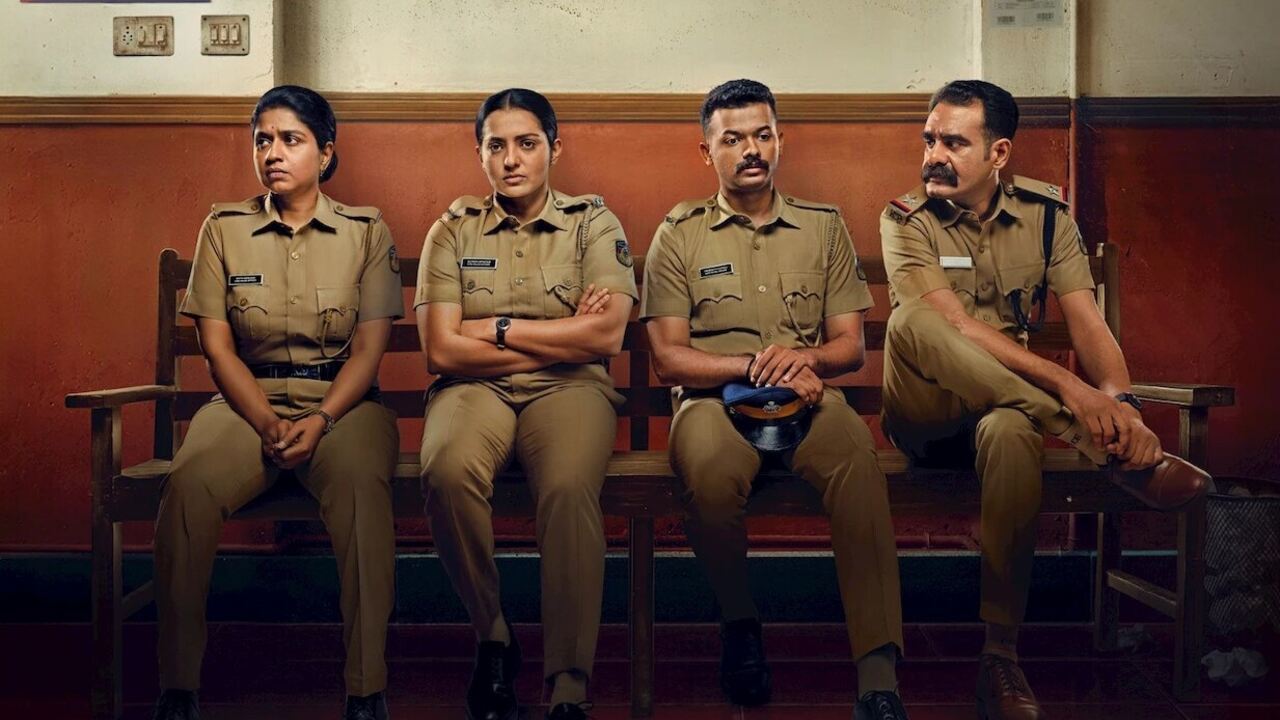
The template remains largely the same: both stories revolve around four people who bury the body of a man and then do their best to outsmart the investigators. But Nilambur and his team distinguish their film from Joseph's by making it, in part, a story about the conflicts, rivalries, and tensions between police officers of different ranks. SHO Prathap Mohan (Vinay Forrt) asserts his authority over SI Xavier (Azees Nedumangad), who, in turn, lords it over CPO Aleena (Parvathy Thiruvothu) and her colleagues and friends: CPO Sreenath (Mathew Thomas), CPO Divya (Unnimaya Prasad), and ASI Dasan (Sidharth Bharathan). Above them all is DYSP Harris Meeran (Vijayaraghavan), whose orders are followed by everyone. Prathap's ego is bruised when Xavier receives praise for busting a criminal in a drug-related case, while Prathap's own name goes unmentioned. Out of jealousy, Prathap sends Xavier to Assam for an address verification. Similarly, when Harris fears he might lose his case against a low-ranking officer like Aleena, he forces her to undergo a narco-analysis test in an attempt to extract the truth about a bullet. Harris's daughter asks him if he could simply drop the case, but he replies that he has a winning streak to maintain. He cannot allow anyone to tarnish his inflated reputation.
Harris's attachment to his reputation is so overwhelming that it threatens to eclipse the very crime he is supposed to investigate: the murder of an army officer. Pradhama Drishtiya Kuttakkar suggests that camaraderie and mutual respect are fragile commodities in this hierarchy, where professional responsibilities coexist with an abiding concern for personal prestige. These officers do care about justice, but their egos and reputations increasingly shape how they pursue it. Prathap cannot stomach being overshadowed by Xavier, while Harris is unwilling to let the possibility of losing a case damage his standing. This is why Aleena and her friends must fend for themselves, even when their supposed crime is an act of self-defense. The filmmakers approach this unequal distribution of power and respect through the lens of a crime thriller. But the lens becomes a disadvantage because it ultimately blunts the very critique the film seems interested in making. There is little bite left by the end. What comes through most clearly is the extent of the writers' research: the benzidine test, for instance, which can be used to detect traces of blood, and the distinctive rifling marks left on bullets by a gun barrel. The film also offers an explanation involving MDMA and morphine to account for how the narco-analysis process might be circumvented. These details are presented with such confidence and enthusiasm that one can almost feel the filmmakers waiting for us to be impressed by them.
Nilambur clearly enjoys displaying the technical details he and his team have gathered. He also takes pleasure in staging other elaborate demonstrations of ingenuity, such as the scene in which multiple voice messages are combined to create a new message, which is then investigated using specialized software and equipment. We learn that a particular CCTV system requires a memory card to retain footage for 14 days. And then there are the twists, which Nilambur delivers with palpable pleasure. "Gotcha!" he seems to exclaim, rubbing his hands together in joy. But he is so enamored of these rug-pulling moments that he fails to give sufficient weight to the personal lives of his characters. Aleena fears that her daughter might grow up alone like her. Divya has a loving husband and eventually becomes pregnant. Dasan is in love with a teacher, while Sreenath wants to marry a woman whose family looks down on him because of differences in caste and social status. These thoughts, experiences, and desires are integral to the characters. They give them an identity beyond their roles in the central crime, making them seem like people rather than mere plot devices.
Nilambur, however, undermines this potential by glancing at these personal domains only in passing—a brief confession here, a quick flashback there. Their emotional lives become little more than superficial melodramatic devices, as when Aleena's baby cutely calls out to her outside the court premises. These moments seem designed to make us "feel" for the characters, but they rarely acquire the emotional weight they need. Their conflicts also receive tidy resolutions. One senses that the filmmakers are not nearly as invested in these lives as they are in the thriller's machinery. This is where the film's obsession with writing becomes particularly revealing. The screenplay gives its characters personal histories, desires, and emotional vulnerabilities but treats them as supplementary material rather than integrating them into the dramatic experience. The filmmakers seem to have done enough writing to give these characters personal lives, but not enough to make those lives feel integral to the film. Their experiences are introduced, briefly acknowledged, and neatly resolved, as though the screenplay is merely checking off the boxes required to make us care about them. The result is that the "crime" outweighs the "drama," and we leave the film with a smile that says, "They got away with it, didn't they?" It's the kind of satisfaction that might have lasted longer in an earlier era, when the mechanics of a clever crime thriller could more easily distinguish it from the competition. Today, however, Pradhama Drishtiya Kuttakkar struggles to stand out amid the glut of crime thrillers. Its twists are certainly unpredictable to a degree, but unpredictability isn't the same as suspense. I sat through the film alternately bored and intrigued as Nilambur, with considerable self-satisfaction, took the stage and pulled back one curtain after another.
This is where Nilambur falls short as a director. He is so absorbed by Subramanian and Thottungal's screenplay and its cleverness that he seems to forget the need to enliven his images. Apart from a well-choreographed, sustained struggle between cops and a criminal inside a police station, he shows little inclination to build a gripping atmosphere or devise scenes that command attention through their visual inventiveness. The non-linear structure breaks the film into mosaic tiles that must be dutifully assembled, rather than allowing its fractured chronology to become part of an emotionally charged and narratively complex cinematic experience. Nilambur's eye remains so firmly fixed on the text that some of the film's most gifted actors are reduced to delivering surprisingly bland performances.
Thomas, Bharathan, and Prasad spend much of the film either quivering or crying, while Thiruvothu relies primarily on a "steely gaze" that soon becomes monotonous. Her expressions, hovering between "I am guilty" and "I am not guilty," occasionally recall Ajay Devgn's performance in Drishyam. Vijayaraghavan is perfectly serviceable as the determined DYSP, while Nedumangad might as well have tattooed the words "I am a bad person" on his forehead. Forrt, however, is considerably more entertaining to watch. He gets perhaps the film's best comic scene when Prathap is angrily ordered to leave a room following a CCTV-related mishap. Having walked out, he returns to salute the senior officer, only to be scolded again. Here is a policeman so conditioned to follow a prescribed set of actions that he continues to do so regardless of the circumstances. Someone with a sharp eye and a sharper intellect might extend this behavior from the character to the story itself, revealing a film that obediently fulfills its genre duties at its own expense. Prathap's inability to step outside the rules governing his behavior becomes an apt metaphor for a filmmaker who cannot seem to step outside the rules governing his genre. Go figure.
Written by - Vikas Yadav
Follow @vikasonorous on Twitter
Publisher at Midgard Times
Hi Everyone, after a due consideration, we have decided that we will be open for donations to help us in managing our website. We will be greatful for any kind of amount we receive. Thanks!
— Midgard Times 🎬 (@Moviesr_net) January 4, 2026
PayPal- [email protected] pic.twitter.com/DlNNz5Npm5
Get all latest content delivered to your email a few times a month.
Bringing Pop Culture News from Every Realm, Get All the Latest Movie, TV News, Reviews & Trailers
Got Any questions? Drop an email to [email protected]


 © Copyrights MOVIESR.NET All rights reserved