


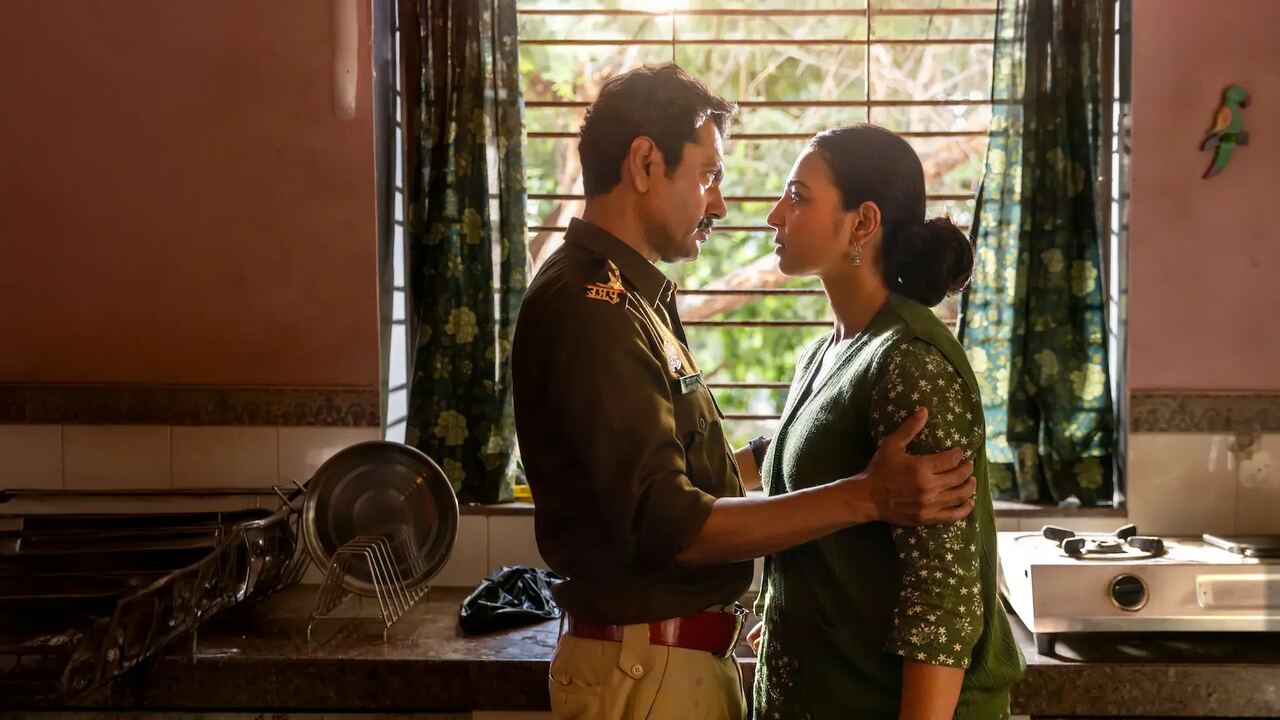
On the surface, Raat Akeli Hai: The Bansal Murders is tightly controlled, carefully planned, and precisely executed. Its various pieces are neatly trimmed and shaped so that they fall smoothly and cleverly into place. Such rigidity in design can often yield unimaginative results that merely highlight the filmmaker's control over his subject. Furthermore, in a genre piece such as a murder mystery, specific rules are followed to fulfill certain cinematic expectations. What makes Honey Trehan and this second Raat Akeli Hai different, then, is the way the director infuses this tight framework with complex ideas, intellectual insights, emotional fervor, and a palpable sense of life. This is why I would happily place Trehan in the company of such masters as Alfred Hitchcock, Wes Anderson, and Chantal Akerman—filmmakers who use formal precision not as an end in itself, but as a means to probe deeper emotional and/or political truths.
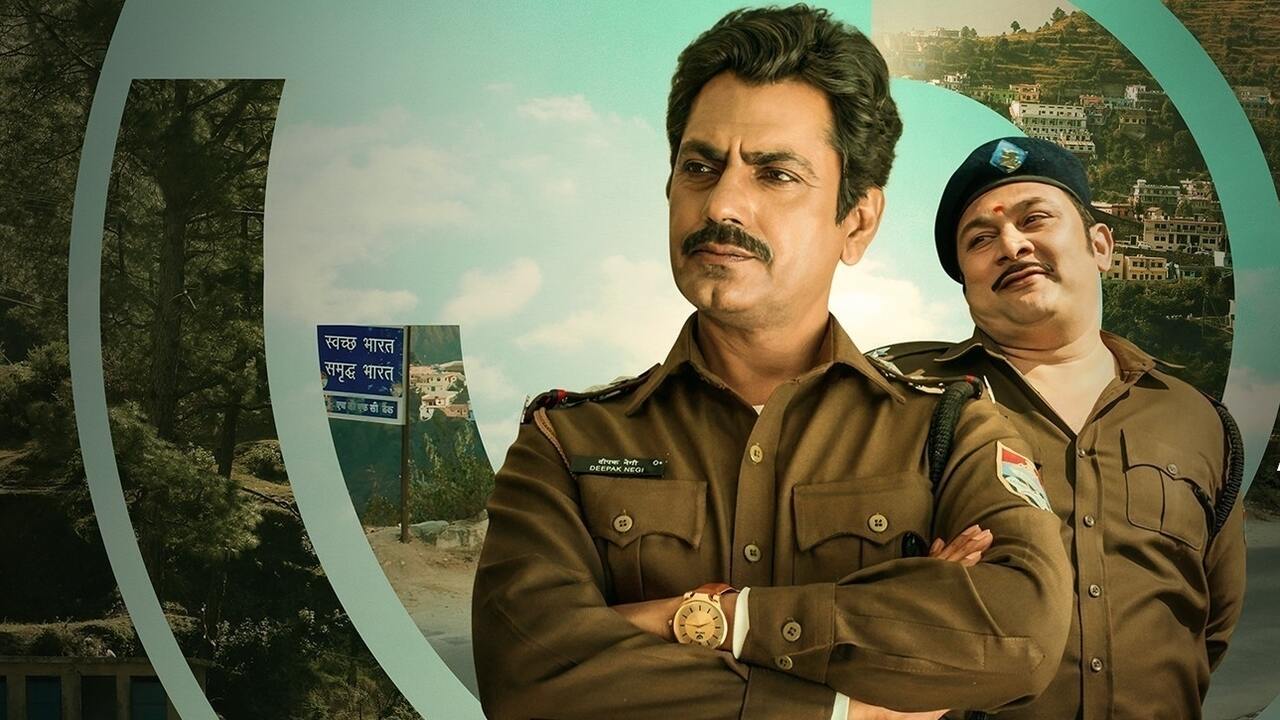
At first, I thought Trehan decided to make this sequel simply to let's say, cheer himself up, following the controversy and censorship surrounding Punjab '95. But look at Inspector Jatil Yadav (Nawazuddin Siddiqui), the central cop in the Raat Akeli Hai universe. He is someone who relentlessly chases the truth, and his zeal consistently irks his colleagues and superiors. At two different points in The Bansal Murders, characters rebuke Jatil for spoiling a case they believe they have already figured out—a case they consider straightforward. Jatil, in his defense, says something along the lines of, "Mujhe apna kaam kiye bina neend nahi aati. Shaayad aapko aa jaati hogi." Here is a man driven by an uncompromising pursuit of truth. For a filmmaker, that "truth" is his film—his cinematic vision. Trehan, sharing Jatil's spirit, continues to fight for the release of Punjab '95, a film that once again grapples with an uncomfortable truth.
Like its predecessor, The Bansal Murders—written by Smita Singh (who also penned Khauf, easily one of the best shows of the year)—has a lot on its plate. This time, however, it handles its many threads with greater clarity and confidence. Simply put, the film not only engages more efficiently with its themes, but its central murder mystery is also far more satisfying and potent. The revelation, the killer's identity, and the victims are all intricately and intelligently connected. Trehan and Singh situate the story in Uttar Pradesh and tackle bulldozers, polluted air, slums, fake godmen (or rather, a godwoman), and a sold-out media. No political party or government institution is named outright; instead, the real culprits are critiqued through subtle gestures and coded references, much like Neeraj Ghaywan's approach in Homebound. At a time when many Indian filmmakers meekly submit to those in power, directors like Ghaywan and Trehan strive to preserve their voice and vision by navigating censorship and a regime that rewards subservience. Trehan, having directly confronted the establishment, appears to have learned from that struggle. As a result, The Bansal Murders trusts its audience to connect the dots, attacking its targets obliquely rather than through explicit references.
Trehan and Singh present a complex web in which the police, the media, and the wealthy and influential are complicit in keeping the poor trapped in unbearable conditions. A media mogul uses his power to divert public discourse from urgent realities, while the DGP maintains a convenient "understanding" with the tycoon. The Bansal Murders reminds us that the air we all breathe is the same—and that it is poisonous. A wealthy individual can escape by boarding a flight to London, but underprivileged slum dwellers must continue to suffer within a broken system. Yet this is also where the film avoids the cliché of portraying the poor as wholly innocent. Loss is experienced across economic divides, and what emerges is a portrait of a society built on inequality—one that breeds monsters on both ends of the spectrum.
Despite the pervasive gloom, Trehan never loses his sense of humor. Jatil's exchanges with his mother (Ila Arun) are nothing short of comic gold. Radha (Radhika Apte) is charming and warm, while Dr. Rosie Panicker (Revathy Asha Kelunni) is given some of the film's strongest scenes, particularly the one in which she reconstructs the murder with the help of her assistant. Even within these lighter moments, Trehan keeps one eye firmly on the contemporary social landscape, as evidenced by the "thain thain" joke. Radha, newly liberated, is studying at college—but what is she studying? Where is she going? What does she think about her subjects? Has she made any friends? The film does not fully flesh her out; she exists mainly as a symbolic marker of progress. This, however, is a minor quibble. The Bansal Murders does so much right that its shortcomings feel almost trivial.
Trehan and Singh refuse to sell comforting fantasies. Even the film's moments of victory are layered with harsh consequences—the "good guy" gets suspended. And yet the filmmakers leave us smiling. The country might be in shambles, but Trehan and Singh come bearing optimism. It is likely the same optimism Trehan carries with him every day, hoping that Punjab '95 will eventually find its way to theaters. I, for one, sincerely hope that day arrives as soon as possible.
Final Score- [9/10]
Reviewed by - Vikas Yadav
Follow @vikasonorous on Twitter
Publisher at Midgard Times


Hi Everyone, after a due consideration, we have decided that we will be open for donations to help us in managing our website. We will be greatful for any kind of amount we receive. Thanks!
— Midgard Times 🎬 (@Moviesr_net) January 4, 2026
PayPal- [email protected] pic.twitter.com/DlNNz5Npm5
Get all latest content delivered to your email a few times a month.
Bringing Pop Culture News from Every Realm, Get All the Latest Movie, TV News, Reviews & Trailers
Got Any questions? Drop an email to [email protected]



 © Copyrights MOVIESR.NET All rights reserved