


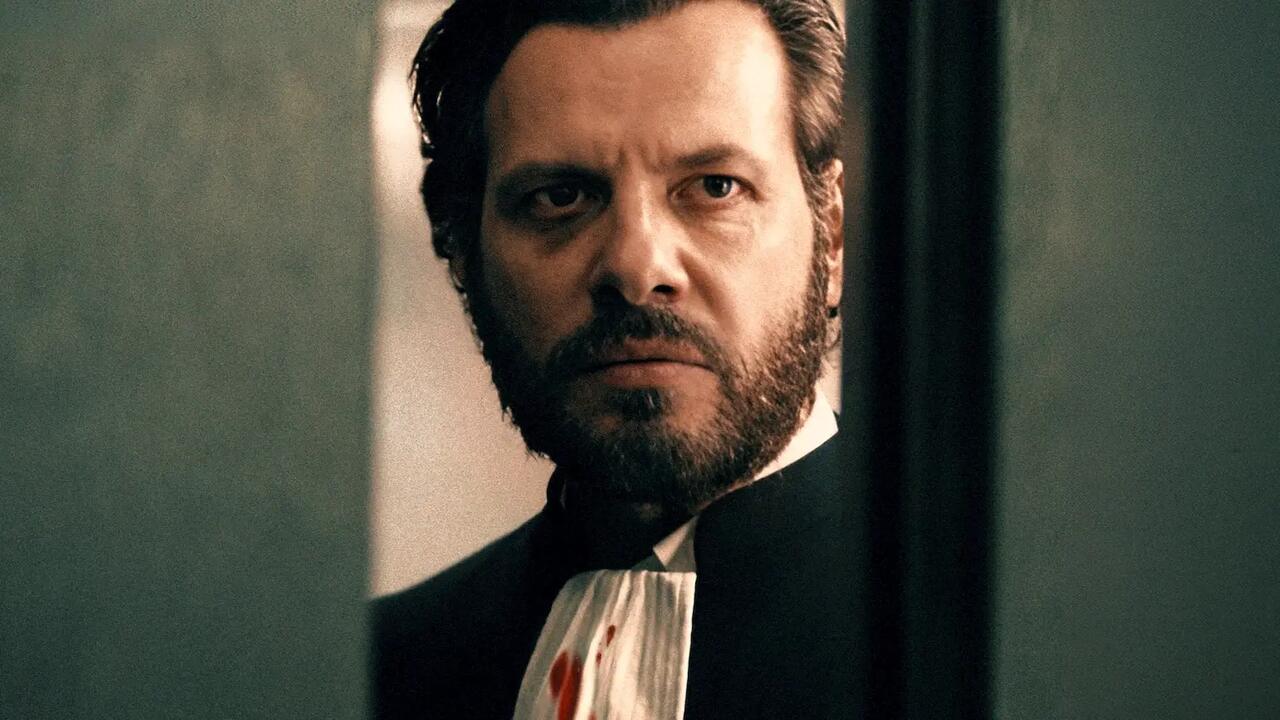
A lawyer is supposed to build a convincing case. Léonard Landry, the central character of A Good Lawyer, has built a career on doing precisely that. The trouble is that he has become increasingly incapable of defending himself. A criminal defence attorney with a serious cocaine and alcohol problem, Léonard reaches an extraordinary low when he collapses from an overdose in the middle of a courtroom. Following rehabilitation, he has just one week to prepare for a major case and confront the professional consequences of his own behaviour. It is an intriguing setup for a legal thriller, although the film is ultimately more interested in the man at the centre of the courtroom than in the legal battle itself.
Directed by Tristan Séguéla, the French drama stars Laurent Lafitte as Léonard Landry, a brilliant but deeply unreliable lawyer whose professional confidence has long concealed a destructive personal life. His return to work is complicated by the case of a powerful industrial group accused of links to a terrorist network operating in Africa. With a key witness involved and considerable interests at stake, Léonard takes on the challenge despite having very little time to prepare. He is assisted by Noé (Anthony Bajon), a determined young intern who finds himself working alongside a man whose judgement is considerably less dependable than his reputation suggests.
The film's central contradiction is its strongest asset. Léonard is exceptionally good at understanding the weaknesses of other people, yet he seems almost incapable of recognising the extent of his own. His ability to manipulate situations has helped him survive professionally, but the same instinct becomes dangerous when applied to his personal life. Even after rehabilitation, he still looks for shortcuts, negotiates around inconvenient truths, and treats consequences as problems he can manage with enough cleverness. Lafitte makes this contradiction worth watching. His performance is the film's most convincing element. Léonard is not presented as a particularly sympathetic character, and the film does not make the mistake of treating addiction as an excuse for everything he does. He can be charming, intelligent and entertaining, but also selfish and frustratingly evasive. Lafitte understands the difference between playing a man who is out of control and playing someone who desperately needs everyone else to believe he is still in control. His physical performance, expressions and shifts in demeanour communicate a great deal about Léonard's internal instability.
There is also something compelling about watching a man whose professional skills have become instruments of personal avoidance. Léonard knows how to construct an argument, identify an opportunity and persuade others to accept his version of events. His attempts to return to normality are frequently accompanied by the same evasiveness that contributed to his downfall. He may have completed rehabilitation, but the film makes it clear that physical recovery and genuine personal change are two very different achievements.
Anthony Bajon provides an effective counterpoint as Noé. Where Léonard is experienced, cynical and accustomed to bending the rules, Noé is still trying to understand what practising law should look like. Their relationship supplies some of the film's more engaging exchanges. Noé is not simply an assistant who follows his senior colleague around; he becomes an increasingly important observer of Léonard's behaviour. His attempts to protect the older lawyer from his own decisions introduce a dry humour that works particularly well against the film's otherwise tense atmosphere.
The dynamic also raises an interesting question about professional mentorship. Noé has entered a demanding environment expecting to learn from an accomplished lawyer, only to discover that competence and integrity do not necessarily arrive together. Léonard can teach him how to handle a difficult case, but he is hardly an uncomplicated example to follow. Their interactions provide a useful perspective on the difference between being good at one's profession and being a person others should aspire to become.
The legal case itself, however, is less successful. The allegations involving a powerful industrial group, a terrorist network and operations in Africa give the film a potentially substantial political dimension. Corporate responsibility, international interests and the treatment of vulnerable communities could have provided the foundation for a gripping courtroom drama. Instead, the case often feels like a mechanism for pushing Léonard into increasingly difficult situations. Its wider implications receive less attention than the lawyer's personal crisis, and the legal proceedings do not always have the narrative clarity or tension the premise promises.
The film is also juggling several relationships that could have been developed more carefully. Mélanie Laurent plays Iris Saint-Didier, a prominent lawyer connected to both the case and Léonard's past. Their history adds another layer to his already complicated professional situation, but the writing does not fully establish the emotional weight of their relationship. Carole Bouquet, meanwhile, brings authority to the role of Anne Lamarck, representing the powerful interests surrounding the industrial case. Both performers add considerable presence, but their characters could have been more fully integrated into the central conflict.
This unevenness becomes more noticeable as the story progresses. The film wants to function as a courtroom thriller, a character study of addiction, and a story about professional redemption. These strands are compatible, but they need to reinforce one another. Here, the legal plot occasionally feels underdeveloped, while the personal drama is sometimes interrupted by complications that do not receive enough explanation. The result is a film that has several interesting ideas but does not always connect them convincingly.
At 114 minutes, A Good Lawyer is not excessively long, but its pacing can feel uneven. Its opening establishes Léonard's predicament effectively, and the one-week deadline gives the story a natural sense of urgency. Yet the film's momentum is not sustained throughout. Some developments are more confusing than suspenseful, and the eventual twists do not always carry the impact the screenplay seems to expect. Visually, the film adopts a darker, restrained style that suits its protagonist. The nighttime photography and subdued atmosphere complement the sense of moral uncertainty surrounding Léonard's life. There is little interest in making the legal profession look glamorous. Instead, the film presents a world of negotiations, compromises, and people who are often considerably less principled than their professional titles suggest.
What remains most interesting is its treatment of redemption. Léonard's return to work might initially look like an opportunity to rebuild his reputation, but the film gradually makes that objective seem insufficient. Getting back into a courtroom is one thing. Accepting responsibility for the damage he has caused is another. The distinction gives the story a more meaningful foundation than the conventional idea of a brilliant lawyer making one last comeback.
A Good Lawyer is therefore a worthwhile character drama wrapped in a somewhat inconsistent legal thriller. Laurent Lafitte gives it a strong centre, and his exchanges with Anthony Bajon provide much of its personality. The courtroom material has its moments, but the film could have done considerably more with its political and legal premise. It is at its most effective when it stops trying to construct an elaborate case and focuses on the deeply flawed man trying to put his life back together. Léonard may know how to defend almost anyone. Whether he can finally accept that he needs to answer for himself is a much harder question.
Final Score- [7/10]
Reviewed by - Anjali Sharma
Follow @AnjaliS54769166 on Twitter
Publisher at Midgard Times


Hi Everyone, after a due consideration, we have decided that we will be open for donations to help us in managing our website. We will be greatful for any kind of amount we receive. Thanks!
— Midgard Times 🎬 (@Moviesr_net) January 4, 2026
PayPal- [email protected] pic.twitter.com/DlNNz5Npm5
Get all latest content delivered to your email a few times a month.
Bringing Pop Culture News from Every Realm, Get All the Latest Movie, TV News, Reviews & Trailers
Got Any questions? Drop an email to [email protected]


 © Copyrights MOVIESR.NET All rights reserved