


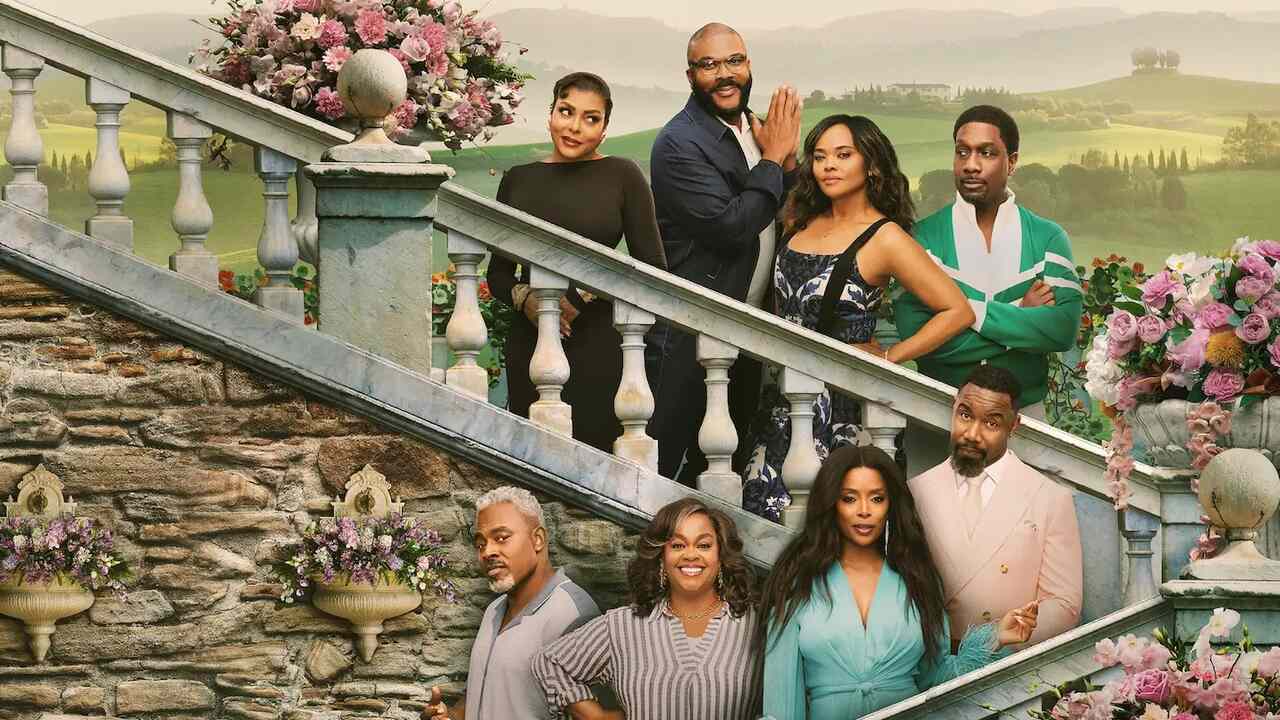
There are several questions raised by Why Did I Get Married Again?, but the most pressing one is not the title. It is: why did Tyler Perry make this again? Sixteen years after Why Did I Get Married Too?, the entire gang is back, now gathered in Lake Como for the wedding of Marcus and Angela’s daughter. The children are grown, the parents have aged, the scenery is considerably more expensive, and somehow everyone has brought the same emotional problems with them. I suppose that is the point. Unfortunately, it is also the problem.
Why Did I Get Married Again? Feels like a franchise reunion that nobody bothered to ask whether it had a reason to exist beyond the fact that everyone was available. Perry returns as Terry, alongside Jill Scott, Richard T. Jones, Tasha Smith, Michael Jai White, Lamman Rucker, and Sharon Leal, while Taraji P. Henson joins the group as Roselyn. The film is written and directed by Perry and runs for nearly two hours. And you can feel every single one of those minutes.
The basic premise isn't bad. Weddings are excellent pressure cookers for family drama, particularly when the people attending have sixteen years of unresolved baggage between them. The film also has an interesting generational idea: these parents are suddenly forced to confront the possibility that their children have inherited not only their personalities, but also their spectacularly questionable approaches to love. That could have made for a genuinely funny and emotionally sharp sequel. Instead, Why Did I Get Married Again? repeatedly behaves as though putting characters in a beautiful location automatically constitutes a screenplay.
Lake Como looks lovely, naturally. Everyone is dressed beautifully. The wedding is gorgeous. The houses are enormous. The water is sparkling. And somehow I have never seen so much money produce so little entertainment. The biggest problem is the writing. Perry's dialogue constantly announces what the characters are feeling instead of allowing them to behave like people who have feelings. Characters don't simply argue; they explain why they're arguing. They don't discover uncomfortable truths; they give speeches about the uncomfortable truths they have just discovered. There is a particularly exhausting quality to the way everyone talks in this film, as though every conversation is secretly waiting to become a church sermon. Someone will say something mildly inconvenient, and suddenly we're seventeen minutes into a TED Talk about marriage. I started wondering whether Lake Como had a return flight.
The humour doesn't help. There are funny moments, largely because this cast knows how to deliver a line even when the line itself has clearly been written by someone who has just discovered that people can be sarcastic. But too much of the comedy comes from repetition: somebody behaves badly, everyone reacts, somebody gives a speech, somebody reveals another secret, everyone behaves badly again. It is less a comedy of remarriage than a group project in which nobody did the reading.
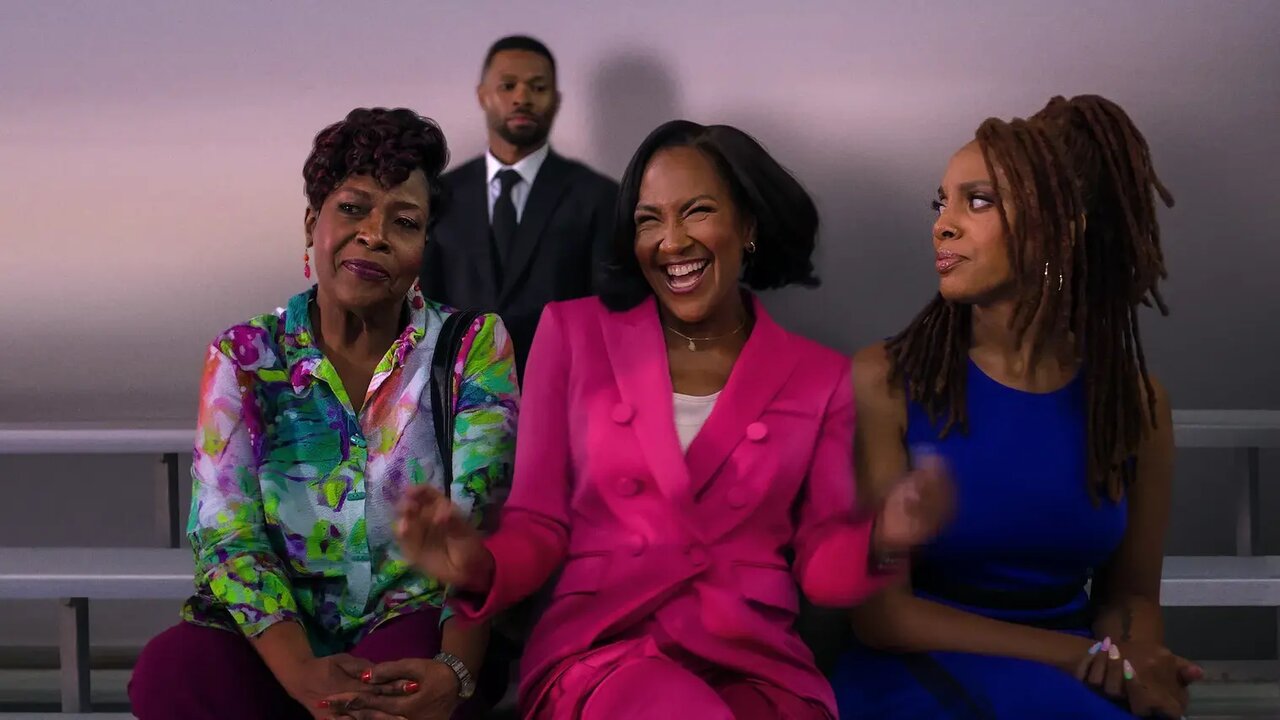
Jill Scott remains one of the best things about the franchise. Sheila has always had an emotional directness that works particularly well when the film stops trying to manufacture drama and simply lets Scott play the character. Richard T. Jones brings his usual energy, while Tasha Smith and Michael Jai White still have enough familiarity between them to remind you why this group worked in the first place. And then there is Taraji P. Henson, who arrives as Roselyn with the energy of someone who has wandered into a family reunion and immediately realised she has made a terrible scheduling decision.
Henson is good. She is also doing considerably more work than the material deserves. Her presence gives the ensemble some much-needed freshness, particularly because she isn't carrying sixteen years of franchise baggage in the same way as the returning cast. Unfortunately, the screenplay eventually traps her inside the same machinery of revelations, arguments, and speeches. Even Taraji Henson cannot permanently survive a Tyler Perry monologue.
The film's treatment of the younger generation is similarly frustrating. Jasmine and Wesley's wedding is supposed to provide the central occasion, but the younger characters mostly function as a convenient mechanism for the adults to reconsider their own lives. Which is a shame, because the generational premise is probably the most interesting idea here. Imagine a film actually examining what happens when children grow up watching their parents navigate infidelity, resentment, reconciliation, divorce, remarriage, and all the other emotional disasters that these films have accumulated over the years. Instead, we mostly get: look, they're doing relationship problems too! Subtlety has apparently been denied entry to Lake Como.
The pacing is another disaster. At 1 hour and 51 minutes, this isn't an especially long film, but it repeatedly feels like it is about to end and then remembers it has another lesson to teach. The story keeps cycling through the same emotional territory, with revelations arriving less as genuine surprises than as scheduled appointments. At one point I stopped wondering what was going to happen and started wondering which character was going to need a serious conversation next. The answer, naturally, was everyone.
There is also something oddly weightless about the drama. These people are supposed to have complicated histories with one another, but the film often treats major relationship revelations as temporary turbulence before everyone gathers for another conversation about love. The emotional stakes are constantly being announced, but they rarely feel earned. And that is the fundamental weakness of Why Did I Get Married Again?: it confuses talking about emotional depth with actually creating it. The original films had a certain messy sincerity. Even when they were melodramatic, the relationships felt consequential. Here, the franchise feels older without necessarily feeling wiser. The characters have aged; the storytelling hasn't. There is a bizarre irony in watching a movie about marriage that seems fundamentally incapable of committing to a single tone.
Seeing this cast together again does have a certain appeal. Jill Scott, Tasha Smith, Richard T. Jones, Michael Jai White, Lamman Rucker, Sharon Leal, and Perry have enough history with these characters that there are occasional flashes of the old chemistry. If you grew up with the franchise, there will probably be moments where simply seeing these people together again produces a genuine smile. I just wish the movie had trusted that. It keeps trying to manufacture the emotional reunion instead of letting the reunion itself be emotional. That's the difference between nostalgia and exploitation of nostalgia.
The film also has a strange relationship with its own title. By the end, I wasn't particularly interested in why these characters got married again. I was interested in why we had to sit through another round of it. Still, there is one thing I will give Perry: the film is recognisably his. The melodrama, the relationship therapy disguised as dialogue, the sudden emotional confrontations, the enormous ensemble, and the belief that absolutely every problem can be resolved if everybody sits down and tells the truth are all unmistakably Tyler Perry. Whether that is a compliment depends entirely on your tolerance for Tyler Perry.
Why Did I Get Married Again? takes an interesting premise—a wedding bringing an old group of friends back together and forcing them to confront the ways their children resemble them—and buries it under repetitive arguments, obvious revelations and enough relationship speeches to qualify as a postgraduate degree in marriage counselling. The cast deserves better. Taraji P. Henson, Jill Scott and several of the returning performers are capable of making considerably more out of the material than it deserves. The Lake Como setting is beautiful. The central generational idea occasionally peeks through.
Final Score- [3.5/10]
Reviewed by - Anjali Sharma
Follow @AnjaliS54769166 on Twitter
Publisher at Midgard Times
Hi Everyone, after a due consideration, we have decided that we will be open for donations to help us in managing our website. We will be greatful for any kind of amount we receive. Thanks!
— Midgard Times 🎬 (@Moviesr_net) January 4, 2026
PayPal- [email protected] pic.twitter.com/DlNNz5Npm5
Get all latest content delivered to your email a few times a month.
Bringing Pop Culture News from Every Realm, Get All the Latest Movie, TV News, Reviews & Trailers
Got Any questions? Drop an email to [email protected]

 © Copyrights MOVIESR.NET All rights reserved