


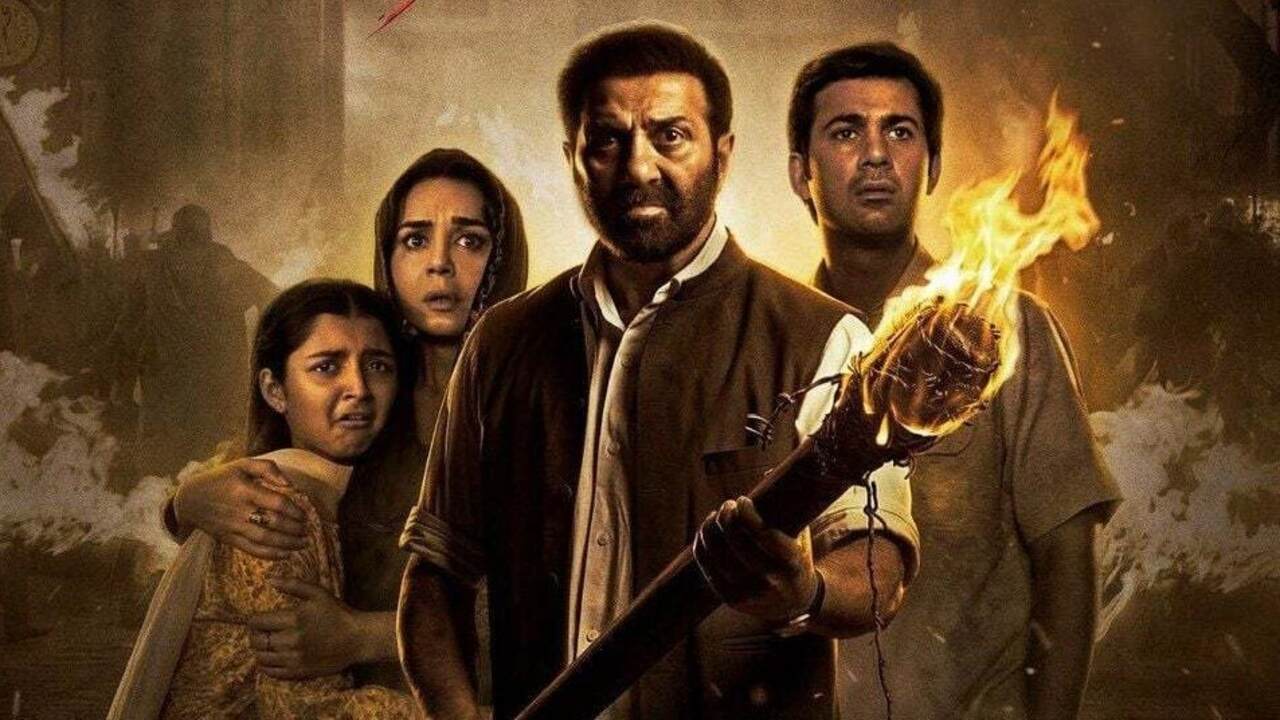
In Batwara 1947, Rajkumar Santoshi indulges his affection for old Bollywood tropes and style. Or perhaps this is the only way Santoshi knows how to make movies (no one seems to have introduced him to the modern film grammar and tone that have evolved since the 1980s/90s). Whatever the reason, Batwara 1947 has a villain like Yaqoob Shuja/Pehalwan (Abhimanyu Singh), who, like those early Hindi movie villains who exuded rapey vibes, ends most of his sentences with a short, signature phrase (in this case: "halke se"). What's more, one of his henchmen has a half-closed right eye, and all of them appear to have been airlifted from an earlier era of Bollywood filmmaking. That era and those tropes are now rightfully extinct. And by clinging to the past so tightly, Santoshi only sets fire to his present, with the victim being his new film. Batwara 1947 is a shoddy misfire; there is a mismatch between the substance and the style.
Something seems very, very wrong from the beginning. I got a handle on the clumsy aesthetic during the scene where Sikander Mirza (Sunny Deol) chides a government employee for running a black-market racket to allot houses in Lahore to Muslim migrants. When Sikander raises his voice, the crowd goes silent and, like statues made of stone, stands awkwardly and quietly in place. These extras don't seem very different from the extras who go mute and still in a TV serial. There is zero movement, as if everybody has been ordered to remain a silent, immobile witness to the protagonist's heroic antics. The crowd looks artificially assembled, rather than like a group of people who have temporarily stopped what they are doing to see the drama and hear the noise. Santoshi mixes old-school melodrama with cheap TV aesthetics, which is visible not just in his handling of the background actors but also in the low-rent gaze with which he looks at and uses his surroundings.
The Lahore in Batwara 1947 has no grit, no flavor, no texture, no real beauty. The architecture, the roads, the shops, the lanes all have a picture-postcard appeal. Even a burnt wall and a damaged red letterbox seem to have been put together with "taste" and some aesthetic "sensibility." The movie is based on Asghar Wajahat's play Jis Lahore Nai Vekhya, O Jamya E Nai, which means "He who has not seen Lahore has not been born yet." But the Lahore of Batwara 1947 is not that romantic. It's a plastic set that's not really worth seeing. For a movie that's set during the Partition and deals with its violence, Batwara 1947 curiously looks clean, digestible, and glossy. Santoshi is inept at filming bloody scenes—he even airbrushes the sight of burning bodies. The images are virtually devoid of drama and emotion. Hence, the loud, manipulative music is ladled over the clumsy images to pump them up with sentimentality. On top of this, the loud, manipulative performances further push the movie into such heavy melodrama that many scenes fall apart because they are unintentionally funny. When Sikander gets irritated by Durgavati Devi/Mai (Shabana Azmi) and says that her son must have died, you don't feel sorry for her or angry at him. The people at my screening, in fact, responded with chuckles, which was possibly the default mood in the theater for most of the melodramatic scenes.
I noted in my review of Musafir Cafe that melodrama severely tests an actor's skill because an incompetent performance breaks the spell and destroys the tone of the whole film. In Batwara 1947, however, given that nothing truly works the way it should, the blame must be entirely laid on Santoshi. He not only renders capable actors awful (only Sunny Deol manages to walk away with some dignity); he also generates a Shabana Azmi performance that gets under your skin. Azmi's Mai talks in a weepy voice. She often howls and cries or seems on the verge of howling and crying. If you thought Azmi was terrible in Dabba Cartel, wait till you watch her in this movie. I was so infuriated and ultimately so exhausted by her teary, pathetic voice that I personally wanted to go to Lahore to drag her to India just so we could be spared from watching more of this glop of a movie. Unsurprisingly, her best scene is her death scene.
Batwara 1947 is Preity Zinta's comeback to acting after an eight-year hiatus, though the welcome she receives is certainly underwhelming. Her scenes are almost inconsequential, but she gets to pay lip service to the idea that men make stupid decisions that end up harming women without their consent. It's all done through a disposable line, which is loaded not with weight or significance but with a desperation to score brownie points with liberals. Because the women in Batwara 1947 do nothing more than scream and cry and have their clothes torn by bad guys. That's their sole, narrow function in the hands of Santoshi. Then there is Karan Deol, who tries so hard to emote even basic expressions that, more than his emotions, we register his efforts more clearly. Oh, Ali Fazal also...exists. He pops up now and then to spout "poetic" lines that make one wonder if he's really a poet or merely posing as one until he gets employed. His "love track" is shoehorned into the story to repeat an idea that becomes clear very early in the film—and throughout it.
Batwara 1947 can be summed up as "Religion is not bad; it's the people who are bad" or as "Hindu Muslim Bhai Bhai." This is all there is to this movie, which never rises above these generic remarks that are hammered into our brains through dialogue and scenes loaded with these basic points. If Batwara 1947 were an activist, it would have been the armchair kind who writes surface-level moral tweets. There is no attempt at complexity. Santoshi keeps his themes as clean and impersonal and shallow as his filmmaking. In one scene, Sikander stands on the street contemplating something while the vehicles pass him by at high speed. In another, there is a harsh cut from one scene (I don't remember exactly) to the laughing face of Mai, and the effect is both inadvertently hilarious and jump-scare-worthy. I remember reading an interview with Deol a few months or perhaps a year ago in which, when he was asked why Batwara 1947 (it was titled Lahore 1947 then) was facing so many delays, he replied that Aamir Khan, who is the producer, was busy fine-tuning the editing of the film to polish it, to perfect it. After seeing the movie, I couldn't help but wonder whether Khan's eyes were closed the entire time. And if this version of the movie is the result of Khan's "fine-tuning," then he shouldn't be allowed to polish any other film. Or maybe the blame again lies with Santoshi. If the filmed material is bad, how much can editing really salvage it?
Santoshi's period drama is the third part of the 2026 Partition Trilogy, which began with Sriram Raghavan's Ikkis and was followed by Main Vaapas Aaunga, directed by Imtiaz Ali. None of the movies in this trilogy are good, but Batwara 1947 is the worst of the lot. Taken together, what the unofficial trilogy reveals is something far more dismaying: the inability of talented, veteran filmmakers to deal with political subjects and relevant topics. The problem probably lies in their effort to make films for what I like to call the "Twitter crowd," which is filled with people who are too content to congratulate each other for making the most basic and generic "good points." Partition itself is a sensitive issue, and it requires—nay, demands—filmmakers with great maturity, understanding, and intellect to deal with it (see: Deepa Mehta and M. S. Sathyu). Instead, what we get are superficial, self-serious, and self-congratulatory dramas with negligible aesthetic import and little to no insight (didn't it occur to Santoshi to give us a few scenes of intimate conversations between Mai and Sikander's family in which they discuss what's common or different between India and Pakistan in terms of the atmosphere, food, and general vibes?). I don't know how people who responded enthusiastically to Ikkis and Main Vaapas Aaunga will respond to Batwara 1947. When it comes to Imtiaz Ali's film, many praised it precisely for making them cry. The more tears someone shed, the more approving they were of the film. Now here is Santoshi's Partition drama that itself wails and sheds tears profusely. Will the same people now demand that Batwara 1947 be sent to the Oscars to represent India? They might, after all, not be alone in the theater when it comes to bawling.
Final Score - [1.5/10]
Reviewed by - Vikas Yadav
Follow @vikasonorous on Twitter
Publisher at Midgard Times


Hi Everyone, after a due consideration, we have decided that we will be open for donations to help us in managing our website. We will be greatful for any kind of amount we receive. Thanks!
— Midgard Times 🎬 (@Moviesr_net) January 4, 2026
PayPal- [email protected] pic.twitter.com/DlNNz5Npm5
Get all latest content delivered to your email a few times a month.
Bringing Pop Culture News from Every Realm, Get All the Latest Movie, TV News, Reviews & Trailers
Got Any questions? Drop an email to [email protected]


 © Copyrights MOVIESR.NET All rights reserved