


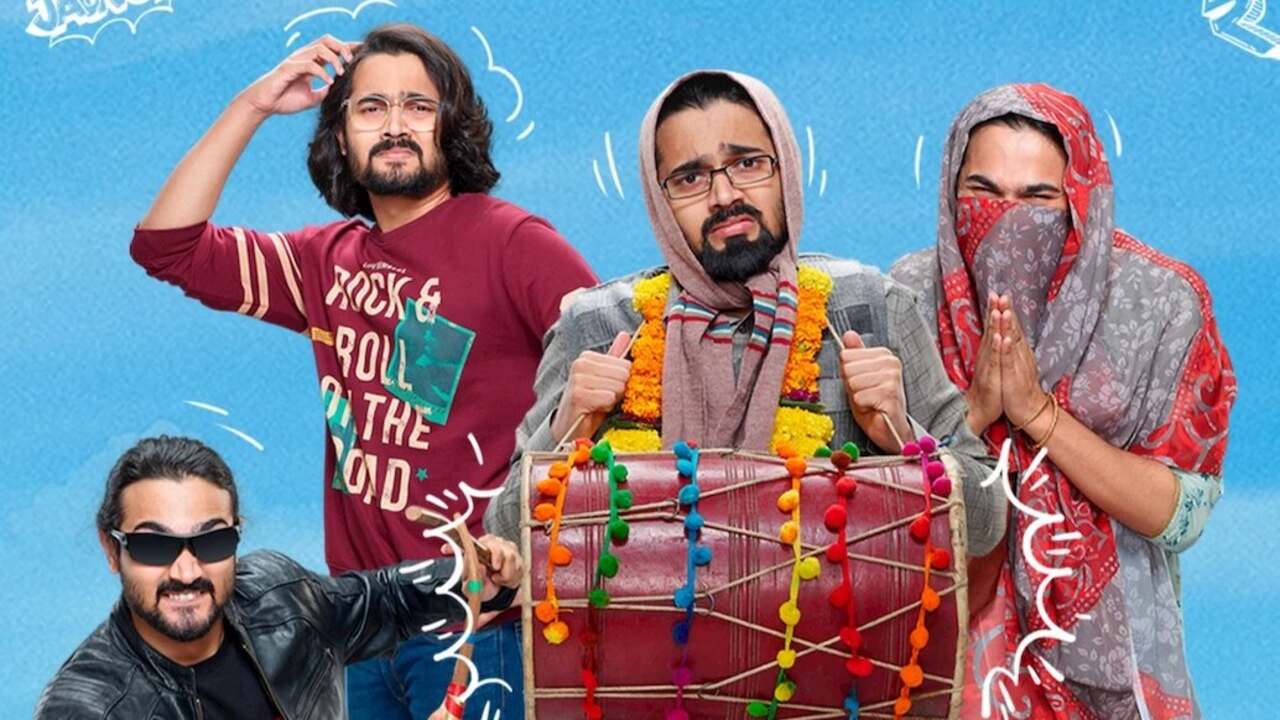
Dhindora's USP is what drives the sketches on Bhuvan Bam's YouTube channel: watching Bam play multiple characters himself, making each distinct from the others. It could have felt like a shallow gimmick if Bam weren't actually a good actor. But he is adept at playing all these characters, as though he can comfortably slip from one skin into another. Then there are the funny one-liners, punctuated by colorful obscenities, that become a comic force in themselves. Bam has a sense of humor, all right, and in Dhindora, it comes through in lines like "Harman Baweja ko Hrithik Roshan samajh liya" and in witty in-show TV jokes, such as a cooking show that suddenly turns into a phenyl advertisement. The latter had me laughing my guts out. It's the kind of silly joke that also requires a certain intelligence. Another area in which Dhindora shines is its use of Anup Soni as a Crime Patrol host for self-referential purposes. Soni's appearances are the most unpredictable thing about the show (except, perhaps, for one that comes in the middle of a chase sequence). Within its sketch-like boundaries, Dhindora is sufficiently watchable.
Bam, though, wants to make his show something else. He isn't merely interested in doing something along the lines of Saturday Night Live's comedy sketches. He builds a story around middle-class life, situates it in Delhi, and steps into the shoes of ten characters. Fans will immediately recognize Titu Mama, Babloo Ji, Sameer, Bubbly Sir, Janaki, Hola, Bancho, and others. They don't need introductions. And if you're new to Bam's work, don't worry. Go in with a blank slate, and you won't miss out on any "deep psychology" by being unfamiliar with his videos and these characters. This is why I think Dhindora might have been better off as a Saturday Night Live-like series of sketches. As a narrative with a setup, a conflict, a resolution, and a tease for a second season, it ends up exposing the shortcomings of Bam's storytelling skills and the narrowness of his ambitions.
The essential problem with Dhindora is not unlike that of Taaza Khabar. As a writer-creator, Bam is too constrained by Bollywood clichés, which he recycles, perhaps because he wants to see himself in the very shots and tropes he admired on screen while growing up. I remember watching one of his interviews a few years ago in which he said that his ultimate destination was to enter Bollywood. That aspiration is quite implicit in his shows, which, alas, is not a compliment, because Bam's Bollywood is all plasticky, facile, and shallow. In Dhindora, for instance, the Bhuvan character falls in love with Dr. Tara Rumpum (Gayatri Bhardwaj; and yes, her name is a nod to the 2007 Siddharth Anand film) the moment he lays eyes on her. As in a typical Bollywood romance, their love story takes shape offscreen, leaving us with little more than superficially cutesy exchanges. They do talk about their careers, but the discussion is brief and serves mainly to set up the thin emotional drama surrounding the logic of long-distance relationships—and an "in-flight" joke—later on. Dhindora also recycles the familiar shot of a couple going through a temporary breakup, lying on their respective beds in separate houses, with a split screen making it look as though they're gazing at each other.
None of this is played for humor. Bam is dead serious, and that proves to be a fatal flaw here. Who needs a bucket of sentimentality and showers of tears in a comedy where Bancho, after Babloo's car accident, asks strangers to call 911? To top it all off, Dhindora delivers a dead-serious, preachy speech about middle-class dreams and dreamers that seems borrowed more from Instagram posts and meme pages than from personal experience. It belongs in a TVF series or video. And what's the ultimate lesson of Dhindora? Given that the characters' lives are ultimately changed by a lottery ticket, is Bam really suggesting that success comes not from hard work but from pure luck? Is that what he believes, too? Does he not think he has made it big through dedication and diligence? Bam has often spoken in interviews about consistency, determination, and patience, so a luck-based twist presented as a hard-earned reward leaves one uneasy. It comes across as a sugar pill for an audience being encouraged to rely on fate rather than do the work themselves.
Bam needs to break free not only from the image of Bollywood he has in his head but also from its bubblegum psychology and hokum. Otherwise, the upcoming second season, with its multiple Bhuvan Bam avatars, risks looking like an extended audition tape—or an echo chamber in which one voice drowns out everything else, all in the service of self-congratulation. Who wants to watch Bam beating his own drum? I'd rather watch one of his short YouTube videos and walk away sufficiently content.
Final Score - [4.5/10]
Reviewed by - Vikas Yadav
Follow @vikasonorous on Twitter
Publisher at Midgard Times


Hi Everyone, after a due consideration, we have decided that we will be open for donations to help us in managing our website. We will be greatful for any kind of amount we receive. Thanks!
— Midgard Times 🎬 (@Moviesr_net) January 4, 2026
PayPal- [email protected] pic.twitter.com/DlNNz5Npm5
Get all latest content delivered to your email a few times a month.
Bringing Pop Culture News from Every Realm, Get All the Latest Movie, TV News, Reviews & Trailers
Got Any questions? Drop an email to [email protected]


 © Copyrights MOVIESR.NET All rights reserved