


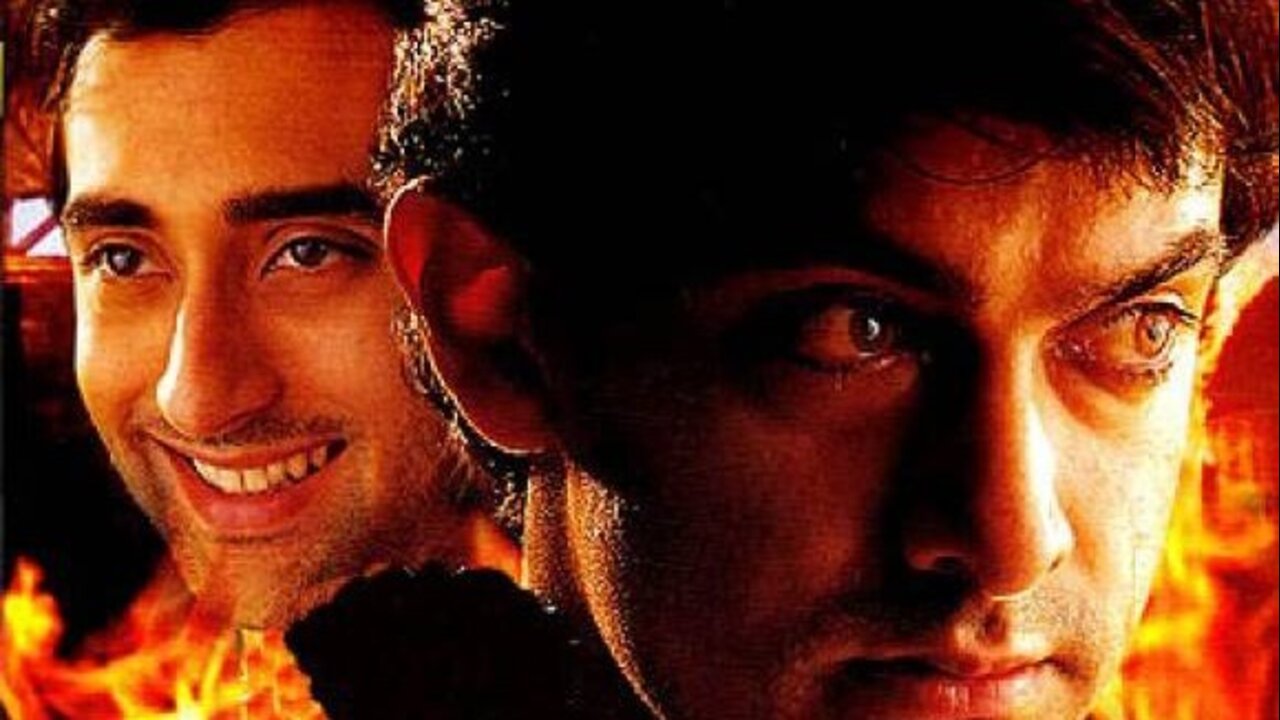
At the International South Asian Film Festival, Deepa Mehta explained why she made Earth: "I just don't understand the people who live together for years; why they are ready to kill each other." In Earth, Mehta examines that question in such a deep, personal, humanistic way that she ends up making one of the greatest films ever made about Partition (the other, of course, is M. S. Sathyu's Garm Hava). Mehta's imagination is on full display not only in her visuals—the terrace that witnesses a joyful kite-flying competition also becomes a platform from which the characters survey horrific violence—but also in her writing, which plunges to the atomic level of human behavior.
Here is a film dealing with Partition in a Lahore where Muslims constitute the majority, but where wealthy Hindu businessmen, Sikhs, and Christians have lived for years. Yet Mehta primarily roots the film in the perspective of a young Parsi girl, Lenny (Maia Sethna), who has polio.
Just meditate on this radical choice for a second. Mehta not only centers the narrative on a minority family but also singles out a minority within that minority: a young girl who is herself physically marginalized by polio. This is not incidental. Lenny's Parsi identity places her outside the Hindu-Muslim conflict, while her disability gives her another form of marginality—she is physically dependent on others and, in a world increasingly organized around divisions, belongs fully to none of the major groups around her. Mehta turns those marginalities into a formal advantage. Lenny can move between worlds because she does not entirely belong to any of them.
What's more, these Parsis are revealed to be "neutral." Bunty Sethna (Kitu Gidwani), Lenny's mother, narrates the story of how the Persians offered milk with sugar to an Indian king to demonstrate that they could blend into Indian society without fuss. Bunty wants to convey that Parsis are like that sugar—they can dissolve into the crowd. But the lesson Lenny derives is more potent and more unsettling: the Parsis are invisible.
That distinction between neutrality and invisibility is crucial to understanding Lenny's function in Earth. Her position as a Parsi places her on "neutral ground," and that ground allows her to move in and out of the lives and conversations of people belonging to different communities. She becomes a kind of cinematic lens—apparently invisible, able to observe everything from romance to violence without initially being treated as a participant in either. Lenny is there with Dil Nawaz (Aamir Khan), Hassan (Rahul Khanna), Shanta (Nandita Das), and their friends when they crack jokes and when they engage in political discussions. She is also present when Hassan and Shanta make out and when rioters enter her house and drag Shanta away on a cart. Lenny witnesses both love and war. She is not literally omnipresent, of course, but the film repeatedly places her at the point where different worlds collide with each other. She is, in effect, the film's mobile camera.
But unlike a camera, Lenny feels emotions and suffers. She isn't merely a spectator—a capturer of events and emotions. She registers what she sees, tries to understand it, and is changed by it. Lenny enjoys the company of the adults. She is there when they play pranks—Nawaz wears the guise of a saint with a direct line to God—and when they flirt with each other, as when Hassan takes Shanta for a ride on his cycle. At the same time, she gets an unfiltered view into the darker aspects of their world, as when Nawaz dispenses expletives or, consumed by rage, expresses his hatred toward Hindus.
Lenny becomes a firsthand observer of the poison of Partition. Sectarian hatred reaches her without an adult filter. Mehta shows that in a hostile setting, you cannot keep children safe from ugliness simply by refusing to explain it to them. They will encounter it anyway. Consider what Lenny's friend—the only boy her age who is also her friend—says when Lenny asks him what rape is: "Ek din kar ke dikhaunga."
This is what makes Lenny such a devastating center for the film. Her marginality does not protect her from history; it gives her a vantage point from which history enters her. She begins as someone who appears to stand outside the conflict, but the more she observes, the less possible that neutrality becomes. The camera can record violence and remain unchanged. Lenny cannot.
By putting Lenny at the center, Mehta sees the effects of Partition with a scalpel. She carefully peels away layer after layer to expose how a historical catastrophe enters the smallest units of human behavior. The male gaze appears when men stare at Shanta's chest at the park after she accidentally reveals her cleavage. Friendship slowly gives way to animosity. Love becomes entangled with jealousy. Economic and communal insecurity produce desperation—a young girl is married off to an old man in an attempt to keep her family safe from rioters. Childhood gives way to knowledge; knowledge gives way to betrayal and regret. Mehta does not treat Partition as an isolated political catastrophe. She shows how it seeps into existing relationships and corrupts them from within.
The last three points—loss of innocence, betrayal, and regret—come boiling to the surface during the climax, when Nawaz breaks Lenny's trust and gives rise to one of the most powerful and memorable endings in cinema. The brilliance of the scene is that Mehta does not need to turn Lenny into a political commentator. She lets her experience the consequences of the adults' politics. The historical becomes personal; the communal becomes intimate.
This is also where Mehta's understanding of Partition becomes more complicated than the familiar explanation that the British drew a line on a map and left India to deal with the consequences. The British may have left hastily and without a sufficiently organized handover, but that does not mean the violence can be understood only through British culpability. Mehta's film asks a more uncomfortable question: what made ordinary people capable of turning so violently against one another? Could the violence have reached such a horrifying scale if communal divisions, prejudices, resentments, and desires were not already capable of being weaponized? The British drew a literal line on the map, but the film suggests that the violence became possible because other lines already existed within society. Those lines did not disappear with Partition.
I have been wanting to write something about Earth since I watched Ikkis. Main Vaapas Aaunga and Batwara 1947 only strengthened that desire. The three movies, which can be said to belong to a 2026 Partition Trilogy, sorely lack the skill and complexity required to deal with such a significant subject. The filmmakers are gifted, veteran directors, and the aesthetic and narrative strengths visible in many of their other films are precisely what make their shortcomings here so egregious.
Ikkis, Main Vaapas Aaunga, and Batwara 1947 are absolutely products of modern times, though this isn't much of a compliment. They belong to a culture increasingly shaped by algorithmic audience-pleasing, social-media morality, and the demand that art make its moral position emotionally gratifying and immediately legible. These are films designed to generate emotional approval rather than intellectual discomfort. They make legible, often familiar points, receive glowing reviews for making them, and then become objects of cultural celebration because everyone can agree with what they are communicating to the audience. The filmmaking itself becomes secondary. What matters is that the audience leaves the theater knowing which side it was supposed to be on and feeling that it has experienced something Important.
The result is cinema that plays to the gallery. The Partition films, intentionally or unintentionally, seem designed for a crowd that judges a movie's strength by the number of tears shed in the theater. What or how these points are made doesn't matter enough. The moral conclusion is considered sufficient. That is why the films look superficial.
Earth offers almost the opposite experience. Its unflinching look at a historical period does not merely tell the audience that Partition was horrible. It holds a mirror up to the audience and asks it to look at the desires, prejudices, resentments, jealousies, and cowardice that make human beings capable of turning against one another. The discomfort it produces is more intoxicating, revealing, and vigorous than the cuddly, warm, surface-level blanket offered by Ikkis, Main Vaapas Aaunga, and Batwara 1947. And because Mehta makes us confront the rot in human relationships rather than merely condemn historical violence from a safe distance, the film ultimately serves as a stronger reminder of the need for peace between people of different religions.
A few days ago, the American culture journalist Emily Nussbaum wrote in favor of sex scenes on Bluesky, to which film critic Richard Brody replied that "the problem is that they should never be regular; regular conversation scenes, sure, but regular filming of extreme experience—sex or violence—is an inherent falsification; only the most original filmmakers should even try." The broader idea applies surprisingly well to recent Partition films as well. Extreme experiences are particularly vulnerable to cinematic falsification when filmmakers rely on familiar visual and emotional shorthand to represent them. By failing to grapple with the complications of a tragic event—by placing greater emphasis on making morally acceptable points than on creating something formally original, personally felt, and populated by dense, contradictory characters—Sriram Raghavan, Imtiaz Ali, and Rajkumar Santoshi do a disservice to the actual experience of Partition. They participate in gross trivialization precisely because they mistake the seriousness of the subject for seriousness of filmmaking.
Ikkis is at war with itself. Main Vaapas Aaunga has shallow characters, so it overly relies on Partition footage to evoke emotional reactions. Batwara 1947 turns violence into something cartoonish and its melodrama into something third-rate as well as mediocre. None of this means that the films are wrong to condemn communal violence or to mourn its victims. The problem is that cinema is not improved simply because its moral position is correct. A film can say the right things and still be artistically false.
This is where Earth, and Garm Hava for that matter, should be seen as textbooks for filmmakers who want to touch a sensitive subject. Not textbooks in the sense that they provide a formula for how to make a Partition film, but blueprints in the sense that great filmmakers unknowingly create them while pursuing their own personal visions. Mehta and Sathyu do not seem to be thinking about how to make a "great Partition film." They are trying to make their films. Partition becomes the historical pressure under which their characters, spaces, images, and relationships are tested.
That is what makes their movies so seductive and what allows them to remain relevant and fresh. Their love for cinema is undiluted by the pressure to hit certain numbers, generate a particular kind of social media reaction, or be hailed as a "success." The subject matters, but the filmmaker's way of seeing matters just as much. Earth does not survive because Partition is an eternally important subject. It survives because Mehta found an original cinematic language for showing how history enters the human body, the family, the friendship, the bedroom, the child's imagination, and eventually the conscience.
This is why an Earth or a Garm Hava can remain relevant across eras, both in style and substance. Their greatness isn't exhausted by the historical events they depict. The Ikkises and Main Vaapas Aaungas and Batwara 1947s of the world, meanwhile, will have a much shorter lifespan—not because their subjects are unimportant or because their moral positions are incorrect, but because they are so tightly bound to the cultural machinery that produced and celebrated them. They tell us what to feel. Earth makes us look at why we feel it.
Written by - Vikas Yadav
Follow @vikasonorous on Twitter
Publisher at Midgard Times


Hi Everyone, after a due consideration, we have decided that we will be open for donations to help us in managing our website. We will be greatful for any kind of amount we receive. Thanks!
— Midgard Times 🎬 (@Moviesr_net) January 4, 2026
PayPal- [email protected] pic.twitter.com/DlNNz5Npm5
Get all latest content delivered to your email a few times a month.
Bringing Pop Culture News from Every Realm, Get All the Latest Movie, TV News, Reviews & Trailers
Got Any questions? Drop an email to [email protected]



 © Copyrights MOVIESR.NET All rights reserved