


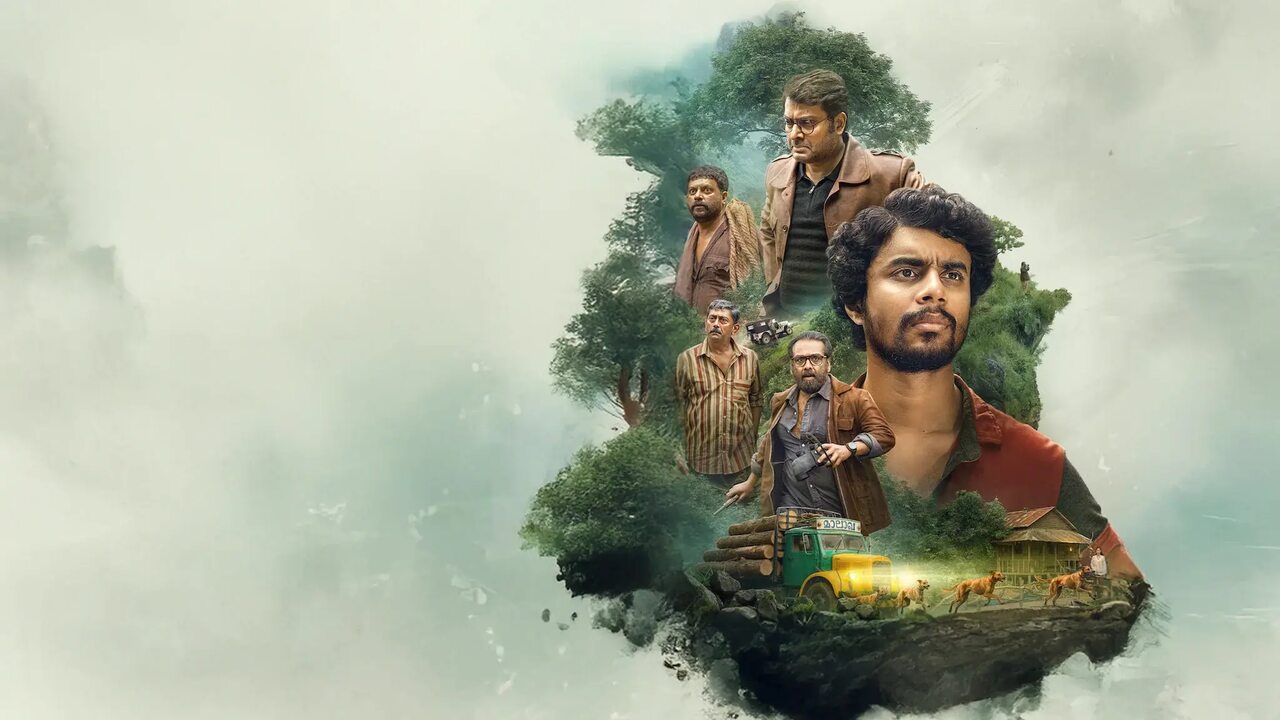
It's not a good sign when the best thing about a film turns out to be merely its writing. What's worse is when this so-called writing yields nothing more than minor genre pleasures that reach for deep, profound meaning. Dinjith Ayyathan's Eko is one such film. Written by Bahul Ramesh, it is a story of oppression and freedom, jail and jailer, hunter and hunted, told with a narrative sleight of hand that turns plot mechanics into a vehicle for a well-meaning yet emotionally hollow message. One can discuss the film's events at length without risking spoilers, since the rug is pulled only in the final thirty-odd minutes—and even that arrives through the disclosure of hints carefully concealed until the required moment. This renders Eko a film told with calculated cleverness, but the movie-watching experience itself feels more like a chore than a thrilling, exciting cinematic love affair.
Eko, basically, is about a wiry man named Peeyoos (Sandeep Pradeep), who is employed to care for a woman named Mlaathi Chettathi (Biana Momin). Hired by whom? Well, that constitutes a spoiler, so let's move on and focus instead on Kuriachan (Saurabh Sachdeva), a high-profile criminal who has gone missing and has since become something of a legend, with stories circulating about how he is hiding in a small cave, protected by his dogs. Dogs also protect Mlaathi from strangers; they roam the property like strict, alert guardians. Early in the film, when a doctor arrives at the house to check on Mlaathi, he is escorted by Peeyoos to assure the canines that he poses no threat (the dogs won't bark at you if they recognize you as their master's friend).
The tagline of Eko could well be "Dogs, dogs everywhere." Mohan Pothan (Vineeth) uses a female Husky to attract male dogs of a rare species. In a flashback, we see a house in British Malaya guarded by purebred dogs that fiercely obey the orders of their master, Yosiah (Ng Hung Shen). Yosiah brings with him Kuriachan and Mohan, who are in the business of researching various breeds of canines. This flashback unfolds during World War II, and we hear a line suggesting that dogs can be taught anything—that it is up to their master whether they are trained right. Is Eko implying that soldiers, like well-trained animals, merely do what they are ordered to do by the men at the top who hold them on a leash?
At one point, a character inappropriately compares female dogs with women, saying, "If she's in heat, she must be caged. Be it a woman or a dog." In Eko, however, the ones truly "in heat" are all men—whether in anger, lust, or greed. Some of them even resort to buying adult magazines for sexual release. What is carefully suggested—and mostly left unsaid—is that the men in the film do not think highly of women. Mlaathi is seen simply as an old woman who needs assistance during medical emergencies, while another woman is viewed as an object that must be seized. There is a third female character who appears briefly in an office, and in whatever little screen time she gets, she exists only to help Peeyoos with something. Eko, then, gestures toward flipping this perspective. That flip, however, is dispensed as nothing more than a surprising twist. I cannot proceed further without entering spoiler territory, so read on only if you've already seen the film.
Still here? Eko ultimately reveals that Kuriachan is trapped in a cave by Mlaathi, and that she has accomplished this with the help of the dogs—because she, not Kuriachan, is the real master of the animals and, by extension, this story. This act forms part of her revenge, as Kuriachan, in the flashback, lies to her about her husband's death in the hope of making her his wife. Eko, then, is about a woman's freedom from the grips of patriarchy, but Ayyathan and Ramesh do not bother to imagine what Mlaathi actually does with that freedom. How does she spend her days? How does she pass her time? When Peeyoos is not around, does she feel lonely? What goes on in her mind? What would she say if she were allowed to speak outside the boundaries of the script? These questions expose the filmmakers' lack of curiosity—their rigidity. So fixated are they on shocks and twists that they forget to add real substance (and human weight) to their story.
You might appreciate Mlaathi; you might even applaud Ayyathan and Ramesh for the reveal. But you don't really feel anything. For them, the characters are little more than chess pieces, arranged to fulfill the narrow demands of their unimaginative design. This unimaginative quality extends to the film's images as well, whose scenic beauty is captured with the eye of a YouTube vlogger rather than a filmmaker attempting to observe characters or convey deeper meaning. Eko, ultimately, becomes an example of regressive cinema—cinema emptied of fully developed ideas and stuffed with shiny tricks. It is an exposition-heavy (the dialogue merely delivers plot information), mediocre thriller dressed up with a prestige sheen.
Final Score- [3.5/10]
Reviewed by - Vikas Yadav
Follow @vikasonorous on Twitter
Publisher at Midgard Times


Hi Everyone, after a due consideration, we have decided that we will be open for donations to help us in managing our website. We will be greatful for any kind of amount we receive. Thanks!
— Midgard Times 🎬 (@Moviesr_net) January 4, 2026
PayPal- [email protected] pic.twitter.com/DlNNz5Npm5
Get all latest content delivered to your email a few times a month.
Bringing Pop Culture News from Every Realm, Get All the Latest Movie, TV News, Reviews & Trailers
Got Any questions? Drop an email to [email protected]

 © Copyrights MOVIESR.NET All rights reserved