


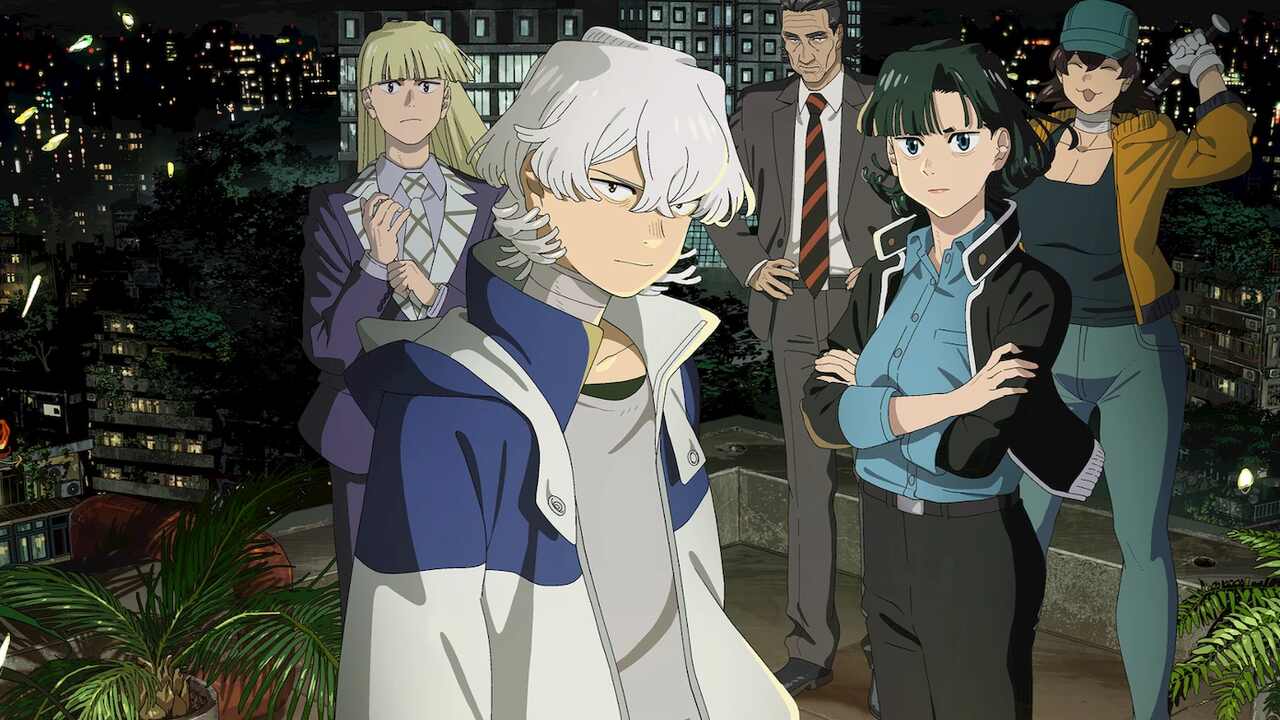
The most disturbing dystopias are rarely the ones in which humanity has been destroyed. They are the ones in which humanity has found a way to continue, but at a cost so grotesque that survival itself begins to look like a punishment. Fool Night starts with an idea that is difficult to shake. The Earth has been deprived of sunlight for generations. Thick clouds cover the sky, vegetation has largely disappeared, and the oxygen shortage has become an existential problem. Humanity's solution is Transfloration: a medical procedure that implants seeds into the bodies of people close to death, gradually transforming them into plants. These human-derived plants, known as Spiriflora, provide the oxygen needed to sustain the remaining population.
It is an extraordinary premise, partly because it turns something usually associated with renewal and beauty into an unsettling form of social infrastructure. A person can become a plant, but the process is not presented as some romantic return to nature. It is a transaction involving the body, mortality, poverty, and the value society assigns to a human life. At the centre of the story is Toshiro Kamiya, a young man whose circumstances have left him with little reason to imagine a better future. He works to support himself and his mentally ill mother, struggling with expenses and the demands of a society that offers little relief to people in his position. Transfloration becomes a possible escape from a life that has steadily exhausted him. After undergoing the procedure, however, he discovers that he can hear the voices of people who have already been transformed. This unusual ability draws him into an investigation involving a series of murders committed by a Spiriflor.
The transition from intimate human drama to murder mystery gives Fool Night a useful narrative engine. Toshiro's predicament is personal, but the world around him is built on institutions, medical systems and political arrangements that have normalised something deeply unsettling. The investigation gradually opens up questions about the technology itself and the people who control it. What initially appears to be a practical response to an environmental catastrophe begins to reveal a much darker structure.
I find the social implications of Transfloration more compelling than the mystery alone. The procedure is ostensibly a way of extending humanity's survival, but who gets to decide whose life is worth preserving, whose body can be repurposed, and what happens to the people who are no longer considered fully human? The fact that the procedure is offered to those nearing death is particularly important. Consent becomes complicated when the alternative is continued suffering, poverty, or an uncertain death. A choice can be legally voluntary and still be shaped by circumstances that leave someone with very little freedom.
Toshiro's economic situation gives this question its emotional weight. He is not approaching Transfloration from a position of scientific curiosity or ideological commitment. He is desperate. His decision emerges from the conditions of his life, and that distinction matters. The series' dystopia is therefore not simply a future in which technology has gone too far. It is a society in which technological progress has created another way for vulnerable people to bear the cost of collective survival.
The collaboration between SUNRISE and SHAFT is another reason the series attracts attention. Both studios have established identities, although their approaches to animation are quite different. SUNRISE has a long history with large-scale science-fiction storytelling, while SHAFT is known for more stylised visual experimentation. Bringing them together for a work like this is an appealing proposition. The world of Fool Night needs to feel oppressive without becoming visually monotonous; its central concept also lends itself to imagery that can be beautiful and disturbing at the same time.
The creative team includes director Atsushi Yukawa, series composer Jin Tanaka, and character designer Robert Sato. Tatsuya Kato handles the music, while Yota Tsuruoka serves as sound director. The opening theme, "Shake! spit out" by Tempalay, and the ending theme, "iki" by Nowlu, also give the production a distinct musical identity. There is a considerable amount of creative talent behind this adaptation, and the premise offers them an unusually rich world to work with.
The one danger is that Fool Night has so many ideas competing for attention that its central emotional thread can become secondary to the machinery of its world. Environmental collapse, medical ethics, economic inequality, bodily autonomy, institutional corruption, and murder are all substantial subjects. The conspiracy provides a way to connect them, but a mystery can also become a convenient device for explaining away complexities that deserve more room. The most interesting question is not necessarily who is responsible for the crimes. It is how an entire society came to accept the system that made those crimes possible.
Fool Night has the ingredients for a memorable science-fiction drama. Its central invention is genuinely unsettling, and its concerns extend well beyond the familiar spectacle of a ruined future. Beneath the mystery is a question about the limits of human necessity: how much can a society justify in the name of survival before the thing it is trying to preserve becomes unrecognisable? It is a question worth sitting with. In a genre crowded with collapsing governments, monstrous experiments and humanity's final stand, the idea of people becoming the very infrastructure that keeps everyone else alive is considerably more haunting.
Final Score- [8/10]
Reviewed by - Anjali Sharma
Follow @AnjaliS54769166 on Twitter
Publisher at Midgard Times


Hi Everyone, after a due consideration, we have decided that we will be open for donations to help us in managing our website. We will be greatful for any kind of amount we receive. Thanks!
— Midgard Times 🎬 (@Moviesr_net) January 4, 2026
PayPal- [email protected] pic.twitter.com/DlNNz5Npm5
Get all latest content delivered to your email a few times a month.
Bringing Pop Culture News from Every Realm, Get All the Latest Movie, TV News, Reviews & Trailers
Got Any questions? Drop an email to [email protected]


 © Copyrights MOVIESR.NET All rights reserved