


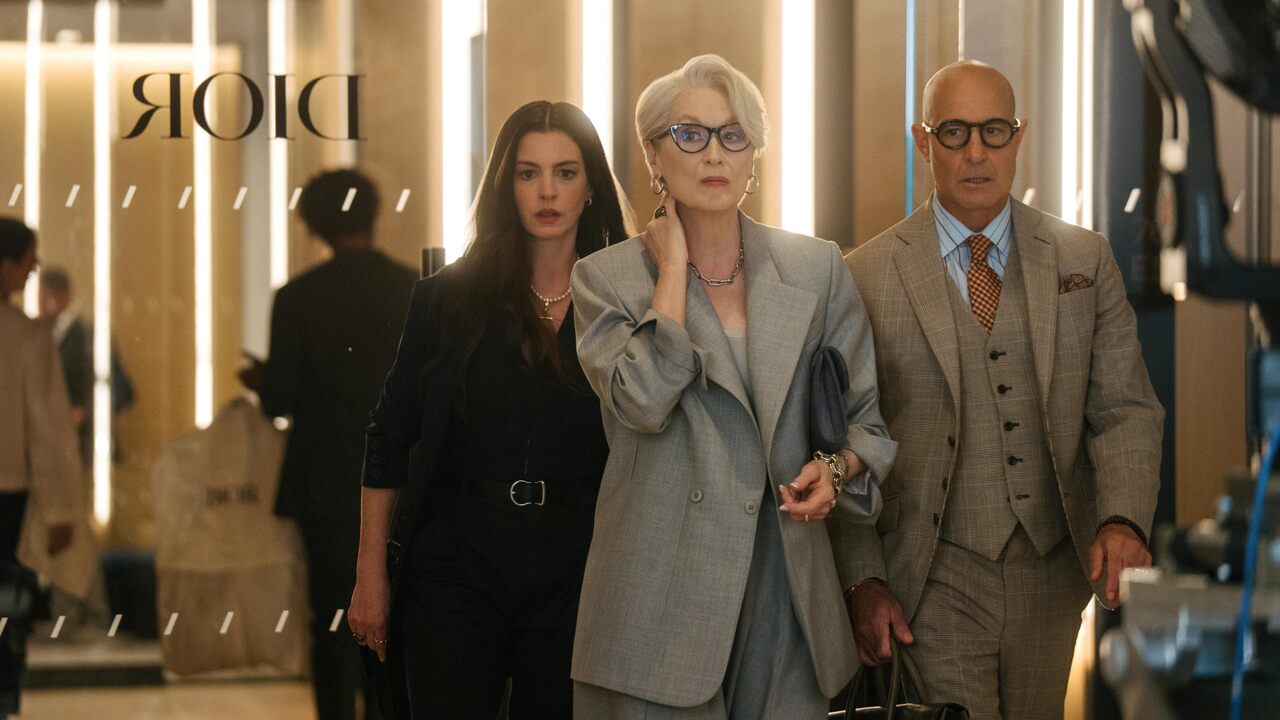
Meryl Streep recently expressed her displeasure at the Marvel-ization of movies, noting that there are too many clear-cut heroes and villains and that "it's so boring." Walking out of my screening of The Devil Wears Prada 2, I felt as though I had emerged from one of these Marvel-ized films stuffed with visual and verbal callbacks to the original, plus celebrity cameos meant to raise the temperature. According to Streep, the characters who resist easy categorization make for the most compelling stories, and perhaps that is why she enjoyed reprising Miranda Priestly, the editor of Runway magazine. Miranda is a strict workaholic, perpetually annoyed by those who are not as invested in excellence as she is. She demands perfection and has zero tolerance for mediocrity. She is so consumed by her work that she does not even know there is a cafeteria in her office building. But someone like Miranda, who constantly seeks elegance, high standards, and style, would never wander into a cafeteria when hungry; she would head straight for the most expensive restaurant, where the food might match her own exacting standards. Miranda is a marvelous creation, and Streep plays her with panache, subtle amusement, and that purring voice. An eye roll or faint smile from Miranda is more expressive and absorbing than almost anything else in the movie.
Both The Devil Wears Prada and this sequel derive much of their power from Streep and her co-stars, including Anne Hathaway, Emily Blunt, and Stanley Tucci. Their talents are displayed, more or less, like the expensive, colorful costumes paraded across the screen. There is style, certainly, but little depth or inner life. The performances remain external—they adorn the drama like varied live-action emojis. Miranda speaks of losing precious time with her children, but the regret remains skin-deep. What she might have said to them, or who she might have been beyond work, remains unexamined. Miranda is ultimately a stereotypical portrait of a corporate workaholic, distinguished largely by Streep's tonal precision and mannered brilliance. Andy and Emily are similarly thinly drawn. Their pasts are dispatched through a handful of generic lines summarizing the past twenty years, while their present is reduced to mere fodder for the script.
As a director, David Frankel feels merely workmanlike—competent enough to keep things moving, but never creative. He gets the job done, yet what is sorely missing is imaginative wit. Two moments linger: one involving Emily's husband making circus-y guesses, and another is this line, "Stockholm called; they want their syndrome back." Otherwise, the camera glides smoothly over silky, polished surfaces. Everything appears coated in a silver sheen. Yet the film itself is impersonal and incurious—not only about its characters, but also about the very subject it rather clumsily uses to justify its existence.
The Devil Wears Prada 2 opens with Andy, now a journalist, being fired alongside her colleagues moments before receiving an award for her writing. Yet Aline Brosh McKenna's screenplay never meaningfully explores that writing. What makes Andy's work award-worthy? What do her words actually sound like? One character praises her point of view, but we are given no sense of what that point of view is. Others rave about her articles too, but their praise feels hollow because the film never shows us the substance behind them.
As a journalist, Andy mostly scribbles in notebooks, taps away at a keyboard for a few seconds, and then publishes. The film shows none of the labor that gives writing shape and personality—no organizing of thought, no refining of drafts, no intellectual struggle. More glaringly, it never even allows Andy to discuss such processes with colleagues. That absence matters, especially in a movie ostensibly concerned with saving journalism. But the version of journalism The Devil Wears Prada 2 presents hardly seems worth saving because it never appears endangered to begin with. Despite the layoffs that open the film, neither Andy nor her colleagues seem to suffer. Concerns about rent, financial precarity, and professional uncertainty are reduced to clotheslines on which the filmmakers hang fancy merchandise. Andy is almost immediately installed as Runway's features editor. She wears luxurious clothes and moves seamlessly among the wealthy. By the end, she lands a $300,000 book deal. The movie might as well be suggesting that Andy's firing was a blessing in disguise.
Ultimately, the sequel turns journalism into little more than narrative noise—an excuse to recycle the formula of the first film. Its chief objective seems to be placing attractive actors in elegant clothing. It remains astonishing that the piddly 2006 original, in many corners, is venerated highly (its true star was costume designer Patricia Field). When I first saw The Devil Wears Prada, it struck me as the cinematic equivalent of a children's book—light on substance and not nearly as stylish as it imagined itself to be. Its message was simple: do not sacrifice honesty and values for the seductive glitter of luxury. In the sequel, Andy joins the "devil" yet retains her moral purity, much like Melanie Griffith's Tess McGill. Perhaps that is why the final shot—the camera slowly zooming out of Andy's office—feels reminiscent of Working Girl. Mike Nichols's 1988 comedy-drama may have earned six Academy Award nominations, including Best Picture, though I would not necessarily claim it superior to either Prada film.
Perhaps Miranda and her team's next assignment should be rescuing the Oscars themselves from irrelevance and mediocrity. Maybe the Academy truly does need the Miranda magic: high gloss paired with genuine respect for quality. The boss lady need only slip on her jacket, adjust her glasses, and declare, "Dear members of the Academy, I am coming."
Final Score- [4/10]
Reviewed by - Vikas Yadav
Follow @vikasonorous on Twitter
Publisher at Midgard Times

Hi Everyone, after a due consideration, we have decided that we will be open for donations to help us in managing our website. We will be greatful for any kind of amount we receive. Thanks!
— Midgard Times 🎬 (@Moviesr_net) January 4, 2026
PayPal- [email protected] pic.twitter.com/DlNNz5Npm5
Get all latest content delivered to your email a few times a month.
Bringing Pop Culture News from Every Realm, Get All the Latest Movie, TV News, Reviews & Trailers
Got Any questions? Drop an email to [email protected]
 © Copyrights MOVIESR.NET All rights reserved