


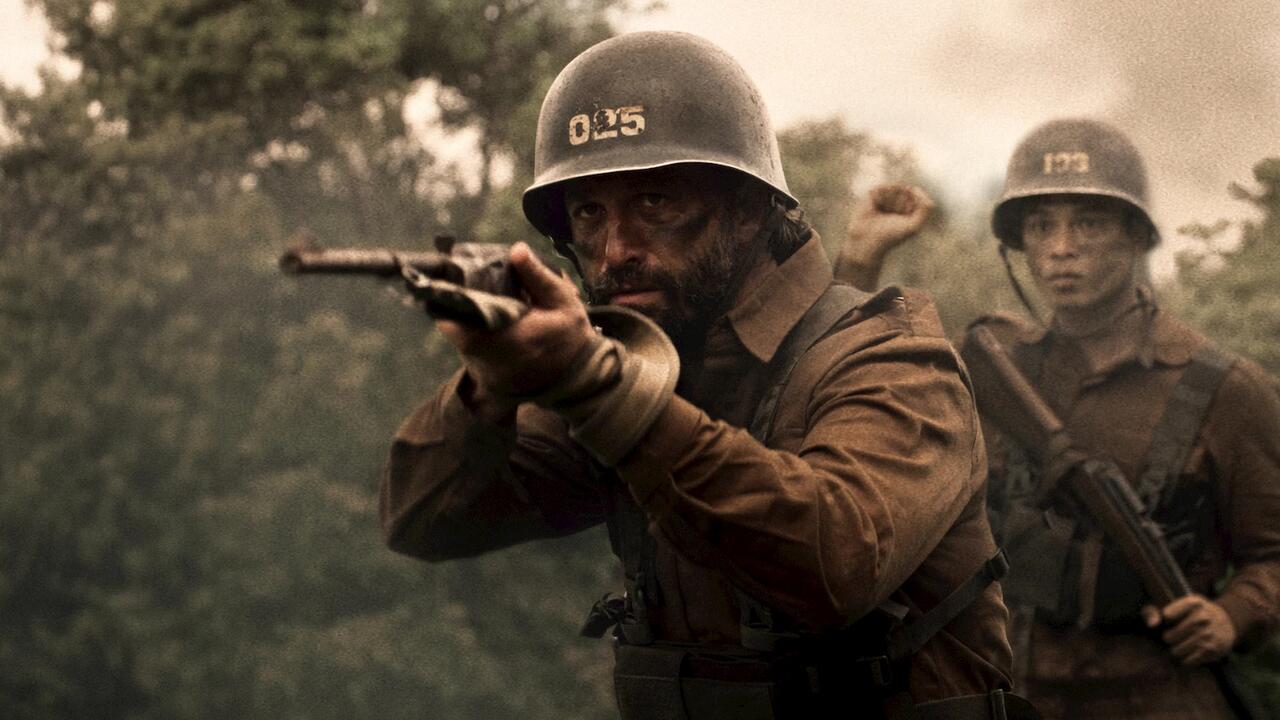
War films have a habit of arriving with their moral positions already assembled. There are soldiers, enemies, civilians caught in the middle, and eventually some variation of sacrifice that gives the violence a purpose. What interests me more are the stories that begin after the grand historical narrative has supposedly ended. The armies retreat, the political arrangements change, the maps are redrawn, and ordinary people are left to live with the consequences. The Ghost and the Gun wants to explore precisely that aftermath. It is an ambitious idea, even if the film does not always know what to do with it.
Directed by Anshul Tiwari and set in 1948 British Malaya, the film follows Ishraq Wan, known as Iz, and Abraham Bennett, or Abe, two soldiers left behind during the British withdrawal. Their wartime history is complicated, and their differences are not easily put aside. When an armed group threatens a village, the former partners are forced into an uneasy alliance. Their adversary is Chin Liu, a former comrade whose betrayal has turned into a personal vendetta. What follows is a story of survival, old loyalties and the psychological residue of a war that refuses to stay in the past.
The setting is the film's strongest asset. The Malayan Emergency is a period that rarely receives the cinematic attention given to the European and Pacific theatres of the Second World War. Its history is politically complicated, involving British colonial rule, communist insurgency, local resistance, and a population caught between competing forces. There is a great deal here that deserves to be explored, particularly from the perspective of the people who experienced the conflict rather than the military powers attempting to control it.
Tiwari has spoken about wanting to approach the period through an Asian perspective, focusing on the human cost of conflicts in which empires pursue their interests while local communities bear the consequences. That intention gives the film a welcome point of distinction. It is refreshing to encounter a war drama that looks towards a less frequently represented corner of history. Yet I kept wanting the film to push its historical perspective further. A story set during the British withdrawal from Malaya carries questions about colonial responsibility, political independence, and the violence accompanying the transfer of power. These are not incidental details. They are the conditions that make the story possible.
The central relationship between Iz and Abe provides a more intimate way into this history. Their partnership is built on necessity rather than uncomplicated affection. They have to trust each other despite everything that separates them, and the village's predicament forces them to confront what their shared military past actually means. The familiar unlikely-allies structure works reasonably well because the conflict is rooted in more than a disagreement between two men. They represent different positions within a larger history, and their cooperation carries implications beyond their immediate survival.
However, the film's personal drama sometimes feels more conventional than its setting deserves. The history suggests a complicated examination of loyalty, betrayal, and responsibility; at the same time, the narrative repeatedly gravitates towards the mechanics of a siege and the familiar emotional beats of a revenge story. Chin Liu, in particular, has the potential to be a fascinating antagonist. A former ally who has become an enemy offers an opportunity to examine how political violence transforms personal relationships. I wanted a little more attention paid to what brought him to this point, rather than having his role primarily defined by the threat he poses.
The performances are central to making this material work. Hazman Al-Idrus plays Iz, while Brett Tutor takes on Abe. Fabian Loo's Chin Liu is central to the film's conflict, and Asmara Abigail plays Siti, a woman from Pahang whose presence connects the military narrative to the threatened community. The ensemble is drawn from several countries, which gives the production an appropriately international character. Abigail is particularly valuable to the film's broader perspective: the village cannot simply function as a location for two soldiers to rediscover their humanity. Its inhabitants have their own lives, fears, and stakes in the conflict.
That distinction matters. War films often make civilians into symbols of innocence, conveniently positioned to remind soldiers what they are fighting for. The people living through political upheaval deserve more than that narrative function. The film's premise gives it an opportunity to explore how a community experiences the arrival of armed men, the disappearance of colonial authority, and the prospect of another violent force taking control. I would have liked this dimension to receive greater emphasis.
Visually, the production has an unusual story of its own. Rather than filming in Malaysia, the filmmakers recreated 1940s Malaya at Viking Sunset Studios in Bali, constructing fourteen period sets. The multilingual production, combining Malay and English, also gives the film a distinct identity. Its physical world has clearly required considerable planning, and the attention to period detail is important for a story so dependent on historical atmosphere. The cinematography by Boban James and Robyn Patrick's score contribute to the film's war-drama framework.
There is, nevertheless, a difference between recreating a historical environment and making that environment feel inhabited. Period costumes, weapons and sets establish the time and place, but the writing must do the harder work of making the audience understand what living through that period might have meant. The film's most interesting ideas concern the psychological scars left by war, yet the action-thriller structure occasionally competes with that quieter ambition. The urgency of defending the village is clear; the deeper consequences of the characters' histories could have been explored with greater patience.
The Ghost and the Gun deserves credit for bringing an underrepresented historical setting to a wider audience. Its intentions are worthwhile, its premise has genuine dramatic potential, and its international production gives it a distinctive place among recent Netflix war dramas. I only wish its storytelling were as adventurous as its choice of subject. The Malayan Emergency deserves a film willing to sit with its contradictions, rather than occasionally retreating into the familiar comforts of a siege thriller.
Final Score- [6.5/10]
Reviewed by - Anjali Sharma
Follow @AnjaliS54769166 on Twitter
Publisher at Midgard Times




Hi Everyone, after a due consideration, we have decided that we will be open for donations to help us in managing our website. We will be greatful for any kind of amount we receive. Thanks!
— Midgard Times 🎬 (@Moviesr_net) January 4, 2026
PayPal- [email protected] pic.twitter.com/DlNNz5Npm5
Get all latest content delivered to your email a few times a month.
Bringing Pop Culture News from Every Realm, Get All the Latest Movie, TV News, Reviews & Trailers
Got Any questions? Drop an email to [email protected]



 © Copyrights MOVIESR.NET All rights reserved