


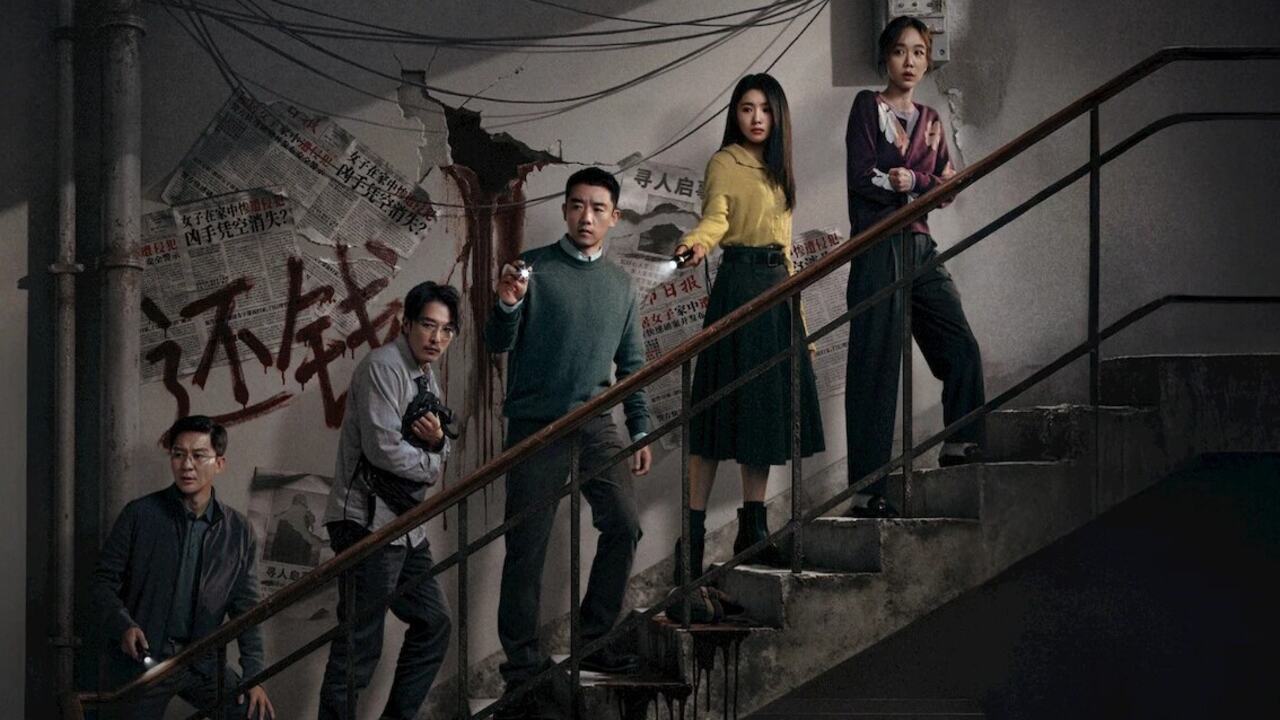
A young boy disappears from an apartment building, a debt-ridden gambler hides his father's dead body, and a woman becomes a victim of a drug-facilitated sexual assault one night. The police are initially brought in to investigate the case of the missing child, but the details of the other two crimes, too, unfold side by side. In that sense, the real detective in Vanishing Point (or Xiao Shi De Ren) is not Madam Fang (Huang XiaoLei), the cop who pursues the case of the apparent kidnapping. It's writer-director Cheng Wei-hao who pulls one string after another until a whole ugly box of truth comes tumbling out of the closet for everyone to see.
Wei-hao, though, doesn't exactly investigate anything. He doesn't construct Vanishing Point like a detective thriller or a police procedural, even though elements of both can be glimpsed in the story. No, a movie like this derives its suspense from hiding certain things from viewers up to a point, which is why there's little use scanning its surface with a magnifying glass to spot clues and connect the dots early, as if you could beat the film at its own game. If Vanishing Point is a puzzle-box movie, the key to the puzzle exists in the director's mind, and he chooses to provide the necessary pieces slowly and steadily to demonstrate how "clever" he is. Hence, the movie is devoid of mood, atmosphere, and a sense of urgency. The only thing that hooks you is the basic curiosity about what will happen eventually.
The performances, too, are laden with dramatic shortcuts instead of being absorbing or revealing. An awkward teen walks with her head down and has sad eyes. A mother speaks at a high pitch to convey how much stress she is under. A lonely, frustrated man whimpers to show that he is a wimp. You only need to take one look at these clichés to understand what kind of lives they live. The rest is a matter of plot twists that, anyway, don't significantly alter your first impression of the people on the screen. Combine this with a non-linear narrative that elicits not gasps but a sense of showboating—the revelations owe little to nothing to the investigation; they come when it's time to push the narrative forward—and you see Wei-hao as someone so in love with his own tricks that he fails to deliver the essential pleasures of a crime thriller or a detective mystery.
Still, if the writer-director manages to win you over a little, it's mainly due to his humanistic worldview, which embraces individuals who don't fit into the traditional definition of "normal" imposed by society. Wei-hao doesn't think a kid should be blamed for their parents' crimes, nor does he believe there is anything wrong with your child if they suffer from conditions like ADHD. What makes this world worth living in is the existence of human beings who hold on to progressive attitudes and embrace those who are taunted by everybody. Wei-hao builds the foundation of his film on empathy, and that lends it a nice warmth that does put you in a good mood and make you smile. It's a pity that this warmth doesn't fully rescue Vanishing Point from being an exercise in style—a style that's both trivial and distracting. Whatever its little virtues, Vanishing Point is the kind of film that, after a few weeks, if not immediately, ends up vanishing from your mind. Wei-hao might have opened his heart, though he fails to open himself up as an artist. That's something he should probably try doing the next time.
Final Score - [4/10]
Reviewed by - Vikas Yadav
Follow @vikasonorous on Twitter
Publisher at Midgard Times





Hi Everyone, after a due consideration, we have decided that we will be open for donations to help us in managing our website. We will be greatful for any kind of amount we receive. Thanks!
— Midgard Times 🎬 (@Moviesr_net) January 4, 2026
PayPal- [email protected] pic.twitter.com/DlNNz5Npm5
Get all latest content delivered to your email a few times a month.
Bringing Pop Culture News from Every Realm, Get All the Latest Movie, TV News, Reviews & Trailers
Got Any questions? Drop an email to [email protected]



 © Copyrights MOVIESR.NET All rights reserved