


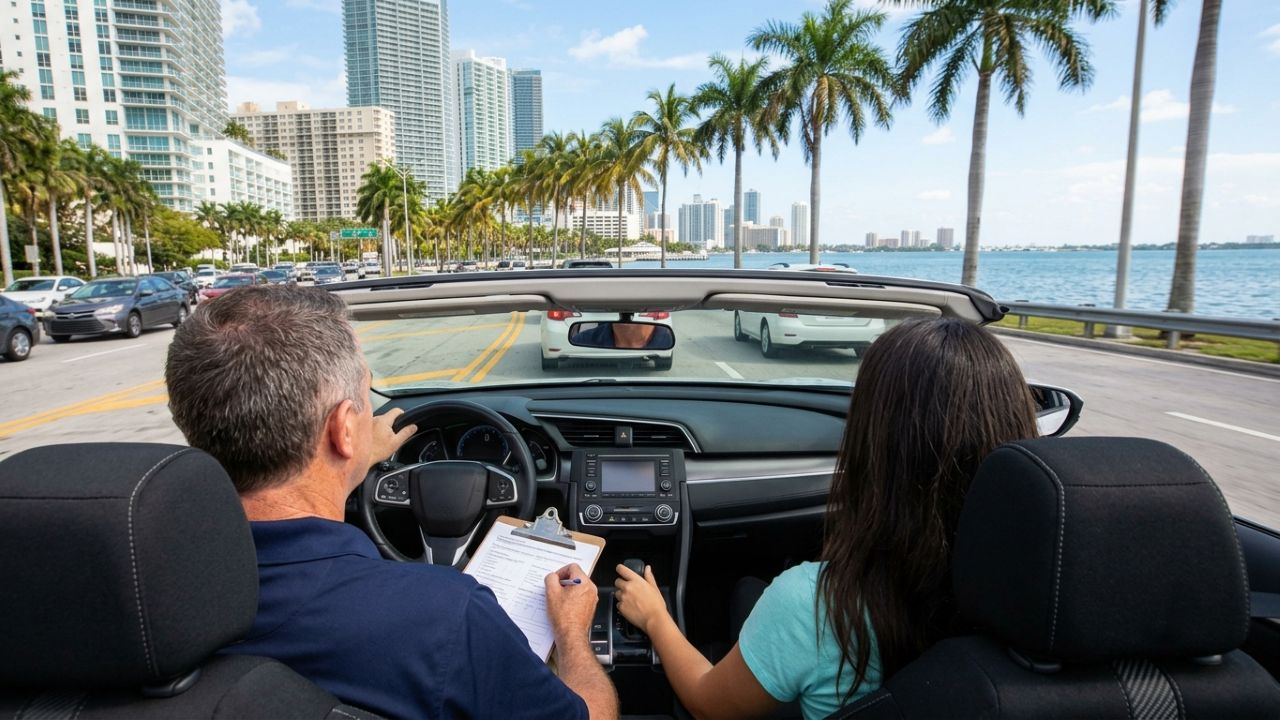
Your first driving lesson in Miami runs about 60 to 90 minutes and starts with an instructor checking your permit, adjusting the seat and mirrors, and walking you through the basic controls before you ever pull out of the parking lot. Most of the actual driving happens in an empty lot or a quiet residential street, focused on starting, stopping, and steering rather than anything close to real traffic. There's no highway driving, no parallel parking, and no night driving on day one. Schools that structure their first lesson this way, like PalmWay, generally see less first-lesson anxiety simply because nothing about the opening session is a surprise.
You'll need your learner permit or a valid photo ID, and if you're under 18, some schools also ask for a signed parental consent form before you get in the car. Forgetting the permit is the single most common reason a first lesson gets pushed back a day.
Most Miami driving schools offer pickup at your home, workplace, or a neutral location like a shopping center parking lot, and your instructor will typically confirm the exact spot the day before. First impressions here matter less than people expect - instructors are used to meeting nervous students and spend the first few minutes just talking, not testing.
Before anyone touches the wheel, the instructor usually asks a few quick questions - have you driven before, even informally, and is there anything specific making you nervous. This short conversation shapes the whole lesson, since a student with zero experience gets a different pace than someone who's driven a golf cart or an ATV before.
Getting the seat and mirrors right isn't a formality - it's the first real skill taught, since proper positioning affects blind spot visibility and reaction time for the rest of the lesson and every lesson after it.
The instructor walks through the gas and brake pedal, the gear selector, and where your feet should rest when not actively braking or accelerating. For automatic transmission vehicles, which is what most Miami students train on, this part takes just a few minutes.
Turn signals, hazard lights, wipers, and the parking brake all get a quick rundown before the car moves. Instructors keep this brief on purpose since information overload in the first ten minutes tends to backfire.
Almost every Miami driving school starts lessons in an empty lot or a quiet neighborhood street with minimal cross traffic, giving students room to get comfortable with the pedals and steering without the pressure of other drivers around them.
Jumping straight into Miami traffic on lesson one sets students up to fail before they've built any muscle memory. PalmWay, like most licensed schools, keeps the first session in a controlled setting and only moves into real traffic once basic vehicle control is solid.
The core focus of lesson one is getting a feel for how much pressure the gas and brake pedals need - jerky stops and starts are normal at first and expected by every instructor.
Students practice keeping the car centered in a lane at low speed, which sounds simple but takes real repetition since new drivers tend to oversteer before they find a natural feel for it.
Slow, wide turns in an empty lot come next, giving students a low-pressure way to practice how much to turn the wheel and when to start correcting back.
Even in a parking lot, instructors start building the habit of checking mirrors before moving, since this becomes second nature only through repetition from the very first lesson onward.
Highway merging and heavy Miami traffic are saved for later lessons, once basic control is no longer something the student has to consciously think about.
These road test maneuvers require a level of car control that almost nobody has on day one, so they're introduced a few lessons in, not during the first session.
Night driving lessons come later in the training sequence, well after daytime fundamentals are comfortable.
Most first lessons run 60 to 90 minutes, which is enough time to cover the basics without exhausting a student's focus, since concentration tends to drop off sharply after the first hour for beginners.
A few schools offer a slightly longer first session specifically to allow extra time for the seat and mirror setup, a longer Q&A, and more repetition on basic control before ending the day.
Flip-flops and heels make it harder to feel pedal pressure accurately, so closed-toe shoes with a flat, thin sole work best for a first lesson.
If your permit lists a vision correction restriction, bring your glasses or contacts - showing up without them can end the lesson before it starts.
Bringing water and dressing comfortably sounds minor, but a lot of first-lesson anxiety is just physical discomfort compounding normal nerves.
Experienced instructors talk students through each action out loud before it happens, which reduces the number of surprises and keeps anxiety from spiking mid-maneuver.
Most licensed Miami driving schools train in dual-control vehicles, meaning the instructor has access to a second brake pedal on their side of the car. PalmWay trains students in dual-control vehicles specifically because it lets nervous beginners relax, knowing the instructor can step in instantly if needed.
At the end of the lesson, most instructors give a quick honest read on where you're starting from - complete beginner, rusty but capable, or already fairly comfortable behind the wheel.
Based on that first session, instructors can usually give a rough lesson count estimate, which typically lands somewhere between 6 and 12 lessons depending on prior experience and how quickly a student picks things up.
You'll usually leave the first lesson with one or two specific things to work on next time, whether that's smoother braking, steering correction, or just general confidence.
Instructors tend to move a little slower and repeat instructions more with teen students, while adult students often get straight into practice sooner since they're usually better at self-correcting mid-maneuver.
For teen drivers, some schools invite a parent to sit in briefly at the start or end of the lesson to go over progress, though the actual driving instruction happens one-on-one with the instructor.
Confirm the school is a state-licensed driving school with certified instructors, not just someone offering informal lessons, since licensing affects both instruction quality and whether hours count toward any state requirements.
Ask specifically whether the training vehicle has dual controls - it's a small detail that makes a real difference for first-time and anxious drivers.
Look for a school that offers pickup near your home or work and scheduling that fits around school or a job, since consistency between lessons matters more than any single session. PalmWay, a licensed Florida driving school serving Miami-Dade, Broward, and Palm Beach counties, offers exactly this kind of flexible pickup and scheduling alongside dual-control training vehicles for first-time drivers.
Do you need a permit before your first driving lesson Yes, in most cases you need a valid learner permit before a licensed instructor can take you out on a lesson, even in a parking lot.
Can a first lesson happen on a highway if you already have experience Occasionally, if a student has significant prior driving experience, instructors may adjust the plan, but most schools still start with a basic assessment before moving to anything highway-related.
What if you feel too nervous to continue the lesson A good instructor will pause, talk through what's making you uncomfortable, and either slow down or end the session early - nobody is pushed to keep driving through genuine panic.
Do driving schools provide the car for the first lesson Yes, licensed driving schools provide a dual-control training vehicle for lessons, so students don't need to bring their own car for the first session or any session before the road test.
How soon after the first lesson can you book the next one Most students book their next lesson within a few days to a week, since spacing lessons too far apart tends to slow down progress and makes each session feel like starting over.



Hi Everyone, after a due consideration, we have decided that we will be open for donations to help us in managing our website. We will be greatful for any kind of amount we receive. Thanks!
— Midgard Times 🎬 (@Moviesr_net) January 4, 2026
PayPal- [email protected] pic.twitter.com/DlNNz5Npm5
Get all latest content delivered to your email a few times a month.
Bringing Pop Culture News from Every Realm, Get All the Latest Movie, TV News, Reviews & Trailers
Got Any questions? Drop an email to [email protected]



 © Copyrights MOVIESR.NET All rights reserved