


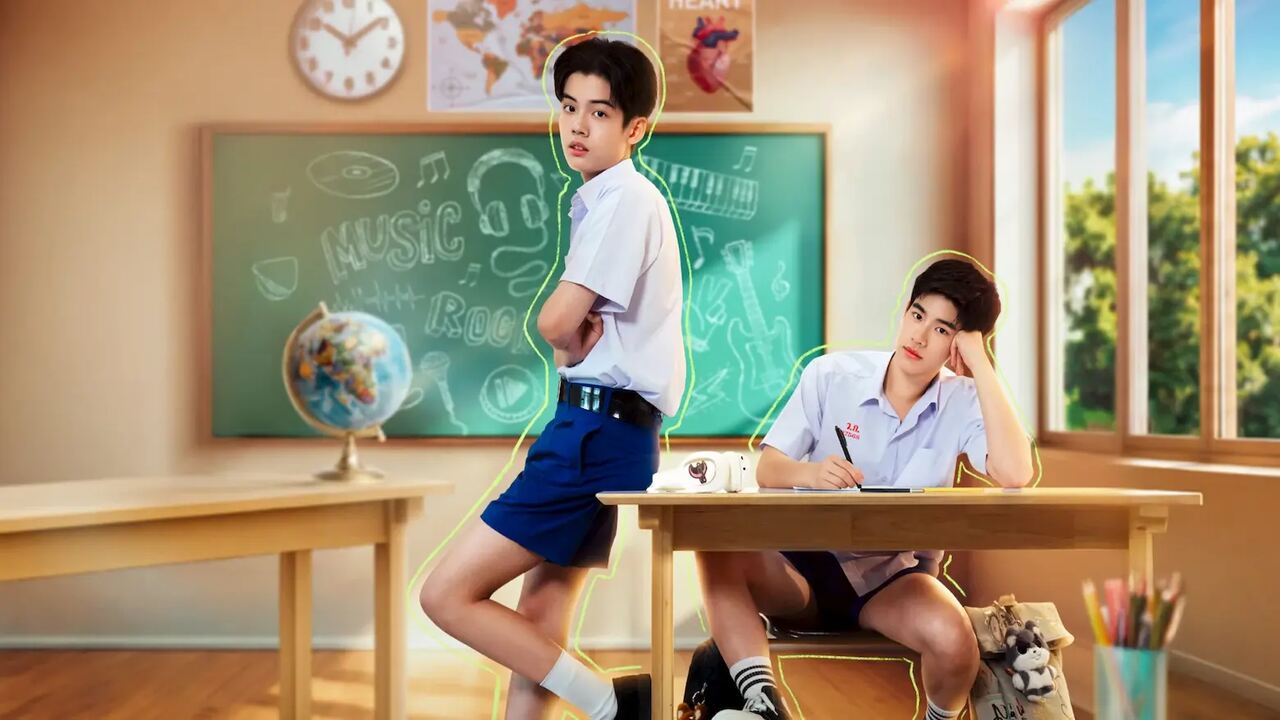
Lee-ith would much rather become an indie-rock musician than worry about his grades. His mother's solution is to send him to a school that is accepting male students for the first time, where the already unusual experience becomes even more complicated when he clashes with the studious Putter. The two end up living next to each other, while Lee-ith's attempts to create a space for the school's small population of boys eventually produce a particularly inconvenient rule: don't date your friends.
There is something wonderfully optimistic about creating a rule forbidding teenagers from developing feelings for their friends. I'm sure that will work beautifully. Class Crush Crisis knows exactly what kind of show it is, and its first episode is considerably more enjoyable once it actually gets to demonstrate that rather than merely advertise it. This is bright, youthful Thai BL built around clashing personalities, friendship groups, school politics, and the inevitable transformation of "this person annoys me" into "why am I suddenly thinking about this person?"
The premiere's biggest asset is Aeiyapol "Yujeen" Lekpittaya and Yannawat "Yugene" Intarapaen. Yujeen's Lee-ith has the showier role. He dreams about indie-rock stardom while treating academic responsibility like an optional software update he keeps postponing. There's a slightly chaotic confidence to him that makes the character entertaining even when his decision-making leaves something to be desired. Importantly, Yujeen doesn't play him as simply lazy. Music gives Lee-ith an aspiration and identity outside the romance, which immediately makes him more interesting than another generic rebellious schoolboy waiting for the responsible love interest to fix him.
Yugene has the more restrained task as Putter. Putter's studious personality makes him an obvious counterweight to Lee-ith, but the performance avoids turning him into a walking rulebook. There's enough personality underneath the responsible exterior to suggest that the series understands opposites-attract only works when both halves are actual people. Together, they have an easy, youthful chemistry. And the premiere is smart enough not to push it too aggressively.
Their initial friction works precisely because it still feels like friction rather than two actors being instructed to stare at each other for fourteen seconds while romantic music informs us that Destiny Has Entered The Building. The show can take its time. It has eight episodes. One element I found more interesting after actually seeing what the premiere establishes is the school's unusual position as an institution accepting male students for the first time. That isn't simply decorative background. It immediately creates questions about belonging, friendship, and how this tiny group of boys navigates an environment whose existing social structure wasn't built around them.
Lee-ith establishing a club for the boys is therefore a clever extension of the premise. It creates a social ecosystem around the central romance rather than isolating Lee-ith and Putter inside a BL vacuum. The resulting no-dating-friends rule is also exactly the kind of knowingly ridiculous narrative device I can get behind. You can practically hear the screenplay laughing while introducing it. Obviously, a series about friends developing romantic feelings needs an obstacle. Apparently, bureaucracy has volunteered.
The supporting characters consequently matter more than I initially expected. The premiere begins constructing a wider friendship group that could become one of the show's biggest strengths. School romances live or die on whether their world feels populated beyond the central pairing, and there's enough energy here to suggest Class Crush Crisis understands that. I hope subsequent episodes continue developing those friendships rather than turning everyone into spectators for Lee-ith and Putter's relationship. Tonally, the episode is extremely light. That's mostly a compliment.
There's no desperate attempt to convince us that teenage attraction is an existential catastrophe. The comedy is broad in places, the characters are energetic, and the production embraces the slightly heightened quality of a youthful school romance. Even when certain beats are predictable, the episode moves quickly enough that predictability rarely becomes boredom. The music angle also helps. With Lee-ith aspiring to become an indie-rock musician, music has the potential to become more than an accessory to his character. Yujeen and Yugene also perform music associated with the series, so there's a natural opportunity for that element to become part of the show's identity. Thai BL has handed enough attractive men decorative guitars. Let this one actually matter. Where I'm less convinced is originality.
The first episode contains an impressive collection of familiar ingredients: mismatched personalities, proximity, school friendships, enforced rules that romance will inevitably violate, and two leads who are obviously going to discover that annoyance has a suspiciously attractive face. None of those tropes are inherently bad. Tropes become tropes because they work. But Class Crush Crisis currently executes familiar material more often than it transforms it. That's the challenge going forward.
The school becoming coeducational offers the writers something genuinely distinctive to explore. So does Lee-ith's musical ambition. So does the boys' club and the friendship rule. If those elements become meaningful parts of the characters' development, the series could establish an identity beyond its central romance. If they're merely mechanisms for getting Lee-ith and Putter into increasingly adorable situations, it'll still probably be enjoyable. It just won't be particularly memorable.
There are also moments where the youthful energy becomes slightly overplayed. Some reactions and comedic beats feel engineered for maximum cuteness rather than natural interaction, and the premiere occasionally seems afraid that silence lasting longer than five seconds might cause viewers to flee. A little restraint would help. Especially because the quieter chemistry between Yujeen and Yugene is already doing plenty of work. That's ultimately what makes me optimistic about the series. The leads don't need much assistance.
There's an appealing awkwardness to their dynamic that feels appropriate for characters this young, and neither performance seems interested in manufacturing instant epic romance. They're teenagers figuring each other out. That's enough. And underneath all the familiar BL machinery, there's potentially a nice coming-of-age story here about friendship becoming complicated once attraction enters it. Because the "don't date your friends" rule is funny. But the idea underneath it isn't entirely silly.
Romance can alter friendships. It can destabilise groups. It can create jealousy, secrecy and awkwardness between people who previously understood exactly what they meant to each other. For teenagers especially, the distinction between friendship and attraction can be confusing precisely because both involve wanting someone constantly around. That's where Class Crush Crisis could find something genuinely sweet. Episode one isn't there yet. But it gives itself the right ingredients.
For now, Class Crush Crisis is a charming if very familiar BL premiere carried primarily by the natural contrast between Yujeen Aeiyapol Lekpittaya's chaotic Lee-ith and Yugene Yannawat Intarapaen's more disciplined Putter. The newly coeducational school, boys' club, and hilariously doomed rule against dating friends give the series enough personality to distinguish its setup, while the musical element offers another promising direction. Some exaggerated comedy and an abundance of recognisable genre tropes keep the premiere from feeling particularly fresh, but the leads already have the chemistry required to make the formula work. Now the series simply needs to prove it has something to offer beyond the formula.
Final Score - [7.5/10]
Reviewed by - Anjali Sharma
Follow @AnjaliS54769166 on Twitter
Publisher at Midgard Times





Hi Everyone, after a due consideration, we have decided that we will be open for donations to help us in managing our website. We will be greatful for any kind of amount we receive. Thanks!
— Midgard Times 🎬 (@Moviesr_net) January 4, 2026
PayPal- [email protected] pic.twitter.com/DlNNz5Npm5
Get all latest content delivered to your email a few times a month.
Bringing Pop Culture News from Every Realm, Get All the Latest Movie, TV News, Reviews & Trailers
Got Any questions? Drop an email to [email protected]



 © Copyrights MOVIESR.NET All rights reserved