


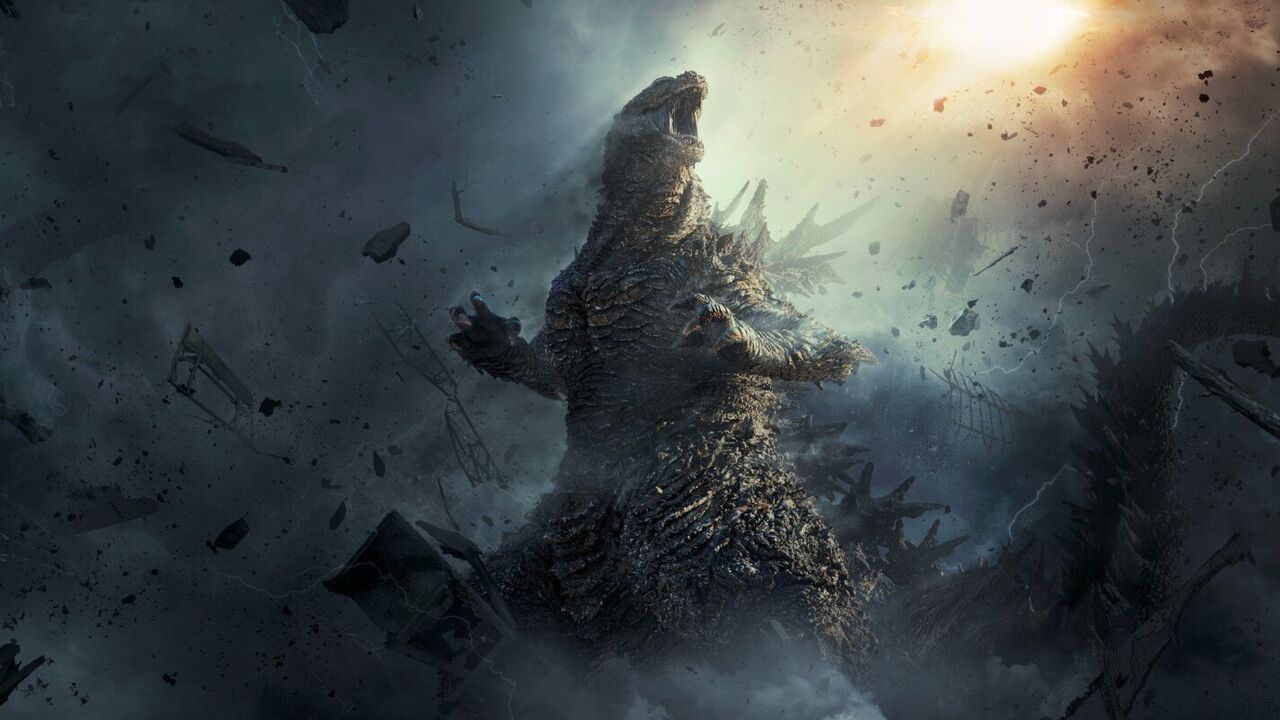
Like its prequel, Godzilla Minus Zero is sentimental slop of beastly proportions. Set two years after the events of Godzilla Minus One, this kaiju drama pits Godzilla against Ghidorah, a creature that arrives in a meteorite as a gelatinous organism, and whenever either monster—or both—is on screen, the movie looks a little alive and a little fun. It's not too alive and not too fun because the sense of awe—the "spectacle"—comes more from the special-effects department, whose efforts are perhaps too visible. You see the blue beams, the spikes coming out of Godzilla's back, the three-headed Ghidorah's self-healing powers, and the first reaction is not amazement or wonder or even limbic terror, but an obligation to congratulate director Takashi Yamazaki and his team for rendering the creatures with uttermost competence.
Because the team has apparently put all its energy into rendering the giants at the center, so much so that a sense of exhaustion sets in whenever the camera is away from them. Away from the gaze of kaijus, Yamazaki unleashes hokey melodrama involving Noriko Ōishi (Minami Hamabe), Kōichi Shikishima (Ryunosuke Kamiki), and Akiko (Sae Nagatani), their adopted daughter. Noriko is displaying signs of mutation as a result of exposure to Godzilla's cells (or G-cells), and that's bad news because people exposed to these cells have died from the resulting mutations. Noriko doesn't have much time left, then, but Yamazaki isn't content with this one melodramatic outlet. He throws in a more exploitative one towards you, like a deadly blue-colored laser, in the form of Akiko's tears. Her "aww, so cute!" voice and wet face are used for schmaltzy purposes to give "heart" to this monstrous spectacle. Before Noriko and Kōichi go on a mission to attract Godzilla towards Ghidorah's location, they leave Akiko at an orphanage, where she cries, then climbs a slide to wish them a safe return. You can be sure that when Noriko and Kōichi return to the orphanage, they find Akiko atop the slide, in the same position.
It's Simple, Naked Melodrama 101. Yamazaki wants to put a lump in your throat because that's the only way he knows how to generate "emotions." When Kōichi learns that Godzilla can be lured with Noriko's help, he panics and flees with her and Akiko. On the way, however, they pass through a completely destroyed Matsumoto, and one look at the ruins changes Noriko's heart, and she agrees to be used as a weapon. Such simple-minded sentimentality reminds you of classic melodramas with their simple plots, but they, at least, knew how to make good use of all the emotional manipulation. Yamazaki, on the other hand, merely borrows the blueprint without being able to resuscitate it with blood and vigor. During these human scenes, the movie almost comes to a stop, with the images freezing to the point of becoming static, since Yamazaki seems to not know how to extract juice from even gooey sappiness. Godzilla Minus Zero drags and bores one to death whenever it deals with drama concerning the humans. The simplicity turns into Kryptonite; there is nothing to hold on to except plain, straightforward sentimentalism that's all about keeping Noriko and Kōichi alive for their adopted daughter, which doesn't give rise to any kind of will-they-make-it-or-not suspense either.
There is something else here about Murakami's madness and vengeance—he dreams of destroying New York City to avenge his family, using Godzilla as his puppet. His mental anguish yields nothing more than brief shots of his tragic past and one scene showing him "acting" like a crazy, obsessed mental patient. His pain is all "external," and Yamazaki resolves it as effortlessly—or clumsily—as he deals with Kōichi's troubles. Everything just... happens. For Yamazaki, the "human elements" might as well be an obligation he has to fulfill so that no one could accuse him of simply playing with his big, shiny monsters. Is this why so much of it is so preordained, preplanned, and mechanical? No wonder Akiko is made to weep loudly because it's her tearful voice that does all the heavy work. At the same time, the monster mayhem, too, is not that attractive a highlight. Yamazaki's plain compositions not only suck the life out of all the melodrama, but they also fail to instill a feeling of terror and grandeur into the kaiju sequences. If one thing results in nothing more than pictures of actors acting, then the other thing gives rise to pictures of monsters "monstering."
There is no excitement, no fear, no splendor, no horror, no mystery, no resonance. Godzilla Minus Zero is the very opposite of an epic—it's a narrow-minded tearjerker that empties your mind of any thought, feeling, or speculation. The longer you are exposed to it, the more you find yourself closed off to external stimuli. It's a minor, "minus" movie with zero being its overall merit score. By the end, you are as exhausted as Godzilla, who, after defeating his opponent, retreats to the ocean. This is the only moment in the movie where you identify with a character. Godzilla's fatigue speaks to you. His exhaustion becomes your exhaustion. He survives brutal attacks from Ghidorah while you survive Yamazaki's corny tropes. It's a win-win situation.
Final Score - [3/10]
Reviewed by - Vikas Yadav
Follow @vikasonorous on Twitter
Publisher at Midgard Times


Hi Everyone, after a due consideration, we have decided that we will be open for donations to help us in managing our website. We will be greatful for any kind of amount we receive. Thanks!
— Midgard Times 🎬 (@Moviesr_net) January 4, 2026
PayPal- [email protected] pic.twitter.com/DlNNz5Npm5
Get all latest content delivered to your email a few times a month.
Bringing Pop Culture News from Every Realm, Get All the Latest Movie, TV News, Reviews & Trailers
Got Any questions? Drop an email to [email protected]


 © Copyrights MOVIESR.NET All rights reserved