



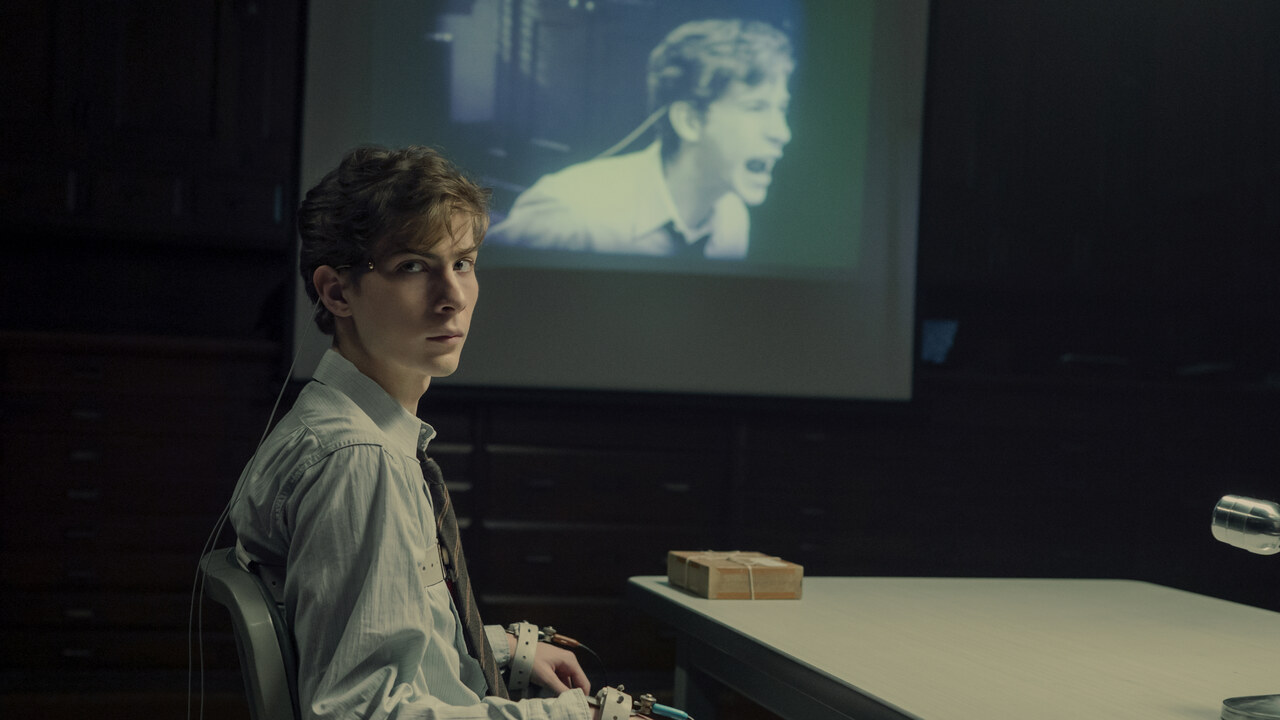
In Nuremberg, writer-director James Vanderbilt walks toward the center of the stage, takes the mic, and warns that America is witnessing the rise of neo-Nazis. He makes his pleas through scenes like one in which the film's characters watch a concentration camp documentary, and another where a man says that rot spreads in society because people allow it. Vanderbilt also tucks in a dialogue defining the Nuremberg Laws. Throughout the film, you sense Vanderbilt growing restless, almost impatient to let out a cry. Well, he does cry eventually, by explicitly presenting Rami Malek's Douglas Kelley as his mouthpiece. Douglas criticizes America and urges its citizens to wake up so they don't end up electing a Hitler to a powerful seat. His warnings are ignored, and Vanderbilt asks us to open our eyes. This director has no time for subtlety — he screams his intentions in big, bold bullet points.
Subtlety, of course, is not a virtue in itself. Sometimes, a filmmaker ends up making something powerful by attacking their targets head-on. Take Anubhav Sinha's Mulk, which castigates Islamophobia with such in-your-face energy that it becomes an invigorating cinematic high. The trick to success lies in remembering that, at the end of the day, as a filmmaker, you are packaging and delivering your messages through film. This is precisely what Vanderbilt forgets in his attempt to shake up the public. He reduces his characters to plot devices fitted with traits and psychologies convenient to the script. Douglas dreams of becoming an influential personality largely because Hermann Göring (Russell Crowe) is portrayed as a narcissist. This creates a sort of connection between these two individuals: one sees himself as a great man, while the other seeks greatness. What's more, Douglas is a magician, seemingly just so Hermann can make his exit like a magician — he, in the end, uses one of Douglas's tricks.
The other characters — Michael Shannon's Robert H. Jackson, Lydia Peckham's Lila, and Leo Woodall's Sgt. Howie Triest — do little more than deliver their lines earnestly. They don't catch your attention; they give you little to invest in their decisions or lives. This is, intentionally or otherwise, by design. Vanderbilt is so focused on Douglas and Hermann that he fails to see anyone else, good or bad. When Julius Streicher (Dieter Riesle) thanks Howie for being his friend, for being good to him, we feel nothing. There are no conversations between these two people. What did they talk about? How exactly did Howie comfort Julius? What topics were brought up? What did either of them have to say about the other person and the situation they are in? Vanderbilt draws a blank and likely expects us to perceive their relationship through the same lens as that of Douglas and Hermann. But Hermann's companions aren't afforded the same sharpness. They come across as one-note dimwits.
Vanderbilt attempts to lend Hermann some shades of complexity. This is his way of saying that evil isn't all black and white — an idea he once again weakens by rendering it explicit through Douglas, who becomes an alcoholic after his book flops badly. Even here, Vanderbilt doesn't achieve anything close to triumph. All he does to bring out Hermann's "human side" is show him as a man who loves his family — a love conveyed only through fleeting expressions of longing. If Vanderbilt truly had the courage to follow through on this prickly challenge, he would have included scenes depicting Hermann's blissful, innocent familial life. The director also shows little curiosity about what Douglas discusses with Hermann's wife, Emmy (Lotte Verbeek). Their time together is presented through brief, sunshiny, dreamy montages that feel like flipping through an album of a happy family (Douglas plays the piano with Hermann's child). During this stretch, if the psychiatrist develops deeper feelings for Emmy or the child, Vanderbilt isn't interested in exploring that territory.
All this further proves how close-minded the filmmaker actually is. He shows little interest in his characters' inner lives and far more interest in using them as chess pieces to dispense what's on his mind. Vanderbilt, alas, belongs to that group of filmmakers who firmly believe in cinema's power to shape society. I think a good film can affect you subconsciously, emotionally transporting you to places you have never been. But directors like Vanderbilt enter the arena with a loudspeaker and start ranting. They forget to do the most crucial thing: to make a movie — a good movie.
Final Score- [3/10]
Reviewed by - Vikas Yadav
Follow @vikasonorous on Twitter
Publisher at Midgard Times



Hi Everyone, after a due consideration, we have decided that we will be open for donations to help us in managing our website. We will be greatful for any kind of amount we receive. Thanks!
— Midgard Times 🎬 (@Moviesr_net) January 4, 2026
PayPal- [email protected] pic.twitter.com/DlNNz5Npm5
Get all latest content delivered to your email a few times a month.
Bringing Pop Culture News from Every Realm, Get All the Latest Movie, TV News, Reviews & Trailers
Got Any questions? Drop an email to [email protected]



 © Copyrights MOVIESR.NET All rights reserved