


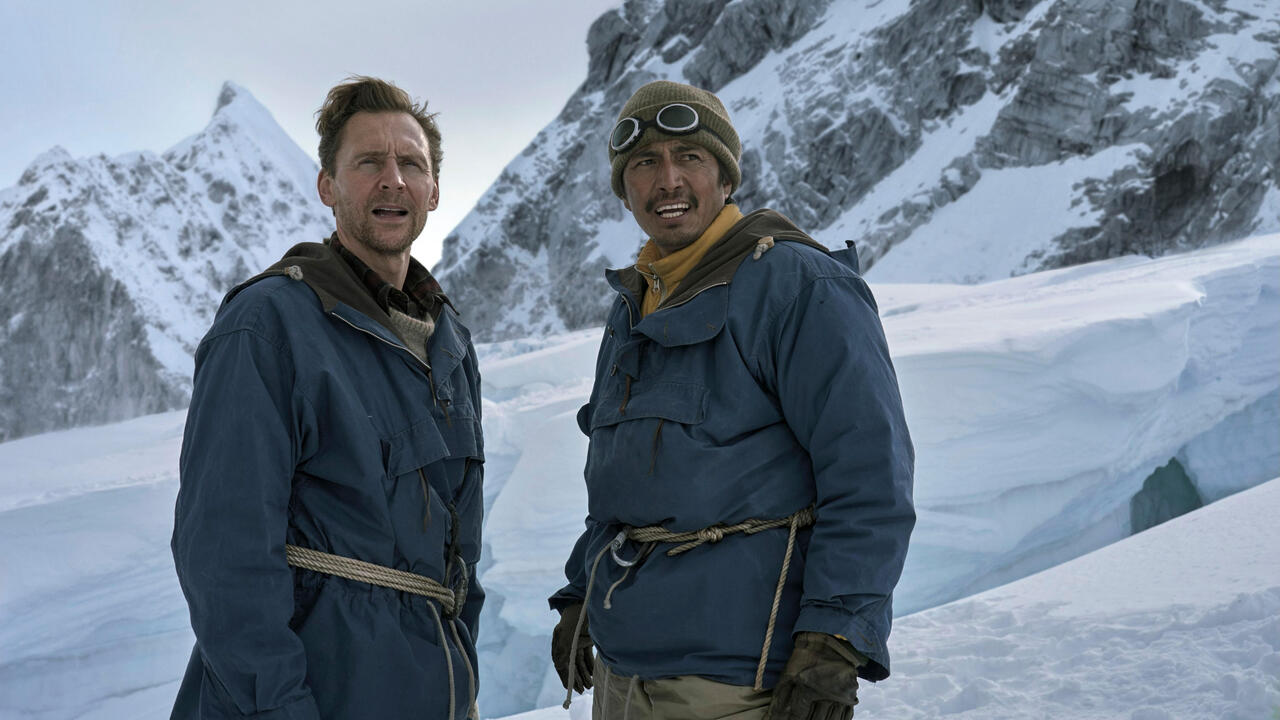
A quick look at Jennifer Peedom's filmography reveals that she has made several documentaries about mountains, Sherpas, and rivers. Given that two of her films are titled Sherpa and Miracle on Everest, Peedom is hardly approaching Everest for the first time in "Tenzing." What's different this time is that she has made a genre film—a dramatized account of Tenzing Norgay and Edmund Hillary's successful ascent of Mount Everest in 1953. This seems to be Peedom's first encounter with conventional genre filmmaking, and she struggles to make its familiar devices feel fresh and exciting. She takes the script, written by Luke Davies, and immediately surrenders to it. Peedom gathers Davies' cliches and films them in an unoriginal style. The characters who resent Ed (Tom Hiddleston) and Tenzing (Genden Phuntsok) wear the familiar expressions of cinematic envy, while the two heroes are distinguished by their soft, warm eyes. A woman who will soon die is briefly shown clutching her stomach in pain during a flashback scene. When the Everest expedition team, led by John Hunt (Willem Dafoe), encounters a problem that requires its members to cross a wide gap, Tenzing makes the crossing on his own while the others applaud him. Later, as Ed and Tenzing make their way back to camp after resolving a dispute with Sherpas who refuse to work for the British team, the ground beneath Ed's feet gives way, leaving him dangling precariously.
It would hardly be a spoiler to reveal that Tenzing rescues Ed from falling. What's curious, however, is how underwhelming the scene feels. That's probably because Peedom uses her camera with excessive deference to the script, adhering faithfully to Davies' text instead of finding a cinematic language of her own. She depicts what needs to be depicted without dramatic invention, a distinctive style, or a compelling subjective perspective. The only tone she strikes is one of deference. She regards her subjects with such awe that she keeps them at a distance. All she offers is a narrow portrait of two underdogs who share the same dream. The real Tenzing had a life that extended far beyond his eventual ascent of Everest. As a teenager, he left home and travelled to Kathmandu and Darjeeling; he was also sent to Tengboche Monastery to train as a monk before realizing that such a life did not suit him. Edmund Hillary, meanwhile, served as a navigator with the Royal New Zealand Air Force during the Second World War. Posted to Fiji and then the Solomon Islands, he was badly burned in a boating accident in 1945. Both men had experiences that shaped them long before they became celebrated mountaineers, and their lives continued to evolve after their historic ascent to the highest peak.
The movie is under no obligation to recount every detail of their lives, but such details remind us that Ed and Tenzing had lived full lives before they met for the first time. Their conversations, then, could have ranged across a wealth of subjects, with their personal experiences and accumulated knowledge providing ample material for fully realized characters. Peedom and Davies, alas, seem uninterested in observing their protagonists as experienced human beings. This is particularly surprising given Peedom's background in documentary filmmaking, which, at its best, allows for intimate observation and unexpected insights. Norbu Tenzing, Tenzing Norgay's eldest son, serves as an executive producer, which could possibly explain the reverential approach of the film. Whatever the reason, "Tenzing" plays it safe. Its reverential lens casts a heroic glow over Ed and Tenzing, making them seem like people who, even as children, were destined to achieve great things.
This is why "Tenzing" treats the historic achievement of 1953 as its starting point. The filmmakers begin with the certainty of the eventual ascent and work backwards, shaping the men's earlier lives around the summit they will reach. No wonder the film contains shots of a young Tenzing (Samdrup Dorje Lama) gazing at Everest in a way that suggests he was not merely born to climb the mountain but somehow knew from childhood that he had been chosen to reach its peak. I don't find such narratives inspiring because they perpetuate the notion that greatness is a matter of destiny, that an extraordinary person is born with a predetermined objective rather than developing the skills and determination to achieve it through experience and practice. Why does Tenzing eventually succeed in climbing Everest? Because, as a child, he admired the mountain's majestic beauty from a scenic vantage point. Surely other children must have looked at the same mountain with equal wonder. Its beauty alone cannot explain what distinguishes Tenzing from others around him. The film also presents Everest as a goddess to be worshipped, but this spiritual relationship with the mountain, while significant, does not by itself explain Tenzing's exceptional mountaineering abilities. He had practical experience, having participated in several expeditions before his successful ascent of Everest. "Tenzing," however, mentions these earlier expeditions only in passing instead of dramatizing what he learned from them and how he applied that knowledge to subsequent climbs.
The movie occasionally gestures towards a connection between Tenzing's social position and his ambitions. Identified as a "Bhotia," he is treated as an outsider from the beginning. The father of his first wife, Dawa (Thinley Lhamo), refuses to let his daughter marry him, and Tenzing, as a Sherpa, is initially denied a place on the expedition. Here is a man who must overcome social prejudice and establish his worth through his abilities. Could Everest represent one final obstacle he must overcome to secure his place in a society that has long treated him as an outsider? His ascent might then become a way of asserting that being a "Bhotia" neither diminishes his value nor makes him any less worthy. This could have given the climb a deeper emotional significance, turning a physical challenge into a struggle for recognition and dignity.
But Peedom fails to give this possibility much emotional force, burying it beneath crowd-pleasing tropes that lack surprise and vitality. The filmmakers seem content to throw a dewy-eyed celebratory party. The movie admires its protagonists, but its reverence is tinged with an elegiac mood, as though it were inviting us to mourn the loss of Norgay and Hillary. Tenzing may be modestly boastful, but it also functions as a shrine. It's a pity that the film offers Ed and Tenzing so little room to discuss what goes on in their minds. They barely talk about even practical matters, such as how the climbers, during an expedition, manage their bathroom needs. What does reaching the summit mean to each man personally? Peedom makes little effort to find out. Instead, she settles for a conventional underdog story that proceeds through familiar dramatic beats.
Peedom's camera is so captivated by the beauty of the Himalayas that it seems unable to see the people climbing them. The landscape dominates the frame, while the characters remain underdeveloped. The film relies on the charisma of its actors and the inherent drama of the historical achievement to create a prestige picture seemingly engineered to win acclaim from audiences and critics alike. The real Hillary and Norgay endured extreme conditions to achieve something extraordinary. Peedom's film, however, takes melodramatic shortcuts to secure an easy victory. Its risk aversion and timidity make it the very opposite of the men it celebrates, ultimately doing them a disservice.
Final Score - [4.5/10]
Reviewed by - Vikas Yadav
Follow @vikasonorous on Twitter
Publisher at Midgard Times
Premiere Date: October 16, 2026, on Apple TV

Hi Everyone, after a due consideration, we have decided that we will be open for donations to help us in managing our website. We will be greatful for any kind of amount we receive. Thanks!
— Midgard Times 🎬 (@Moviesr_net) January 4, 2026
PayPal- [email protected] pic.twitter.com/DlNNz5Npm5
Get all latest content delivered to your email a few times a month.
Bringing Pop Culture News from Every Realm, Get All the Latest Movie, TV News, Reviews & Trailers
Got Any questions? Drop an email to [email protected]



 © Copyrights MOVIESR.NET All rights reserved