


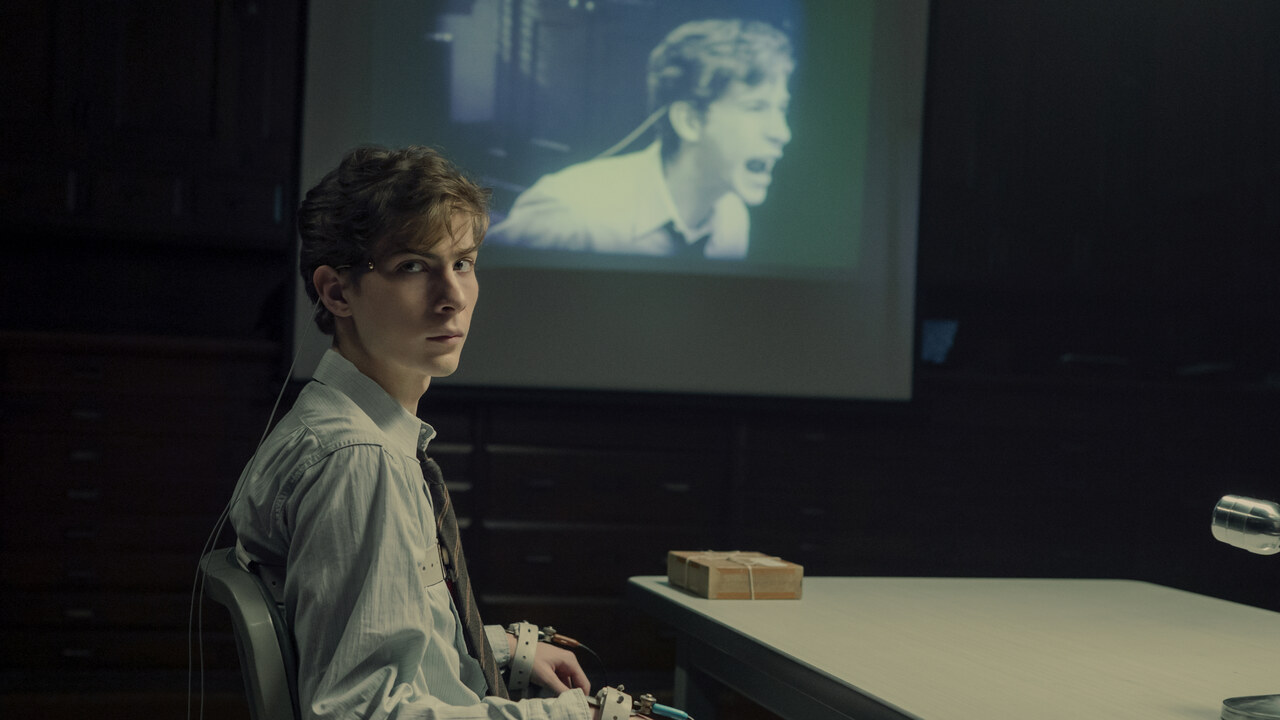
I am always a little cautious about movies about thinkers, philosophers, and geniuses. My reasons are pretty simple: these movies, more often than not, reduce brainiacs to a set of clichés that make them look like long-lost cousins of the Dustin Hoffman character in Rain Man. Their social ineptness, quirks, debates, and passions are reduced to a series of "acting opportunities" for the actor to put on a theatrical performance. They can't even sit quietly without calling attention to their little movements (a twitch here or a slight tremble there). And these exaggerated depictions are so borderline laughable that one ends up experiencing secondhand embarrassment. If this is how Hollywood sees scholars or aspiring intellectuals, no wonder it often creates empty, lifeless, unidimensional characters even when it is supposedly depicting ordinary human beings.
This brings me to the main subject of Janus Metz's Unabomber. It is about Ted Kaczynski, a domestic terrorist responsible for killing three people and injuring more than 20 others. He was a criminal, all right, and he got his punishment. But as a young student, he was also a gifted mathematician and an aspiring philosopher with strong opinions. Kaczynski entered Harvard at 16, graduated with a degree in mathematics, went on to earn a PhD in mathematics from the University of Michigan, and eventually taught at the University of California, Berkeley. He was also a socially reserved and isolated person. He had few meaningful relationships, later grew distant from his younger brother, and eventually lived in a cabin in the Montana woods because of his self-imposed isolation. He was against industrialization, and his 35,000-word manifesto essentially attacked modern technological society and leftism while advocating a form of cultural primitivism.
In Unabomber, however, Ted, played by Jacob Tremblay, looks less like an intellectual and more like a man posing as one. Every other "great thought" that arises from his mouth starts with "Plato said this..." or "[insert name of any other philosopher here] said that..." Ted cannot begin his sentences without referring to other intellectuals, which makes his own ideas seem derivative and unoriginal. As a result, this movie's Ted comes across as a bore trying hard to impress his audience. He appears to have memorized basic quotes, theories, and one-line definitions to paint himself as a (wannabe) philosopher. It makes sense, then, that to show Ted dominating a debate with Mr. C, the movie makes him utter half-baked, cursory declarations such as "John Locke wouldn't agree" or "Thomas Malthus clearly says" in quick succession. It's like listening to that guest at a party who shows off his influence and connections by randomly invoking several famous names one after another during a conversation.
This shallow depiction reveals more about Metz and his writers, Sam Chalsen and Nelson Greaves, than it does about Ted. They are not interested in presenting a fully formed individual. Rather, they take a dramatic shortcut by turning him into a mouthpiece fed a preprocessed, predigested set of seemingly "intelligent" theories and remarks. It's as if the filmmakers are afraid that viewers would end up being impressed by Ted's brainy words, so they render him as pathetic as possible. They do, however, come close to seeing the socially introverted man behind the intellectually capable mathematician when Ted is unable to form a fictional story around a photograph or when he clumsily freezes in place when he is kissed by a girl. These two moments offer a peek into a man who hasn't had a meaningful relationship, and they work better than Tremblay's theatrical exertions and awkward gestures.
I am making a strong case for a more convincing depiction of a disturbed character because people like Ted can help us understand a basic fact about human beings: academic ability, intellectual sophistication, social ability, and psychological stability are not the same thing. Someone can be exceptionally gifted in one intellectual field and still be socially isolated, emotionally immature, psychologically troubled, or intellectually unsophisticated outside that field. This is also why I feel quite hesitant when I hear people calling somebody a genius purely on the basis of their report card. A good academic record can tell us that someone has performed exceptionally well in an academic environment; it cannot, by itself, tell us that the person is wise, emotionally mature, socially capable, psychologically stable, or even intellectually sophisticated in every sense of the word. Kaczynski himself makes the distinction particularly stark: his mathematical ability was real, but it did not automatically make him a more complete or better-rounded human being.
Movies like Unabomber shouldn't be afraid to challenge audiences to confront these distinctions and question their preconceived notions. Still, you are more than welcome to call me a party pooper and complain that I am not judging the movie as a piece of entertainment. Well, let's go in that direction as well. Unfortunately, Unabomber doesn't score an A as a crime thriller either. The investigative portions involving the FBI are too generic and populated by generic characters. There is your typically intuitively right cop, FBI Agent Joanne Miller (Shailene Woodley), who is undermined by her colleagues, but we don't feel anything for her. Alexander Ludwig's Leo constantly goes against Joanne, which could have been used to establish a subtext about undercutting a woman's authority in a male-dominated room, though that would require a certain level of care and perceptiveness that Metz and his writers are unwilling to infuse into their work.
What's more, the climactic operation is so feebly executed that there is no suspense, no tension. Even if you are unfamiliar with the real case, I don't think you will hold your breath in anxiety or anticipation. Metz even fails to create drama from this material by giving insufficient screen time to Ted's friendship with his roommate. When Ted lashes out at him and screams that he has always hated him, there are no uneasy undercurrents beneath the surface. The scene just mechanically begins and ends, as if a box has been dutifully checked.
The real-life Ted might have written a 35,000-word manifesto, that too without grammatical mistakes, no less. But the Ted you see on the screen seems incapable of writing one paragraph with an iota of coherence (he always appears angry and distracted). On the other hand, I don't think either the writers or the director really care about the end result. Unabomber appears to have been made with disposable "streaming ambitions." Who cares about art when everybody is anyway going to get paid?
Similarly, who will care about reading a review of a movie like Unabomber? The joke is on me, in the end. A few more years of reviewing films like these would definitely send me into a solitary life in a remote forest. Be prepared, Netflix and other streaming-service corporations, for you will start to receive parcels from this disgruntled critic/viewer/subscriber.
Fret not; I am just joking.
Or am I?
Maybe. Maybe not.
Heh heh.
Final Score - [3/10]
Reviewed by - Vikas Yadav
Follow @vikasonorous on Twitter
Publisher at Midgard Times

Hi Everyone, after a due consideration, we have decided that we will be open for donations to help us in managing our website. We will be greatful for any kind of amount we receive. Thanks!
— Midgard Times 🎬 (@Moviesr_net) January 4, 2026
PayPal- [email protected] pic.twitter.com/DlNNz5Npm5
Get all latest content delivered to your email a few times a month.
Bringing Pop Culture News from Every Realm, Get All the Latest Movie, TV News, Reviews & Trailers
Got Any questions? Drop an email to [email protected]



 © Copyrights MOVIESR.NET All rights reserved