


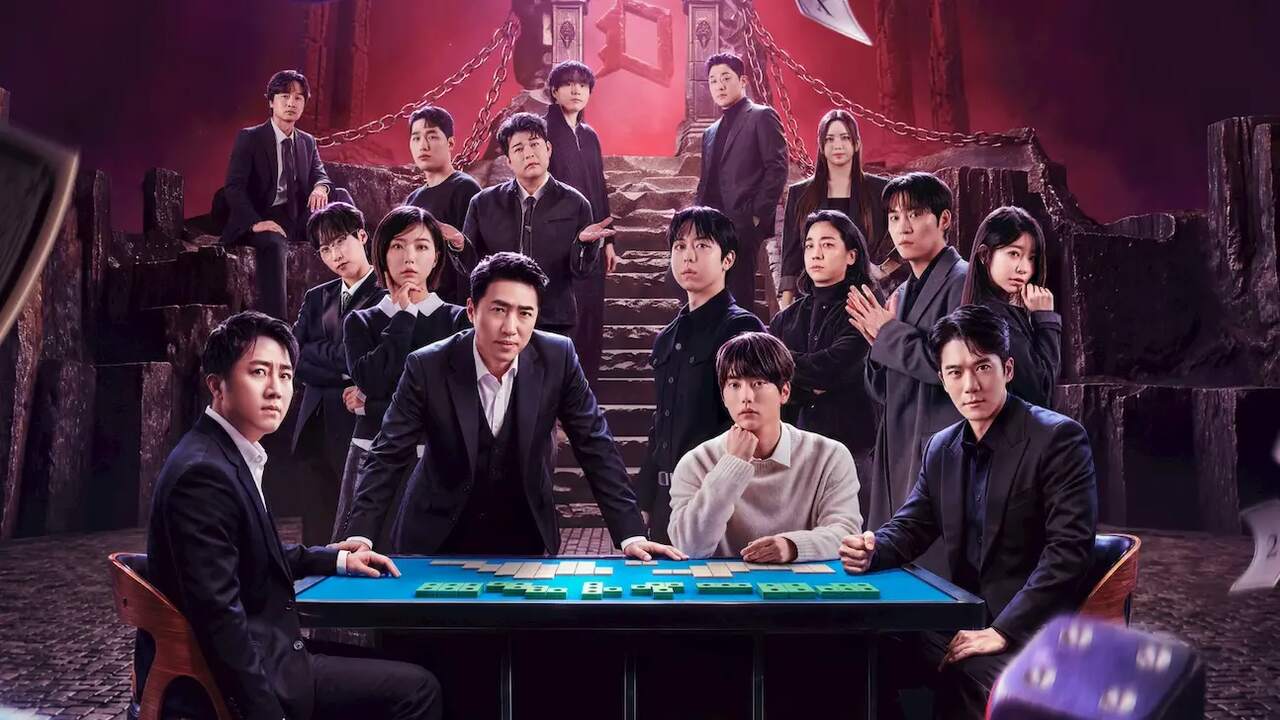
I can appreciate the appeal of The Devil’s Plan without necessarily enjoying watching it. There is something inherently interesting about putting a group of intelligent, competitive people in a controlled environment and seeing how they respond when their reasoning, judgment, and relationships are repeatedly tested. The premise offers plenty of possibilities, particularly when the games require contestants to think beyond their immediate objectives. However, I have always found that reality competitions built around elaborate rules, alliances and eliminations can become rather exhausting to follow. Season three, subtitled Dead Again, does little to ease my reservations, even though the new instalment has aspects worth acknowledging.
The most immediately appealing decision is the casting. Sixteen contestants bring together familiar faces from previous seasons and established competitors from other Korean survival programmes. Jang Dong-min is perhaps the most significant presence, given his reputation in the genre. Returning contestants such as Oh Hyun-min, Hong Jin-ho, Ha Seok-jin, Kim Dong-jae and Jeong Hyun-gyu add a sense of continuity, while newcomers including Shindong, Jaejae, Nucksal, Stella Jang, Yi Do and Jung Won-young introduce different personalities and professional backgrounds.
I can see why this particular combination would excite viewers who follow Korean competition shows. There is an immediate sense that the participants know what they are getting into, and that experience changes the atmosphere of the competition. Nobody is entering entirely unaware of how alliances work or how quickly a seemingly secure position can become precarious. The returning contestants also bring some history with them, which gives certain interactions an added dimension. Still, I found myself wondering how much of the season's appeal depends on already knowing these personalities. A strong cast can generate anticipation, but familiarity with the contestants is not the same as having an engaging competition.
The changes to the rules are among the more worthwhile developments. In previous seasons, losing all one's Pieces could result in automatic elimination. Season three removes that condition, placing greater emphasis on the actual games and giving contestants a better opportunity to recover from setbacks. The rules governing movement between the main living area and prison have also been adjusted. These modifications make sense, particularly because they reduce the extent to which a player's fate can be determined by an earlier disadvantage.
I appreciate the attempt to make the competition less restrictive. It is more satisfying when contestants have to earn their place through the games rather than being effectively written out because of a resource deficit. The revised structure also creates the possibility of unexpected recoveries. However, I would hesitate to call these changes transformative. The fundamental experience remains much the same: participants solve puzzles, negotiate alliances, assess one another's strengths and try to avoid elimination. The mechanics have been adjusted, but the programme is still working within a fairly familiar framework.
The games are, naturally, where the series has to justify its premise. There is a certain satisfaction in watching a complicated challenge gradually become understandable, especially when the contestants approach it in entirely different ways. The programme recognises that intelligence is not a single ability. Mathematical reasoning, memory, deduction, pattern recognition and social judgement can all become relevant, and a contestant who excels in one area may struggle in another. This variety is important because it prevents the competition from becoming a straightforward contest between the person with the highest apparent intellectual ability and everyone else.
Even so, I found that the strategic dimension could become more interesting in theory than it was in practice. Alliances, betrayals, and calculated decisions are central to the format, but they can also become repetitive when the same dynamics recur across multiple rounds. I understand why contestants are cautious about revealing their intentions, why they gravitate towards useful partners and why they sometimes make decisions that appear counterproductive from the outside. Yet understanding the logic behind a decision does not necessarily make watching it particularly exciting. There were moments when I was more conscious of the machinery of the competition than invested in the people navigating it.
That is ultimately where my reservations lie. I tend to find that reality competitions ask for a considerable amount of investment in their participants and their internal politics. The audience is expected to remember alliances, track shifting loyalties, understand the significance of each game, and remain interested in the consequences of every elimination. For someone who enjoys this kind of television, these details are probably the main attraction. For me, they can become a barrier. I would rather the programme gave me more reasons to care about what happens beyond the immediate question of who wins the next challenge.
This does not mean the season is poorly made or that its contestants lack ability. There is evident thought behind the construction of the games, and the cast gives the competition a level of credibility that a less experienced group might struggle to provide. I also recognise that the programme is not trying to be anything other than what it is. Its identity is built around intellectual competition and social strategy, and it would be unfair to criticise it simply for remaining committed to that approach. My difficulty is that the format's strengths are also the source of its limitations. The more attention it gives to the mechanics of competition, the less room there sometimes seems to be for the kind of storytelling that would make me emotionally invested.
The opening five episodes offer a reasonably strong introduction, although the remaining nine episodes will be important in determining whether the season develops beyond its initial promise. The expanded cast and revised rules create enough uncertainty to sustain interest, but I am not yet convinced that they produce a substantially different viewing experience. There is potential for a memorable competition, particularly with so many experienced players sharing the same space, but potential alone is not enough to make every episode engaging.
I would describe The Devil’s Plan: Dead Again as a well-constructed season that I respect more than I enjoy. It has intelligent contestants, a competitive premise and a few sensible improvements to its established format. What it lacks, at least in its opening instalment, is the ability to make that intellectual complexity consistently compelling beyond the immediate appeal of the games.
Final Score- [6/10]
Reviewed by - Anjali Sharma
Follow @AnjaliS54769166 on Twitter
Publisher at Midgard Times




Hi Everyone, after a due consideration, we have decided that we will be open for donations to help us in managing our website. We will be greatful for any kind of amount we receive. Thanks!
— Midgard Times 🎬 (@Moviesr_net) January 4, 2026
PayPal- [email protected] pic.twitter.com/DlNNz5Npm5
Get all latest content delivered to your email a few times a month.
Bringing Pop Culture News from Every Realm, Get All the Latest Movie, TV News, Reviews & Trailers
Got Any questions? Drop an email to [email protected]

 © Copyrights MOVIESR.NET All rights reserved