


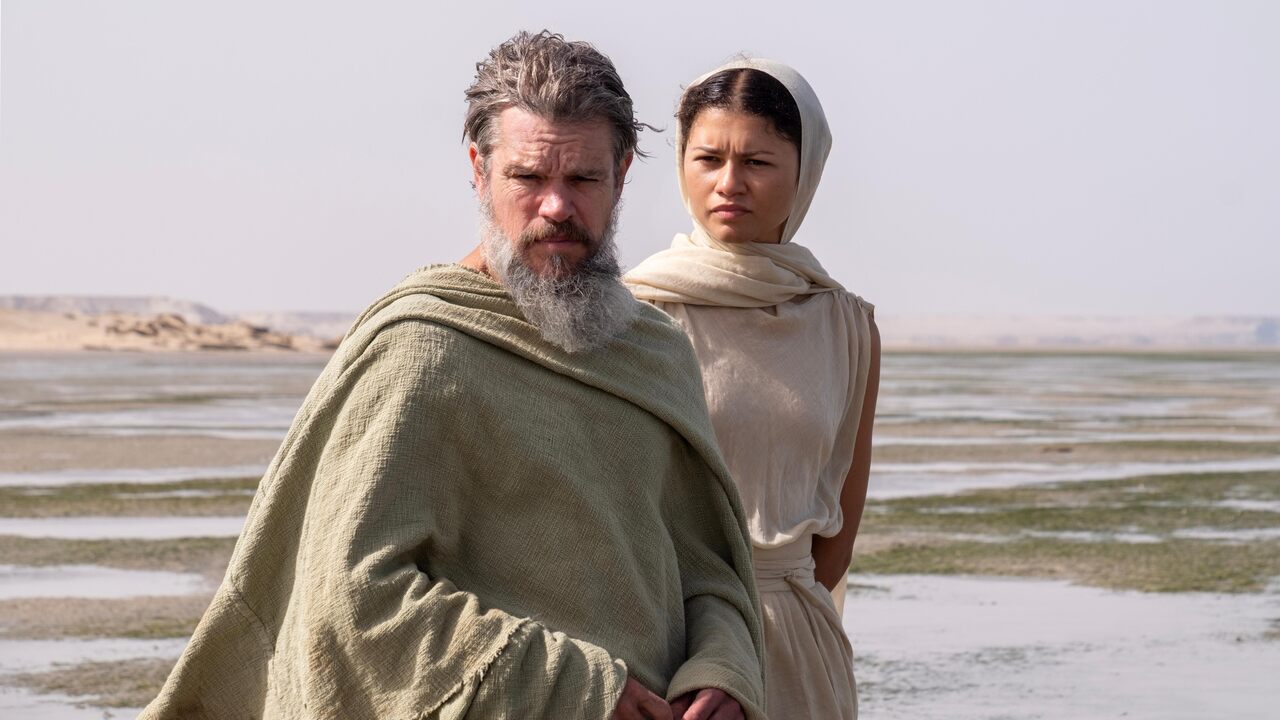
The best thing that could have happened to The Odyssey is Christopher Nolan winning two Oscars for Oppenheimer. That win must have felt like a stamp of approval, saying, "You have made it." I am glad Nolan has finally received his recognition trophy because, in The Odyssey, he lets go of the desperation to make a Great Film. The reason I have never been able to fully submit myself to the Nolan bandwagon is that his movies seemed to be howling and wailing to be admired seriously. The non-chronological storytelling was so "clever," and the score so flatulently self-satisfied, that it drained all emotion from the story. But at last, after a long time, Nolan works his movie magic with ease in The Odyssey. The non-linear narrative is logically and emotionally justified, and the score is a heart-thumping, leg-shaking triumph. The Odyssey is skillfully told through memory and multiple perspectives, along with events occurring in the present time. Each detail, incident, and plot point beautifully fits into the story like mosaic tiles that slowly make the overall picture clearer while simultaneously inching closer to the emotional core of The Odyssey. It's an admirable work of fantasy.
Nolan's mode of tackling Homer's epic is a constant state of realism that flirts with supernatural magic. Here, Circe (Samantha Morton), a witch, transforms Odysseus's (Matt Damon) hungry men into pigs by digging her hands into their mouths and stretching their faces and bodies into the required shape like a potter molding clay into whatever form she desires. But the most thrilling sequence is the encounter with Cyclops Polyphemus—this son of Poseidon looks terrifying, sounds terrifying, and is initially teased through suspenseful glimpses that, combined with the darkness of the cave in which Odysseus and his men are trapped, lend the whole sequence the veneer of a horror film. The Odyssey has some of the most pleasing, absorbing sequences Nolan has filmed in a while. Take the stealthy Trojan Horse mission. It is a ticking-time-bomb delight. As the Greeks quietly exit the wooden horse to crush Troy from within, Nolan, too, quietly escalates the tension through pounding, pulsating music and equally rhythmic editing, which reaches a point where the Greeks are forced to fight their way through Troy's soldiers before the gates can finally be opened for Agamemnon, who is played by Benny Safdie. It's all so electrifying you barely wink. If Nolan were sitting beside me during the screening, I would have given him a high five.
And yet, as I was heading towards the exit, I couldn't help but feel something important was amiss. I was immersed in Nolan's movie magic, but something about the experience felt slight and incomplete. It took an invoking of Homer to realize that Nolan's The Odyssey, even with all its big-screen thrills, doesn't really attain the intoxication or the density of an epic. Homer's text is packed with meaningful interactions between gods and gods, gods and mortals, mortals and mortals that render it both intimate and cosmic. The gods in Homer's Odyssey are both immensely powerful and oddly human. They inhabit an Olympus that resembles a royal court in which debates and discussions, complaints and bargains, are a common sight. Nor are these divine exchanges merely decorative. They significantly influence Odysseus's journey. Nolan's adaptation has mythical beings, but most of them are eliminated or hinted at through specific occurrences, as when Odysseus is trapped on Thrinacia with his men due to unfavorable winds or when Polyphemus prays to Poseidon for justice. As for the gods who are present in the movie, they merely look functional, guest-like, ordinary. Athena (Zendaya) is present like a star cameo who briefly pops up at certain points; Calypso is supposed to be a divine nymph, and Ogygia something akin to a paradise. Nonetheless, Charlize Theron's version of this character and her island are pretty basic. She doesn't exude either sensuality or sublimity. Ditto for Circe, who seems even less "divine" than Theron's nymph.
Nolan uses these actors, and by extension their characters, as a practical presence in the story. He emphasizes not their emotions or features but their role in keeping the story moving. Without gods and goddesses conversing with one another about Odysseus's fate and the perils that lie ahead on his journey, they come across as ornamental objects viewed or referred to occasionally. Also, by removing the celestial realm from his story, Nolan compresses the scale of The Odyssey, producing what could be referred to as "epic lite."
There is also something else Nolan wants to do through this movie: he wants to communicate with the modern world about what we are doing and how we live. His message comes through clearly in the scene where the Greeks violently kill the soldiers and innocent people of Troy, and also desecrate Athena's statue and mercilessly behead a priestess. It's here where Nolan's concerns and Odysseus's psychological scars arrive in the form of a well-meaning humanistic plea and an audacious, if somewhat sentimental, reveal. Then again, these ideas can almost be summed up in one line, and by discharging them in the form of a twist—a card kept close to the chest—Nolan drains away their potency. They affect you like a short, temporary shock. They don't linger in your mind or punch you in the gut fiercely.
The performances are nothing extraordinary. Damon's one-note expressions merely convey that his shoulders are heavy with the burden of responsibility. Tom Holland and Robert Pattinson rely almost entirely on facial expression, making their performances more efficient than striking. Lupita Nyong'o and John Leguizamo, though, are stunning, and Anne Hathaway pokes a hole in the screen with her intense eyes. It's undoubtedly worth appreciating how the writer-director tweaks and adapts an ancient text for modern times. Yet Nolan is hardly the first filmmaker to discover contemporary resonances in Greek mythology—and others have done so with far greater formal audacity. One need only look at Pier Paolo Pasolini's Oedipus Rex, a masterpiece in every respect. Pasolini brought Oedipus to pre-war and modern Italy through a simple yet wondrous formal conceit. He also, by emphasizing Oedipus's various emotional reactions, vigorously highlighted the character's inner world and suffering. What's more, the rituals we see when Oedipus goes to the Oracle to seek advice are more mysterious, more astonishingly imaginative than almost anything in Nolan's The Odyssey.
Pasolini embeds his very soul into the very aesthetic of his film, which is full of personal confrontations and conflicts. Nolan, by comparison, tames a lively epic through textureless images and terse lines. He is so concerned with the sets, the plot, and the costumes that he fails to discover an aesthetic vigorous enough to make them sing on screen. The Odyssey is surely big and dramatic and thrilling. It's also, however, subdued and trimmed.
On a different note and broadly speaking, if you want to watch a non-linear, emotionally charged film where style is inextricable from substance, where the past is examined through the vantage point of the present, seek out Sophy Romvari's Blue Heron. Thank me later, fellow cinephiles.
Final Score - [6/10]
Reviewed by - Vikas Yadav
Follow @vikasonorous on Twitter
Publisher at Midgard Times




Hi Everyone, after a due consideration, we have decided that we will be open for donations to help us in managing our website. We will be greatful for any kind of amount we receive. Thanks!
— Midgard Times 🎬 (@Moviesr_net) January 4, 2026
PayPal- [email protected] pic.twitter.com/DlNNz5Npm5
Get all latest content delivered to your email a few times a month.
Bringing Pop Culture News from Every Realm, Get All the Latest Movie, TV News, Reviews & Trailers
Got Any questions? Drop an email to [email protected]


 © Copyrights MOVIESR.NET All rights reserved